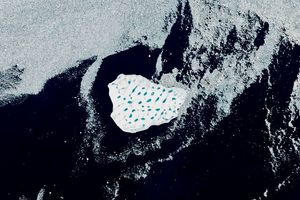
















For several months, scientists have watched cracks lengthen and widen across the tongue of Antarctica’s Pine Island Glacier. On February 9, 2020, images from the European Space Agency’s Sentinel-1 satellites showed that a large iceberg had finally calved from the glacier.
When the Moderate Resolution Imaging Spectroradiometer (MODIS) on NASA’s Aqua satellite acquired this image on February 10, 2020, the berg had already broken into two main pieces and numerous smaller bits. The larger iceberg—about twice the size of Washington D.C.—is the only piece large enough to be named and tracked by the U.S. National Ice Center. The bergs should eventually drift into the Amundsen Sea.
References & Resources
NASA Earth Observatory image by Lauren Dauphin, using MODIS data from NASA EOSDIS/LANCE and GIBS/Worldview. Text by Kathryn Hansen.