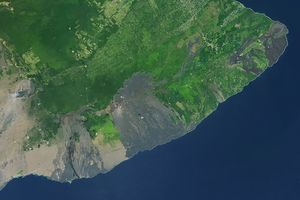














Ash from Cerro Hudson stains the snow in this natural-color image from October 31, 2011. Located in southern Chile, the volcano has a history of violent eruptions, often accompanied by flows of mud, melted snow, and ash called lahars.
SERNAGEOMIN, the Chilean National Geology and Mining Service, reported that Cerro Hudson began to stir on October 25 with a series of earthquakes deep beneath the volcano. The shape of the seismic waves indicated the movement of fluid, likely magma. In the following days, the earthquakes continued and modest plumes rose up to 7.5 kilometers (4.7 miles) above the volcano. The plumes were mostly steam, with some ash. As of October 31, the activity was characteristic of superheated water moving through the upper reaches of the volcano, rather than the eruption of fresh lava.
This image was acquired by the Moderate Resolution Imaging Spectroradiometer (MODIS) aboard the Terra satellite.
References & Resources
- Klemetti, Erik. (2011, October 31). Eruption Updates for Hudson, Hierro and Lokon-Empung for October 31, 2011. Accessed November 1, 2011.
- SERNAGEOMIN. (2011, October 31). Reporte Especial de Actividad Volcánica No 28 Actividad del Volcán Hudson. Accessed November 1, 2011.
NASA image courtesy Jeff Schmaltz MODIS Rapid Response Team, NASA-GSFC. Caption by Robert Simmon.