

















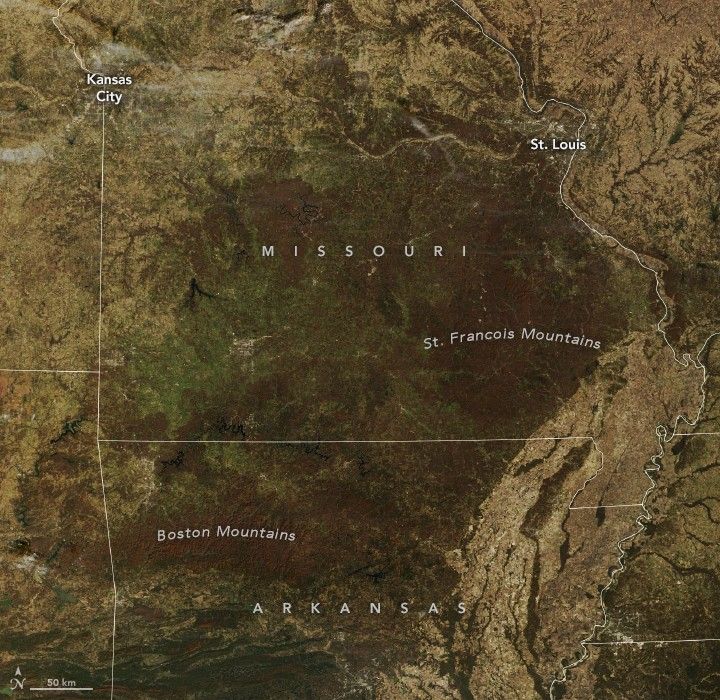


The Ozark Highlands—spanning parts of Missouri, Arkansas, Illinois, and Oklahoma—support remarkable biological diversity, including a range of vegetation that contributes to the region’s vibrant autumn colors. In 2025, a pair of exceptionally cloud-free days allowed satellites to observe the seasonal transformation.
Fall color reaches its peak when air temperatures drop and shortened daylight triggers plants to slow and stop the production of chlorophyll, the molecule that plants use to synthesize food and that makes leaves appear green. When chlorophyll concentrations drop, other leaf pigments—like carotenoids and anthocyanins— get the chance to show off their colors.
Peak color typically arrives in the Ozark Highlands sometime between mid-October and early November, depending on location. The transformation continues for weeks afterward as shades of brown spread across the landscape. The MODIS (Moderate Resolution Imaging Spectroradiometer) sensor on NASA’s Terra satellite captured these images on October 22 and November 16, before and after peak color in 2025, respectively.
Late-autumnal hues can arise for several reasons. For instance, some leaves may still hold a mix of vibrant pigments. Around mid-November in parts of the Ozark region of Missouri, white oaks, black oaks, and scarlet oaks sustained some yellow and red colors. Other areas had already seen leaves drop or their vibrant colors fade, revealing the brown tannins that define a leaf’s final color. Although they lack the intensity of peak foliage, post-peak landscapes of brown, tan, and gray offer a distinct autumn beauty of their own.
The highlands offer scenic roadways that showcase the region’s beauty in every season. To the south in Arkansas, a scenic loop through the Boston Mountains winds over ridges, streams, and valleys. These mountains, located in Arkansas and Oklahoma, contain the region’s highest elevations, reaching over 2,500 feet (760 meters) above sea level. And to the north in Missouri, the Ozark Run Scenic Byway passes through several historic towns as it winds through the St. Francois Mountains.
NASA Earth Observatory images by Lauren Dauphin, using MODIS data from NASA EOSDIS LANCE and GIBS/Worldview. Story by Kathryn Hansen.
References & Resources
- Arkansas: The Natural State (2025, September 3) The Best Drives in the Ozarks. Accessed November 20, 2025.
- Arkansas State Parks (2025) Fall Colors. Accessed November 20, 2025.
- Explore Fall (2025, November) Fall Foliage Map 2025. Accessed November 20, 2025.
- Missouri Department of Conservation (2025) Fall Color. Accessed November 20, 2025.
- U.S. Department of Agriculture, Forest Service (2025) Ozark-St. Francis National Forest. Accessed November 20, 2025.
- U.S. Geological Survey (2009) The Ozark Highlands. Accessed November 20, 2025.