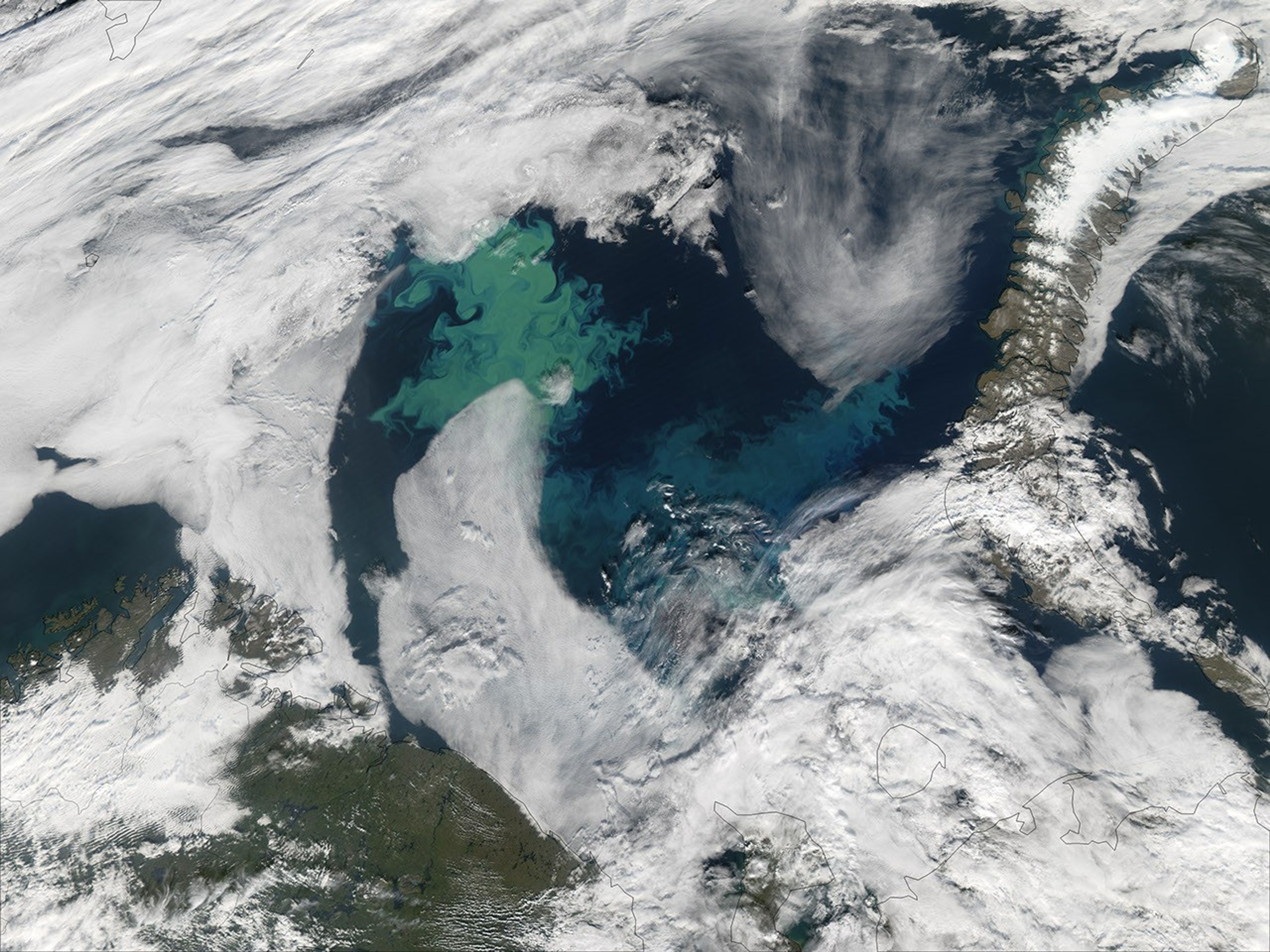














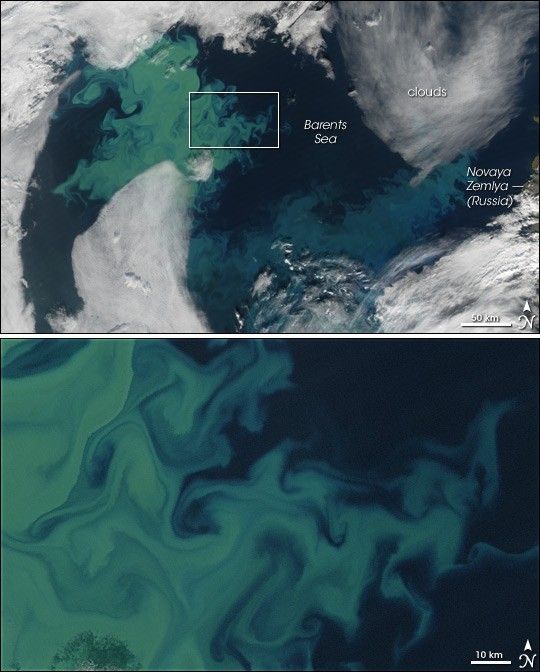
In the Barents Sea north of Russia, marine plant life seems to be refusing to acknowledge that summer is passing and fall is approaching. On August 29, 2006, the Moderate Resolution Imaging Spectroradiometer (MODIS) on NASA’s Aqua satellite captured this image of a dramatic bloom of phytoplankton (single-celled plants) swirling in the waters west of Novaya Zemlya (New Land).
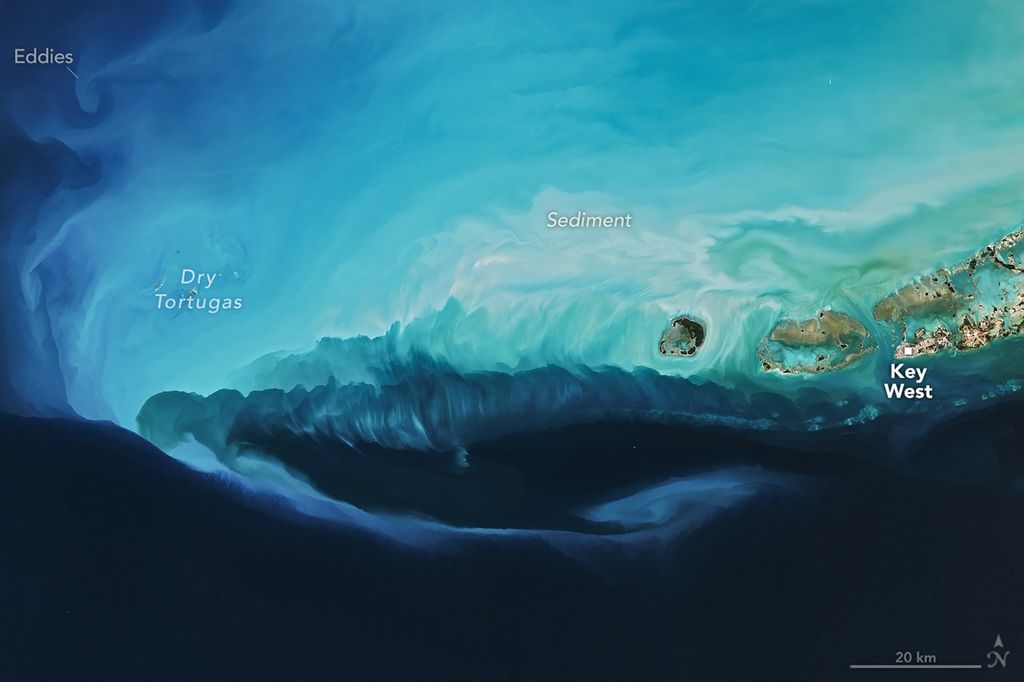
Chlorophyll and light-harvesting pigments that different kinds of phytoplankton contain produce colorful patterns in the water. The extreme brightness and opacity of the bloom in the left side of the image (also shown in the close-up view, below) suggests that the bloom contains phytoplankton known as coccolithophores. In addition to pigments, these phytoplankton have another characteristic that makes them very obvious in satellite images: chalky- white, scaly coverings. These scales, made out of calcium carbonate, are very reflective; they often give the water a bright, turquoise glow.
In addition to their role with other phytoplankton as the base of the marine food web, coccolithophores also have an important place in Earth’s climate system. The scales contain carbon, and any scales that aren’t digested by other organisms sink to the ocean floor and become part of the sediment—a long-term sink of carbon. The chemistry is complicated, though; the reactions that create the scale produce a carbon dioxide molecule as well. The carbon dioxide may be used by the plants during photosynthesis, or it may escape to the atmosphere, contributing to the greenhouse effect. Scientists are working to understand whether the sinking of coccolithophores’ carbon-containing scales outpaces the release of carbon dioxide. They also want to know whether changes in ocean circulation or temperature as a result of global warming might change the abundance of coccolithophores or their role in the ocean’s carbon chemistry. Global-scale satellite observations of the frequency of blooms and the area they cover are a crucial part of the research into coccolithophores and other phytoplankton.
- What Is A Coccolithophore? fact sheet from the Earth Observatory
- What Are Phytoplankton? fact sheet from the Earth Observatory
- More phytoplankton images at NASA’s Visible Earth Website
- More coccolithophore images at NASA’s Visible Earth Website>
- Webpage about Emiliania Huxleyi (the most common coccolithophore) from the National Oceanography Centre, Southampton
References & Resources
NASA imagery created by Jesse Allen, Earth Observatory, using data provided courtesy of the MODIS Rapid Response team.