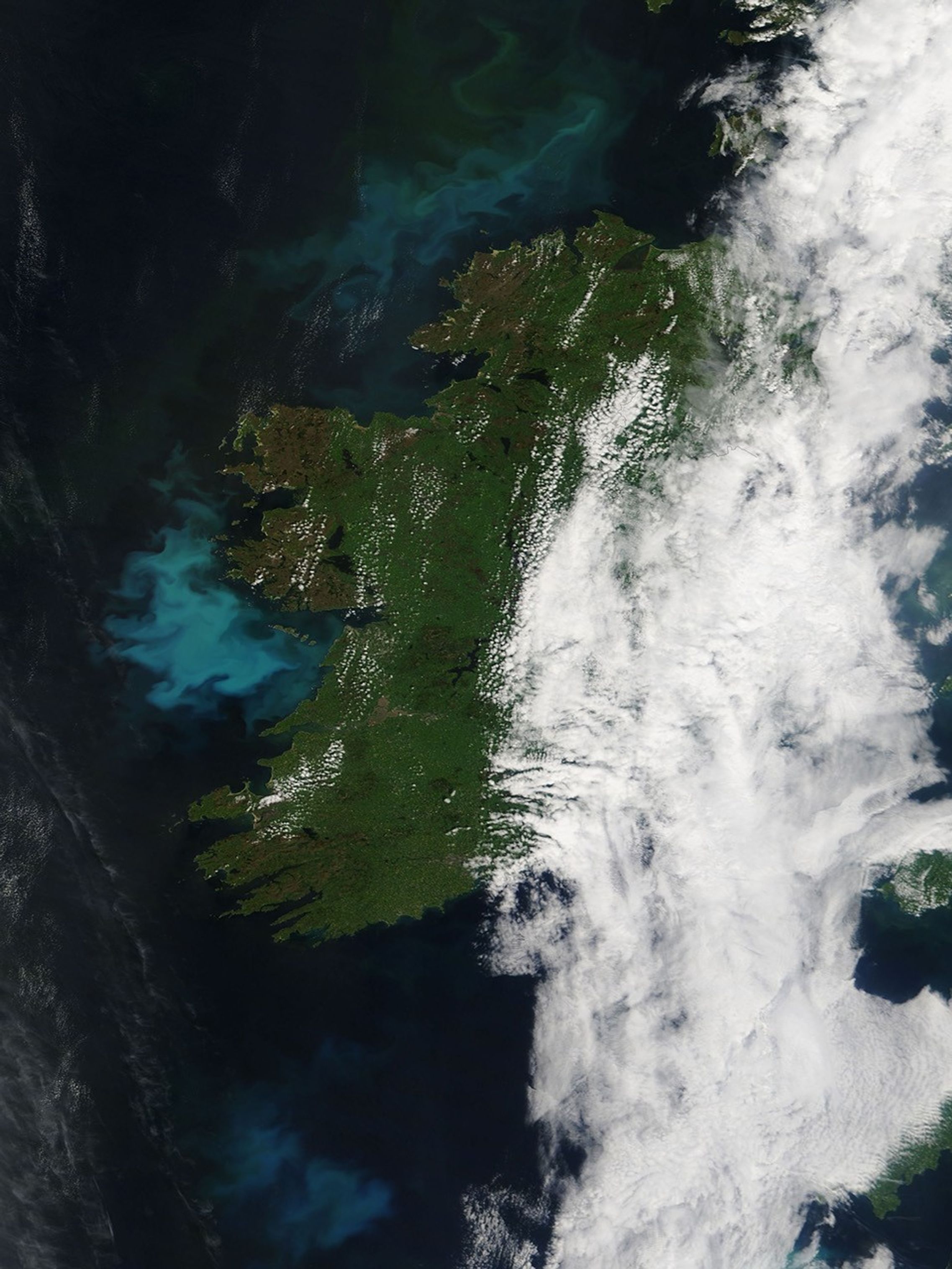

















For several weeks in May and early June, daily satellite images of the North Atlantic Ocean west of Ireland have captured partial glimpses of luxuriant blooms of microscopic marine plants between patches of clouds. On June 4, 2007, the skies over the ocean cleared, displaying the sea’s spring bloom in brilliant color. A bright blue bloom stretches north from the Mouth of the River Shannon and tapers off like a plume of blue smoke north of Clare Island. (In the large image, a second bloom is visible to the north, wrapping around County Donegal, on the island’s northwestern tip.) The image was captured by the Moderate Resolution Imaging Spectroradiometer (MODIS) on NASA’s Terra satellite.
Cold, nutrient-stocked water often wells up to the surface from the deeper ocean along coastal shelves and at the edges of ocean currents. When it does, it delivers a boost of nutrients that fuel large blooms of single-celled plants collectively known as phytoplankton. The plants are the foundation of the marine food web, and their proliferation in this area of the North Atlantic explains why the waters of western Ireland support myriad fisheries and populations of large mammals like seals, whales, and dolphins.
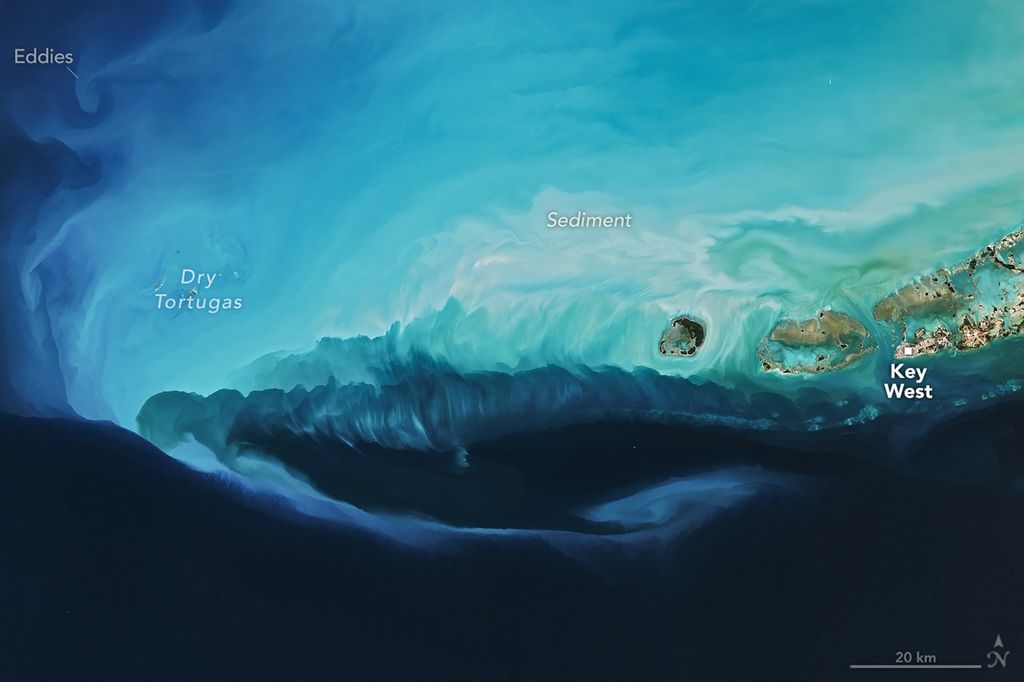
Like plants on land, phytoplankton make their food through photosynthesis, harnessing sunlight for energy using chlorophyll and other light-capturing pigments. The pigments change the way light reflects off the surface water, appearing as colorful swirls of turquoise and green against the darker blue of the ocean. Though individually tiny, collectively these plants play a big role in Earth’s carbon and climate cycles; worldwide, they remove about as much carbon dioxide from the atmosphere during photosynthesis as land plants do.
Satellites are the only way to map the occurrence of phytoplankton blooms across the global oceans on a regular basis. That kind of information is important not only to scientists who model carbon and climate, but also to biologists and fisheries managers who monitor the health of marine natural resources like coral reefs and fish populations.
References & Resources
NASA image courtesy the MODIS Rapid Response Team, Goddard Space Flight Center