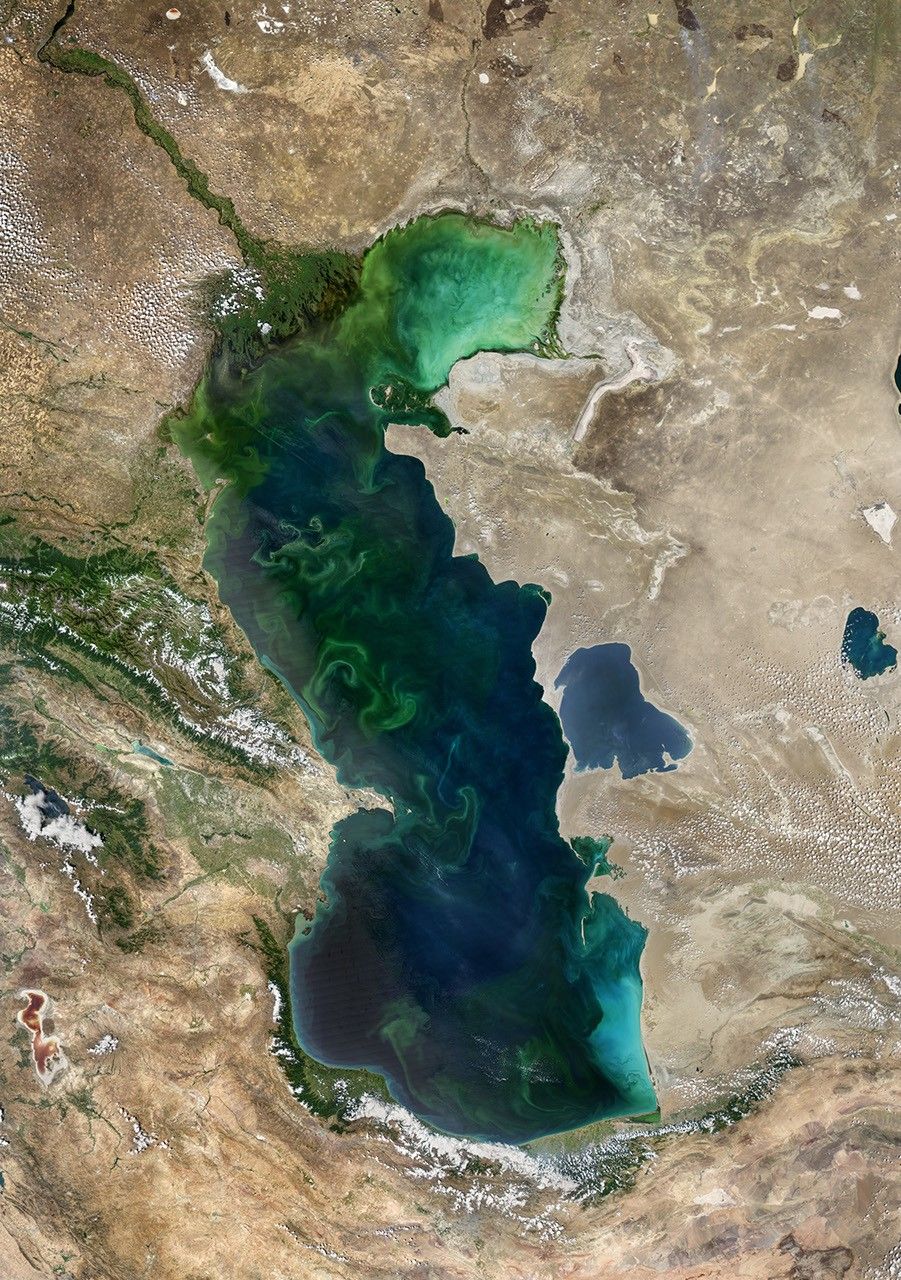
























Given adequate sunlight and nutrients, phytoplankton populations can swell into blooms large enough to be visible from space. On August 3, 2017, the Moderate Resolution Imaging Spectroradiometer (MODIS) on NASA’s Aqua satellite acquired this image of several blooms in the Caspian Sea.
Phytoplankton blooms are often harmless, and are an important food source for marine life. Other times, blooms can be harmful; they can deplete the water’s oxygen and suffocate marine life, and produce toxins that can be harmful to both aquatic creatures and humans.
Lake Urmia is visible west of the Caspian Sea. Microscopic organisms periodically turn the lake’s salty water striking shades of red and orange.
References & Resources
- Gholamalifard, M. et al. (2013) Influence of vertical distribution of phytoplankton on remote sensing signal of Case II waters: southern Caspian Sea case study. Journal of Applied Remote Sensing, 7 (1).
- Mehdipour, N. et al. (2017) Spatio-Temporal Pattern of Phytoplankton Assemblages in the Southern Part of the Caspian Sea. Thalassas: An International Journal of Marine Sciences, 1-10.
- NASA Earth Observatory (2010, July 13) What are phytoplankton?
- NASA Earth Observatory (2016, July 26) Red Lake Urmia.
NASA images by Norman Kuring, NASA’s Ocean Color web. Caption by Adam Voiland.