









What is blue, witnessed by few human eyes, and zips across the sky in less than a second? The answer, “blue jet,” might sound like some kind of fictional superhero. But these jets—generated during thunderstorms—are real. They are also a challenge to observe.
In recent years, cameras and sensors on the International Space Station (ISS) have been helping scientists to characterize blue jets, blue flashes, and other natural light shows produced at the tops of thunderstorms. Scientists want to know how often they occur, the conditions that produce them, and how they might affect Earth’s atmosphere.
A blue jet is basically a type of lightning. But unlike the traditional lightning that we see from the ground, blue jets shoot upward from the tops of thunderstorms toward the edge of space. In less than a second, a jet can reach the stratopause (50 kilometers above Earth’s surface).
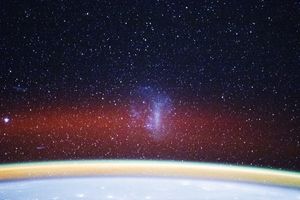
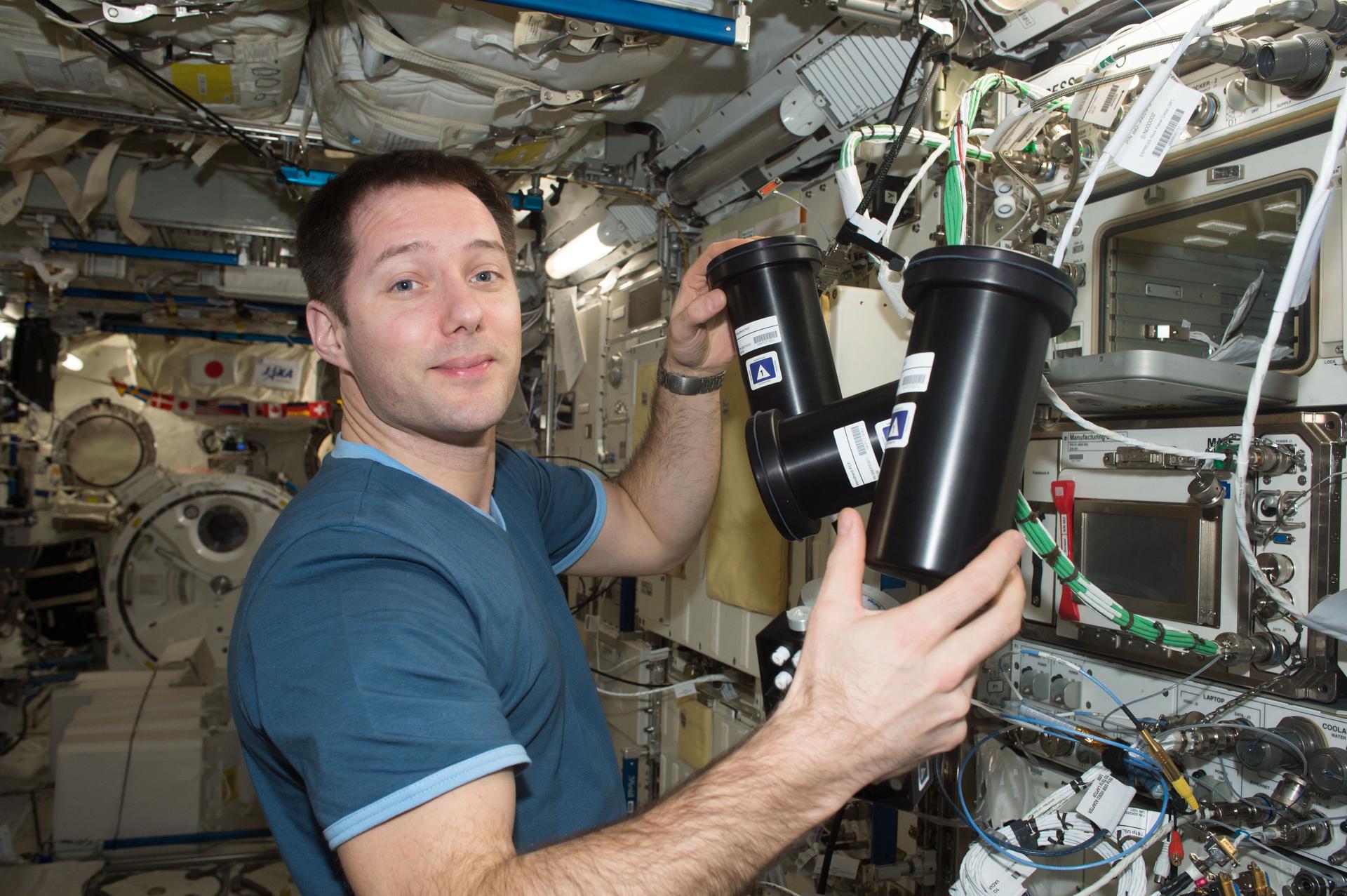
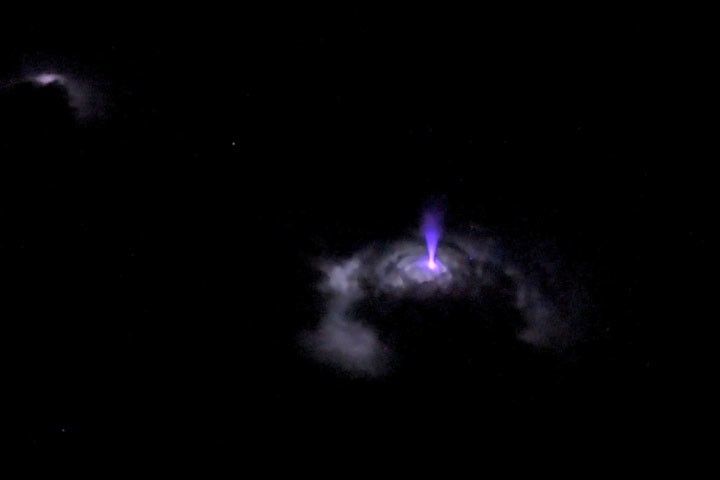
A first-of-its-kind color video shot from the ISS on September 8, 2015, allowed scientists to get a closer look. Floating in the cupola as the ISS passed over India, astronaut Andreas Mogensen noticed an intense thunderstorm developing over the Bay of Bengal. He shot 160 seconds of video with a Nikon D4, capturing 245 brief blue discharges in the top layer of a cloud. One of those discharges rose above the cloud into the stratosphere, as is visible in the image at the top of this page (a still captured from that video). This is a blue jet. The thundercloud is illuminated by traditional lightning.
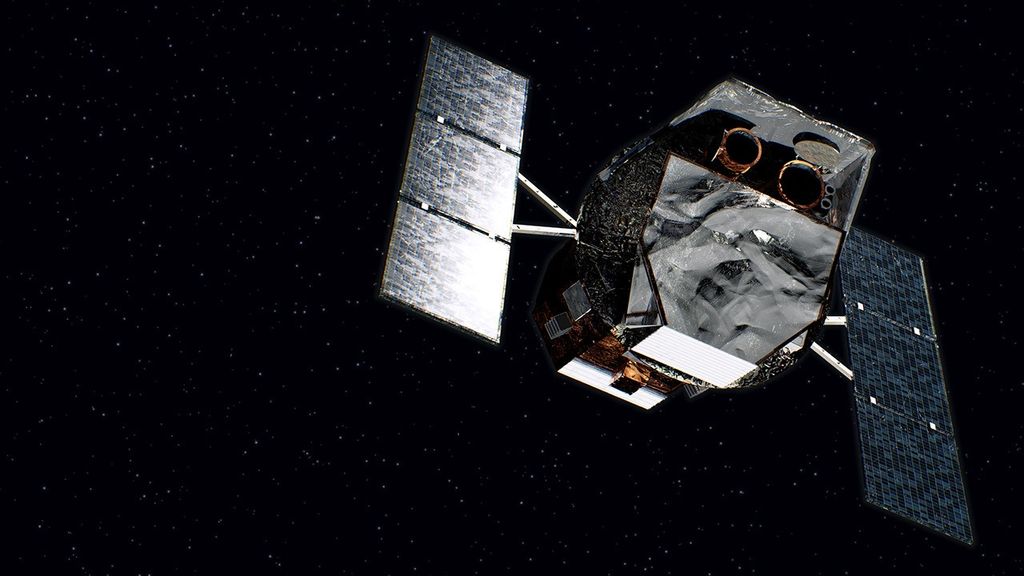
Scientists examined the electrical light show captured in Mogensen’s video and published an analysis in January 2017. The remarkable video remains one-of-a-kind, but researchers have since started to make more continuous observations with instruments mounted on the outside of the space station. NASA installed the Lightning Imaging Sensor in 2017, and the European Space Agency added the Atmosphere-Space Interactions Monitor (ASIM) in 2018.
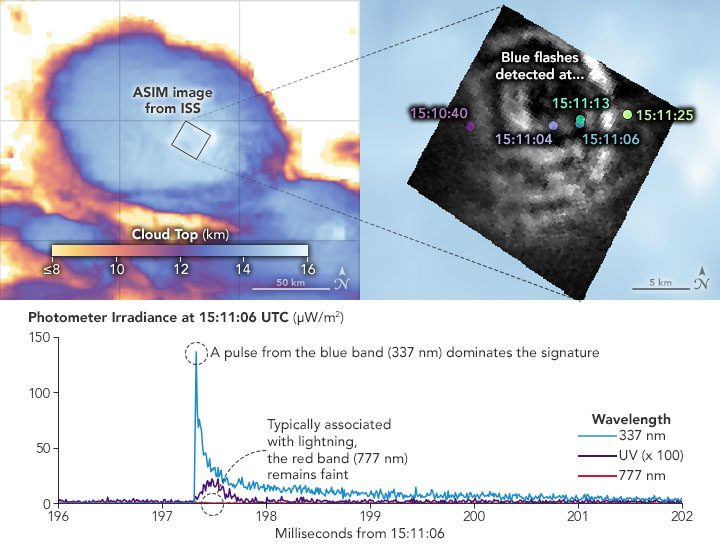
Recently, researchers used ASIM instruments to characterize a thunderstorm that occurred in February 2019, near the island of Nauru in the South Pacific Ocean. In that storm, ASIM cameras observed a pulsating blue jet—the same blue lightning phenomenon captured by Mogensen in the 2015 video.
Using ASIM photometers, scientists also detected other shorter-lived features coming from the cloud top as well—five intense “blue flashes,” each lasting about 10 microseconds. The locations of the flashes on the thunderstorm cell are marked on the map above. One of those flashes—shown in the spectral measurement above—generated the blue jet.
Torsten Neubert, a scientist at the Technical University of Denmark, and colleagues described the events in a 2021 paper in Nature. The researchers think blue flashes at the tops of thunderstorms might be common—an important factor when considering their effect on Earth’s atmosphere.
References & Resources
- Chanrion, O. et al. (2017) Profuse activity of blue electrical discharges at the tops of thunderstorms. Geophysical Research Letters, 44 (1), 96â503.
- The European Space Agency (2017, August 2) Blue jets studied from Space Station. Accessed February 9, 2021.
- NASA ScienceCasts (2017, October 10) A Display of Lights Above the Storm. Accessed February 9, 2021.
- Neubert, T. et al. (2021) Observation of the onset of a blue jet into the stratosphere. Nature, 589 (2021), 371â375.
NASA Earth Observatory images by Joshua Stevens, using data courtesy of Neubert, T. et al. (2021). Astronaut video (still) courtesy of ESA, NASA, and DTU Space. Story by Kathryn Hansen.
None