
















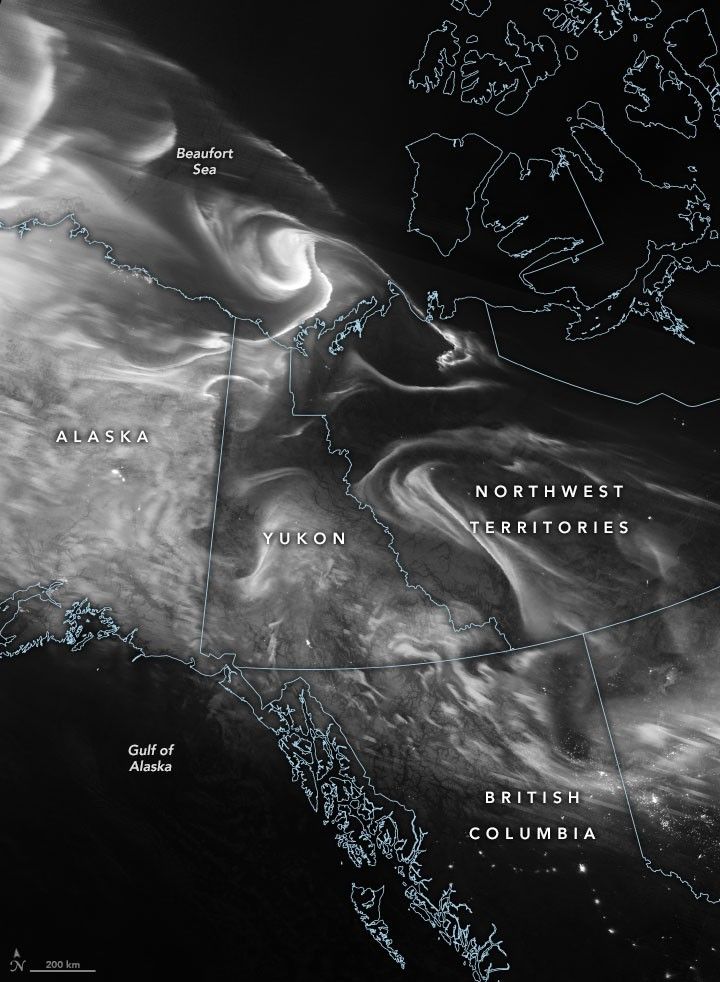
In early February 2021, beautiful auroras appeared to skywatchers in high latitudes and some middle latitudes of Scotland, Canada, Scandinavia, and the United States. Some photographers withstood below-freezing temperatures tocapture the dancing lights in the sky.
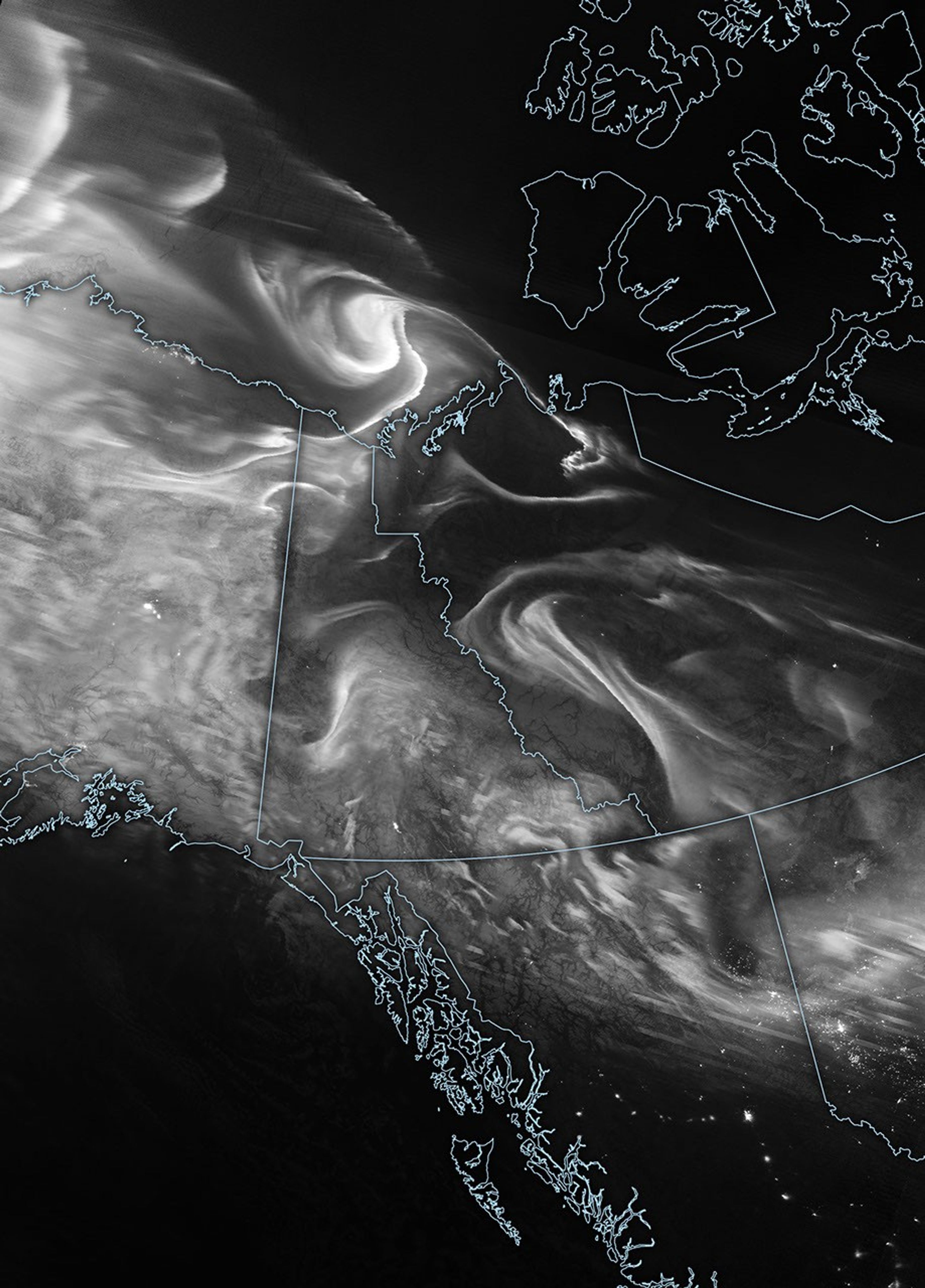
The image above shows auroras over Alaska and western Canada on February 7, 2021, as acquired by the Visible Infrared Imaging Radiometer Suite (VIIRS) on the Suomi NPP satellite. From the ground, the aurora appeared particularly bright in some regions, as the Moon was passing through its last quarter and shedding less light.
The creation of an aurora starts when the Sun sends a surge of particles and energyâthrough solar flares, coronal mass ejections, or active solar wind streams—toward Earth. This surge disturbs Earth’s magnetosphere, the region of space protected by the planet’s magnetic field. The solar particles collide with the magnetosphere and compress it, changing the configuration of Earth’s magnetic field lines (such as their shape and direction). Some particles trapped along the magnetic field lines are accelerated into Earth’s upper atmosphere, where they excite nitrogen and oxygen molecules and release photons of light. The result is the dancing northern lights.
This aurora was caused by a coronal hole that rotated into Earth’s strike zone, according to a report by space weather forecaster Tamitha Kov. A coronal hole—which appears as a dark region on the Sun’s surface—is an area of relatively cooler material in the solar atmosphere that is open to interplanetary space, sending material in a high-speed stream. This was the second occurrence of auroral activity in several days. The previous aurora occurred around February 2 from a different coronal hole that rotated towards the Earth.
References & Resources
- Global News (2021, February 7) âGreat locations for northern lightsâ: Albertans share spectacular shots following bright sky show. Accessed February 12, 2021.
- NASA Blogs (2020, August 7) Coronal Holes and Fast Solar Wind. Accessed February 12, 2021.
- Saskatoon (2021, February 7) âOne of the brightestâ: Saskatoon man captures northern lights on one of the coldest nights. Accessed February 12, 2021.
- TamithaSkov (2021, February 4) Fast Solar Wind Coming in Waves | Solar Storm Forecast 02.04.2021. Accessed February 12, 2021.
NASA Earth Observatory image by Joshua Stevens, using VIIRS day-night band data from the Suomi National Polar-orbiting Partnership. Story by Kasha Patel.