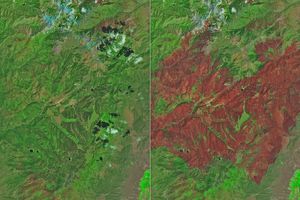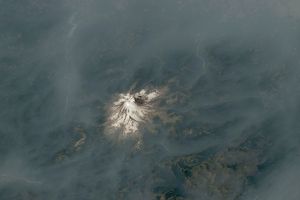


















The Victoria Department of Sustainability and the Environment reported lingering pockets of fire activity in the 149,300-hectare (368,927-acre) Killmore East-Murrindindi Complex North Fire on February 18, 2009. Among the hotspots was a pine plantation in the northeast corner of the fire. That activity may be what is producing the pronounced smoke plume in the upper right corner of this false-color image from the Advanced Spaceborne Thermal Emission and Reflection Radiometer (ASTER) on NASA’s Terra satellite from February 17.
The image uses a combination of visible and near-infrared wavelengths of light to make the smoke more transparent and to highlight burned areas. Unburned vegetation is red, while burned areas are charcoal. The top image is a wide-area view of much of the Killmore East-Murrindindi Complex North Fire. The lower image shows a close-up around the small town of Marysville. The huge fire sprawls across the Cathedral Range Mountains on either side of the Maroondah Highway. Marysville sits near the center of the immense burn scar. At least 39 people died in Marysville, and disaster response crews were still in the field as of February 18, according to news reports.
References & Resources
- Australian Broadcasting Corporation. (2009, February 18). Bushfire Emergency Complete Coverage: Human Cost. Accessed February 18, 2009.
- Victoria Department of Sustainability and the Environment. (2009, February 18). Fires Today - Summary of incidents on Public Land: February 18. Accessed February 18, 2009.
- Victoria Department of Sustainability and the Environment. (2009, February 18). Fires Update: Statewide Overview. Accessed February 18, 2009.
NASA image created by Jesse Allen, using data provided courtesy of NASA/GSFC/METI/ERSDAC/JAROS, and U.S./Japan ASTER Science Team. Caption by Rebecca Lindsey.