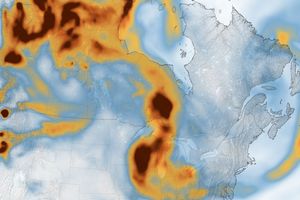





















Bushfires continue to burn in southeast Australia. This false-color image shows the resultingconcentrations of carbon monoxide (CO) at an altitude of roughly 3 km (700 millibars) in theatmosphere over Australia and New Zealand. Data taken by the Measurements Of Pollution In TheTroposphere (MOPITT) instrument aboard NASA’s Terra satellite have been combined for 6 days from January 15-20, 2003. The colors represent the mixing ratios of carbon monoxide in the air,given in parts per billion by volume. In this scene, values range from as high as 250 ppbv (purplepixels) to as low as 50 ppbv (blue pixels). The white areas show where no data were collected,either due to persistent cloud cover or gaps between satellite viewing swaths.
Carbon monoxide is produced as a result of incomplete combustion during burning processes, and is important due to its impact on chemistry in the lower atmosphere. It is a good indicator ofatmospheric pollution, and its presence adversely affects the atmosphere's ability to cleanse itself.Because carbon monoxide is persistent for several weeks, it clearly shows the propagation ofpollution plumes from the region of the Australian fires out thousands of kilometers into the usuallypristine atmosphere of the southern Pacific Ocean. The distribution of pollution over Australiacorresponds closely with satellite observed aerosol emitted by the fires as observed by TOMS.
References & Resources
Image courtesy NCAR MOPITT Team