






















With uses ranging from jewelry to catalytic converters, platinum ranks among the most prized and most expensive metals. About 70 percent of the world’s platinum is mined in the Bushveld Igneous Complex in South Africa—a geological formation roughly the same size as West Virginia. The Bushveld also supplies significant quantities of palladium, rhodium, chromium, and vanadium.
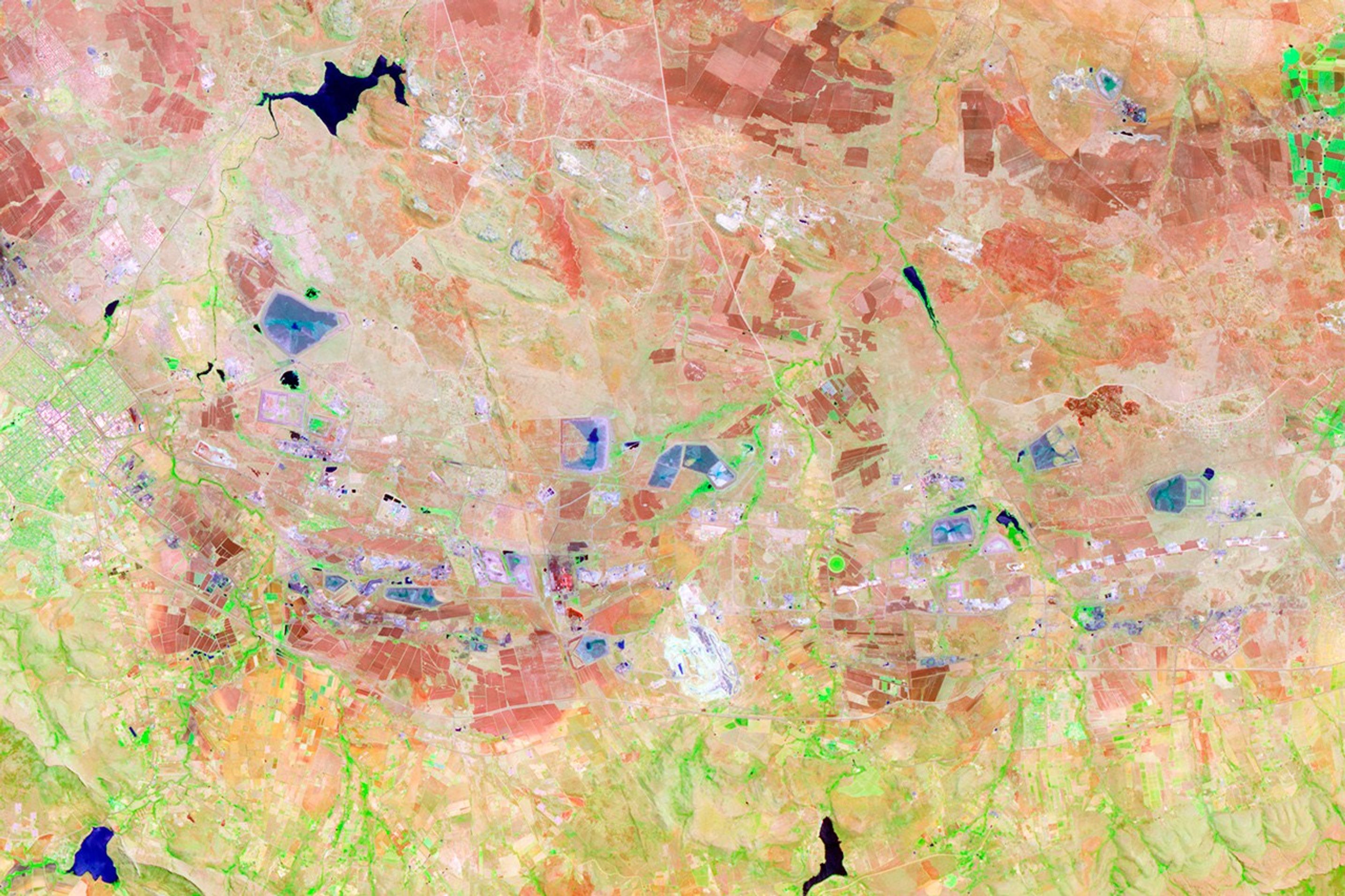
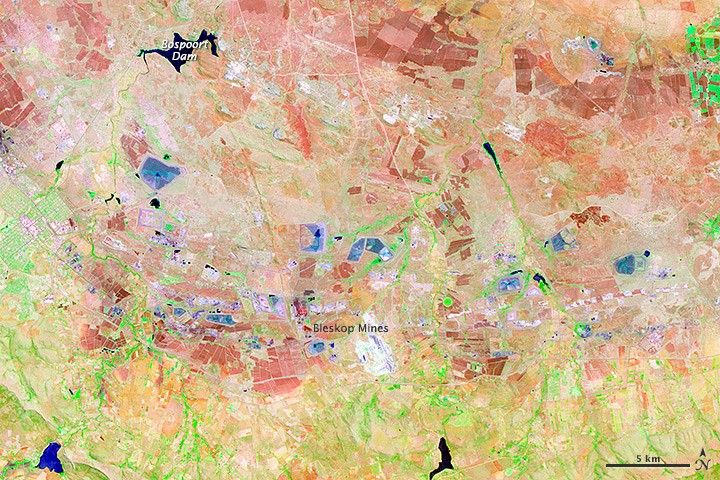
The Advanced Spaceborne Thermal Emission and Reflection Radiometer (ASTER) on NASA’s Terra satellite acquired this image of the Bushveld Igneous Complex on October 24, 2006. It shows part of the Bushveld Complex, an area around the Bospoort Dam.
ASTER combines infrared, red, and green wavelengths of light to make false-color images. In this image, water appears in shades of blue, with darker blue indicating greater water depths. The pale blue polygonal shapes indicate reservoirs and tailings ponds associated with mining operations. Bare rock and sparsely vegetated land appear in shades of red and red-brown. Vegetation is green.
Bushveld is an example of a large igneous province, a massive assemblage of rocks formed by volcanic activity. The Bushveld is not only big in land area; its rock layers are several kilometers thick. The complex consists of multiple “suites” of rocks, each of which in turn holds multiple layers. Different layers are sources of different types of valuable metals; some favor platinum, for example, while others are rich in chromium.
Bushveld is unusual in that, despite its great age—more than 2 billion years—it has not been significantly deformed by subsequent tectonic activity. (It has undergone extensive erosion.) Despite years of extensive study in the area, geologists have not reached a consensus about how this igneous complex formed. One hypothesis is that the complex is a single, massive feature shaped like a giant bowl. Others suggest that it consists of discrete, disconnected structures. In either case, the complex might have received multiple infusions of magma from different sources.
Although there is little agreement about precisely how it formed, dating of the rocks from the Bushveld indicates that the igneous complex formed over a relatively short time period, perhaps less than 10 million years. Before dating techniques constrained the ages of the rock layers to a time around 2.06 billion years ago, many geologists suspected that the complex formed over a period that might have exceeded 100 million years.
References & Resources
- ASTER. Bushveld Igneous Complex, South Africa. NASA Jet Propulsion Laboratory. Accessed February 21, 2013.
- Buck, J.S., Maas, R., Gibson, R. (2001) Precise U-Pb titanite age constraints on the emplacement of the Bushveld Complex, South Africa. Journal of the Geological Society, 158(1), 3–6.
- Kinnaird, J.A. The Bushveld Large Igneous Province. School of Geosciences, University of the Witwatersrand. Accessed February 21, 2013.
- Schouwstra, R.P., Kinloch, E.D., Lee, C.A. (2000). A short geological review of the Bushveld Complex. Platinum Metals Review, 44(1), 33–39.
- State of the Planet. Bushveld Igneous Complex. The Earth Institute. Columbia University. Accessed February 21, 2013.
NASA Earth Observatory image by Jesse Allen and Robert Simmon, using data from NASA/GSFC/METI/ERSDAC/JAROS, and U.S./Japan ASTER Science Team. Caption by Michon Scott.