

















A single caterpillar or bug may seem small and inconsequential, but the collective environmental impact of certain insects can be profound. In fact, insects and other diseases damage 45 times more forest area each year than wildfires, according to one estimate.
One of the key pests in the northeastern United States—the European gypsy moth caterpillar (Lymantria disbar)—has had its population boom in 2016. These voracious insects chewed through large swaths of hardwood forest in New England and the Mid-Atlantic in May and June.
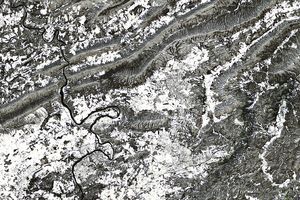
The outbreak of the fuzzy brown caterpillars was so severe that defoliation was apparent in satellite imagery collected by NASA’s Aqua and Terra satellites. The natural-color images above were acquired by Terra’s Moderate Resolution Imaging Spectroradiometer (MODIS) sensor on May 25, 2016 (left), and June 26, 2016 (right). Healthy forests appear green, while defoliated areas have a gray-brown tint.
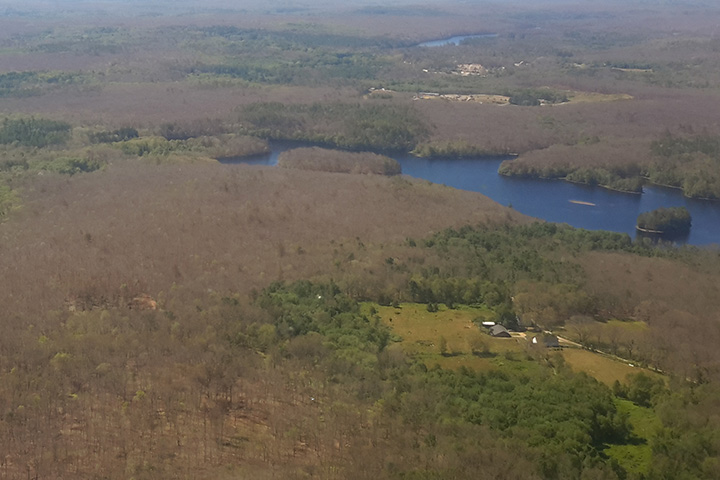
Defoliation by gypsy moth caterpillars tends to be most visible to satellites in early summer, after the caterpillars have hatched and had an opportunity to feed but before trees have had time to regrow leaves. The aerial photograph below shows a closer view of forests near Barden and Scituate Reservoirs in western Rhode Island on June 30, 2016. The greener areas are coniferous trees, which the caterpillars avoid. Brown areas are defoliated deciduous trees, which make up New England’s hardwood forests.
While gypsy moths have been a constant presence in the northeastern United States since being introduced from Europe in the 1860s, their populations swell dramatically in certain years due to several environmental factors. For instance, a decline in the population of white-footed mice—a key predator of gypsy moth caterpillars—can set a forest up for a gypsy moth population boom. Mouse populations usually shrink following years with poor acorn production by oak trees.
Dry weather also can weaken certain pathogens that normally keep the caterpillars in check. “This 2016 outbreak is likely due to two successive dry springs—conditions not conducive to the growth and spread of two naturally occurring bio-controls,” explained Paul Ricard, the forest health program coordinator for the Rhode Island Department of Environmental Management. “The Entomophaga maimaiga fungus and Nuclepolyhedrosis virus have historically kept the gypsy moth population in check.” Indeed, much of the Northeast was in moderate or severe drought in July 2016, according the U.S. Drought Monitor.
The ecological consequences of gypsy moth outbreaks are often cosmetic, but they can become serious. Deciduous trees can normally withstand one or two years of defoliation by caterpillars, but three or more successive years of severe defoliation can result in widespread tree mortality. “Though weak or sick trees could succumb, we are not worried about significant tree mortality yet,” said Ricard.
Meanwhile, predators of the caterpillars—such as cuckoos, blue jays, and orioles—often thrive when populations of gypsy moth caterpillars swell.
References & Resources
- EcoRI News (2016, June 29) What Impact is All This Caterpillar Poop Having on Forest Floors? Accessed July 13, 2016.
- de Beurs, K.M. & Towsend, P.A. (2008, October 15) Estimating the effect of gypsy moth defoliation using MODIS. Remote Sensing Environment, 112 (10), 3983-3990.
- ForWarn (2016, August 10) Monitoring the state of Rhode Island’s forests. Accessed September 26, 2016.
- Providence Journal (2016, July 7) Scott Turner: Millions of moths out on a date. Accessed July 13, 2016.
- Spruce, J. et al. (2011, February 15) Assessment of MODIS NDVI time series data products for detecting forest defoliation by gypsy moth outbreaks. Remote Sensing Environment, 2 (115), 427-437.
- Takepart (2016, July 11) Gypsy Moths Are Destroying Forests as the Climate Dries. Accessed July 13, 2016.
- The Washington Post (2016, July 7) Northeast battles gypsy moths, an insect plague stripping trees bare and delaying airplanes. Accessed July 13, 2016.
- University of Wisconsin-Madison CIMSS Satellite Blog (2016, June 26) Gypsy moth defoliation in parts of New England. Accessed July 13, 2016.
- U.S. Forest Service (2003, October 29) Gypsy Moth in North America. Accessed July 13, 2016.
NASA Earth Observatory image by Jesse Allen, using data from the Land Atmosphere Near real-time Capability for EOS (LANCE). Caption by Adam Voiland, with information from Paul Ricard (Rhode Island Department of Environmental Management), Joseph Spruce (NASA Stennis Space Center), and Phil Townsend (University of Wisconsin). Photo courtesy of Paul Ricard.