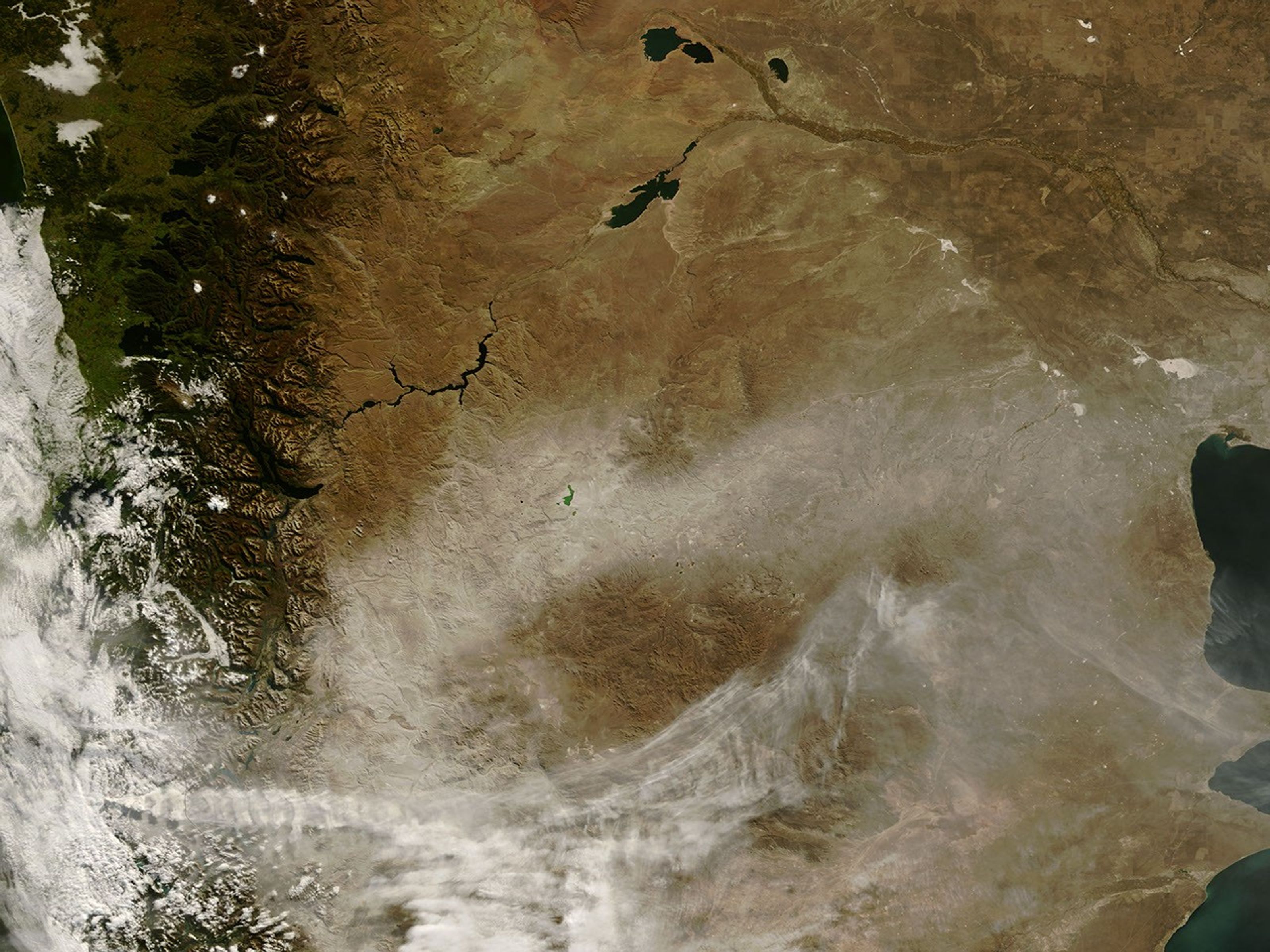




















Ten days after its initial eruption on May 2, 2008, Chile’s Chaitén Volcano had left extensive ash cover on Patagonia’s land surface. The Moderate Resolution Imaging Spectroradiometer (MODIS) on NASA’s Terra satellite took this picture on May 12, 2008.
In this image, Chaitén continues to emit a plume that blows eastward toward the Argentine coast. Rising well above the cloud cover surrounding the volcano, the plume casts its shadow on the nearby clouds. North of the plume, a pale, gray-beige stain discolors the otherwise dark brown landscape. This is volcanic ash that has settled on the land surface. Besides its slightly darker color, the ash that has made landfall differs from the airborne ash in that it follows the topography of the underlying land surface, revealing the sharp contours of low-level ridges.
Unlike ash resulting from burned vegetation, volcanic ash consists of tiny jagged particles of rock and glass. According to Australia’s ABC Science, the ash was expected to cause long-term damage to Patagonian ecosystems and wildlife, as well as local livestock.
References & Resources
NASA images courtesy Jeff Schmaltz, MODIS Rapid Response Team at NASA GSFC. Caption by Michon Scott.