















By day, Lawrence Coy and Steven Pawson are NASA scientists at Goddard Space Flight Center who develop complex data assimilation and reanalysis models of Earth’s atmosphere. But when they need a break, they have an unconventional hobby—searching for ghostly faces swirling in their data.
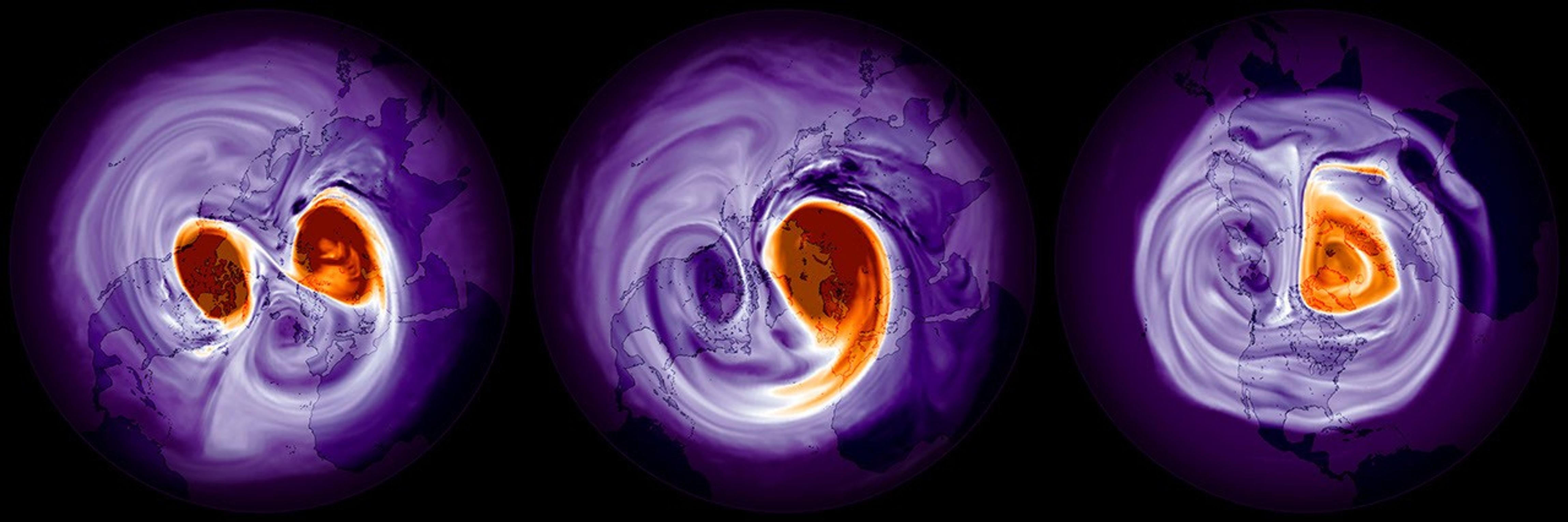
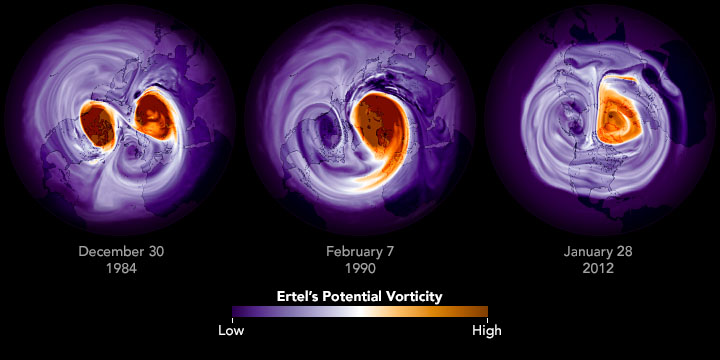
The images above show a few of their favorite finds after scouring roughly 40 years of data. They spotted all of these “faces” while examining visualizations of wind and temperature data from a reanalysis called the Modern-Era Retrospective analysis for Research and Applications, Version 2 (MERRA-2). The reanalysis incorporates weather data from satellites and several other sources to simulate atmospheric conditions on a global scale.
“The best time to find faces is in the winter in the polar regions of the northern hemisphere,” Pawson said. “That’s when the dark conditions of the ‘polar night’ lead to a ring of westerly winds in the stratosphere that atmospheric scientists have long called the stratospheric polar vortex or circumpolar vortex.”
For much of the winter, the polar vortex spins high in the stratosphere. But about once per winter—usually in January or February—something happens that disrupts this circumpolar flow, causing those westerly winds to weaken and temperatures to increase over the pole. This can even cause the winds to change direction and the stratospheric polar vortex to split into sections, Coy explained. “It’s often during or after these events—sometimes called sudden stratospheric warming events—that we'll find a face.”
In all cases, the ephemeral facial features are caused by different arrangements of low and high potential vorticity—a quantity that describes how air masses are spinning. In these plots, areas of high potential vorticity appear orange and have counterclockwise circulation; areas of low potential vorticity appear purple and have clockwise circulation. (German scientist Hans Ertel first published on potential vorticity in 1942).
In the menacing face at the top of the page, a split in the vortex following a sudden stratospheric warming event left two areas of high potential vorticity serving as eyes, while an area of low potential vorticity formed the mouth. The face was seen in potential vorticity data from January 25, 1982, at a height of roughly 30 kilometers (18 miles), roughly the middle of the stratosphere.
In the set of three, the face on the left also had a split vortex, with eyes of high potential vorticity. A more common pattern can be seen in the two smiling images to the right. In both cases, the left eye is made up of a low potential vorticity area, the right eye of a high potential vorticity area, and the mouth by connecting strands of both.
“Steven had the idea of finding at least one of these faces for each winter,” Coy said. “We already have a collection of more than 40 of these, and I bet we will continue looking in future years.”
When Coy and Pawson find faces in atmospheric data, they’re engaging in face pareidolia—the human tendency of seeing faces in everyday objects. Psychological research suggests the habit likely flows from the human brain’s exceptional facial-recognition skills, something that even the youngest of babies can do well.
“Finding these never gets old, and it’s a fun way to get people to think about the stratosphere and our data assimilation models,” said Pawson. “It’s also a good way to highlight year-to-year differences in the stratosphere.”
References & Resources
- Colorado State University Potential Vorticity. Accessed October 28, 2022.
- Gelaro, R. et al. (2017) The Modern-Era Retrospective Analysis for Research and Applications, Version 2 (MERRA-2). Journal of Climate, 30 (14), 5419-5454.
- The Guardian (2021, July 6) So happy to see you: our brains respond emotionally to faces we find in inanimate objects, study reveals. Accessed October 28, 2022.
- Johns Hopkins University What is the Polar Vortex? Accessed October 28, 2022.
- Met Office Sudden Stratospheric Warming. Accessed October 28, 2022.
- NASA Global Modeling and Assimilation Office The Many Faces of the Stratosphere. Accessed October 28, 2022.
- National Centre for Atmospheric Science What is Potential Vorticity? Accessed October 28, 2022.
- Stanford (2012, December 11) Infants process faces long before they recognize other objects, Stanford vision researchers find. Accessed October 28, 2022.
- UNSW (2020, August 14) Why the brain is programmed to see faces in everyday objects. Accessed October 28, 2022.
NASA Earth Observatory images by Joshua Stevens , using MERRA-2 data courtesy of Lawrence Coy/GSFC and the Global Modeling and Assimilation Office at NASA GSFC. Story by Adam Voiland .