







On April 26, 1986, the world’s worst nuclear power accident occurred at the Chernobyl Nuclear Power Plant near the Ukrainian-Belarus border. Toxic radionuclides like Cs137 and Sr90 contaminated an area of 155,000 square kilometers in what is today Belarus, Ukraine and Russia. Hundreds of thousands of people were killed, sickened from radiation-induced illnesses, or resettled to uncontaminated land.
Today, the immediate area remains off limits to humans. The plant was permanently closed in 2000. The surrounding agricultural land has been abandoned, and the two nearby towns (Pripyat to the north and Chernobyl to the south) where plant workers lived are largely ghost towns. Instead of people, abundant wildlife—packs of wolves, deer, and birds—roam and live near Chernobyl.
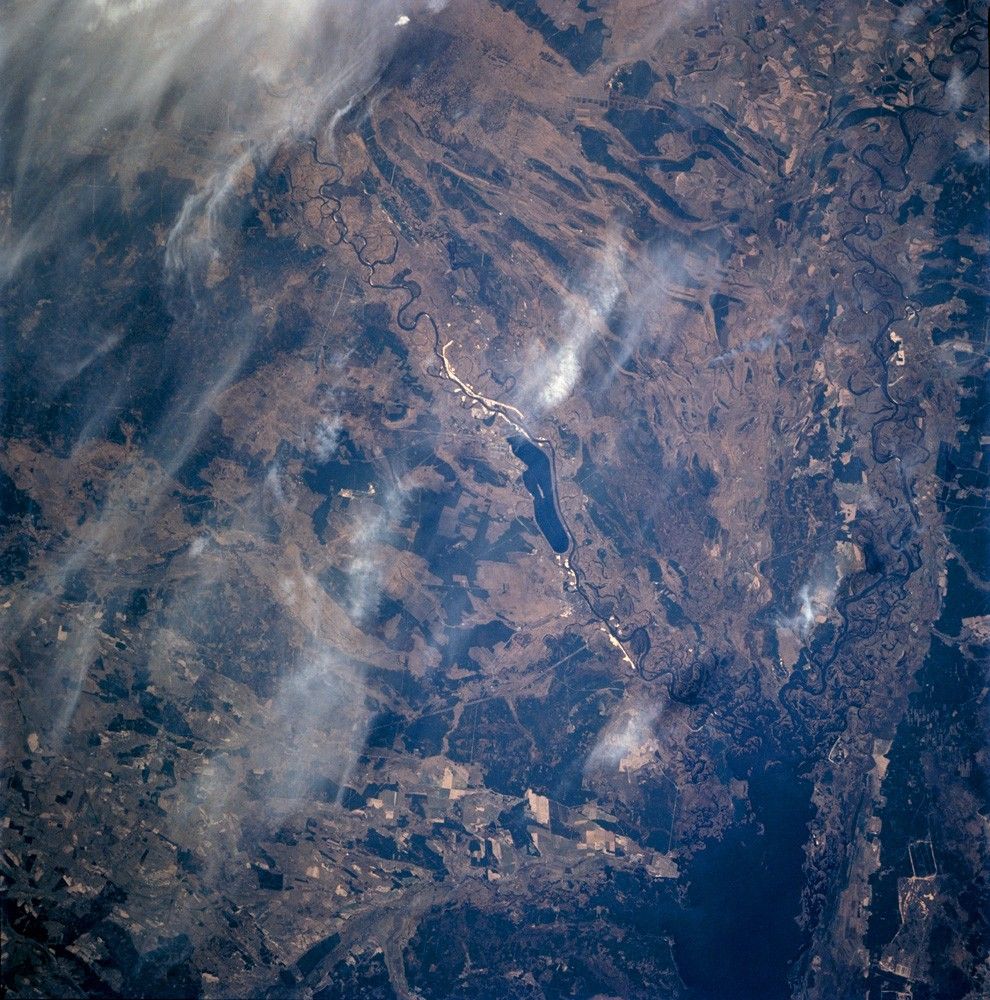
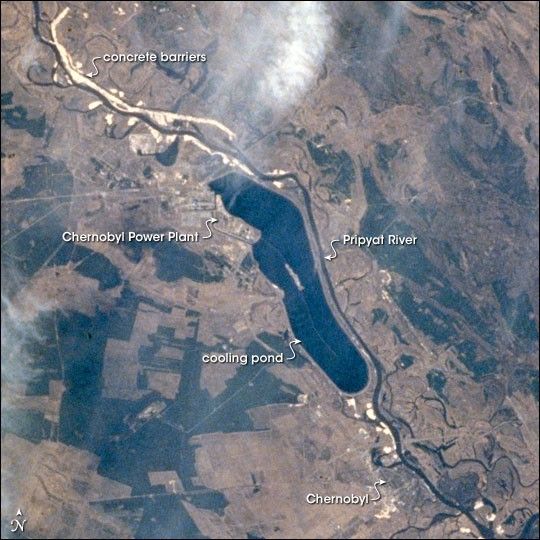
This image, taken from the Russian Mir spacecraft, shows Chernobyl and the surrounding countryside. The power plant is situated on the northwest end of a cooling pond on the Pripyat River, which flows into the Dnepr River just 80 miles north of Kiev. The main features visible in the image are the massive concrete dams and levees that were constructed to contain elements of the power plant and prevent contaminated runoff from entering the local streams. The cooling water canals leading to the pond, and the levees in the middle of the pond that channeled the water circulation can also be seen. The darker green regions are forests and the light green areas are cleared land used for agriculture.
References & Resources
Image NM23-745-116 was taken April 27, 1997, from the Russian Mir Space Station with a Hasselblad medium format camera equipped with a 250-mm lens and is provided by the Earth Observations Laboratory, Johnson Space Center. The NASA-Mir program was the first phase of the International Space Station Program, which now supports the Earth Observations Laboratory. The program trains astronauts to take pictures of Earth that are of value to scientists and the public, and to make those images freely available on the Internet. Additional images taken by astronauts and cosmonauts can be viewed at the NASA/JSC Gateway to Astronaut Photography of Earth.