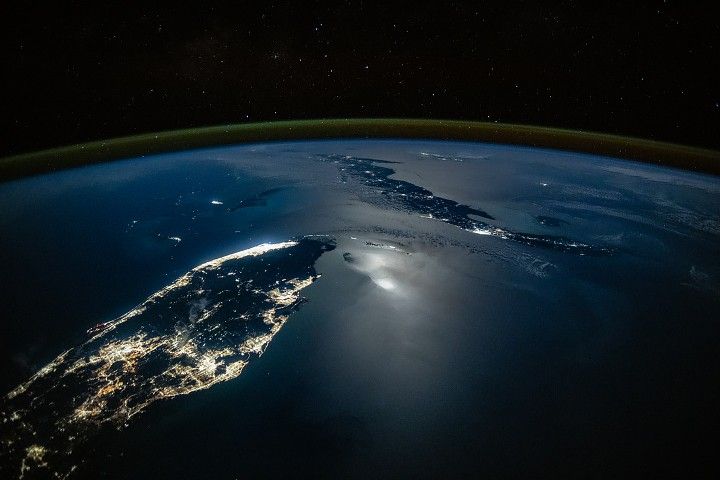


















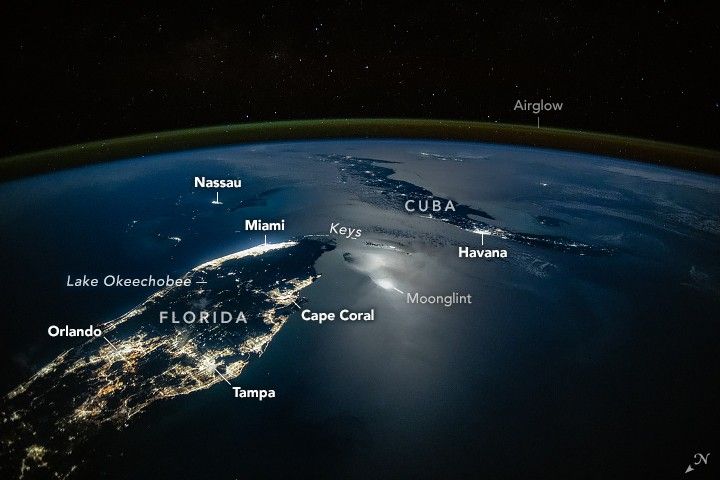
An astronaut aboard the International Space Station captured this oblique view of Earth’s limb, showing the Florida Peninsula and Cuba at night. The photograph reveals the bright center of the Moon’s reflection point, known as moonglint, which is a nighttime equivalent of the sunglint phenomenon often seen in astronaut photographs.
Similar to sunglint, moonglint occurs when the light source (in this case, the Moon) reflects off the water surface at the same viewing angle as the observer—here, a crew member on the space station. This image was taken at 2:23 a.m. Eastern Standard Time on March 19, 2025, during mostly cloud-free conditions. While not visible in the photograph, the Moon had risen approximately three hours earlier, about halfway to reaching its highest point that night. At the time the image was taken, the Moon was in a waning phase, providing about 78 percent of the illumination of a full Moon.
The short focal-length lens used for this photograph provides a field of view roughly similar to that of the human eye. This expansive perspective reveals city size and structure and gives a sense of the curvature of the planet, mirrored by the faint airglow layer above the horizon (Earth’s limb). Dense groupings of light in the peninsula represent some of Florida’s largest cities. The conurbation from Miami to Fort Lauderdale forms the brightest stretch of lights along the southeastern Atlantic seaboard. On Florida’s western coast, Tampa and Saint Petersburg are prominent, while lower-density lighting indicates Fort Myers and Cape Coral to the south. The sprawling city of Orlando lies roughly along the central spine of the peninsula.
Nassau, the capital of the Bahamas, appears as a bright spot about 320 kilometers (200 miles) offshore from Miami. Small towns along the Florida Keys create a faint but discernible string of lights. South of the Keys lies Havana, Cuba’s capital, with the lights of smaller cities dotting the length of the island. Lights near the horizon at the upper right indicate the island nation of Jamaica. This oblique view captures features stretching over 1,400 kilometers (900 miles) in a single frame.
The undeveloped parts of Lake Okeechobee, Everglades National Park, and nearby wildlife management areas represent some of the darkest areas in the image. The marine water surface is also very dark, except for a distinctly brighter zone of reflected moonlight concentrated over the Florida Keys and Cuba.
Astronaut photograph ISS072-E-807123 was acquired on March 19, 2025, with a Nikon Z9 digital camera using a focal length of 28 millimeters. It is provided by the ISS Crew Earth Observations Facility and the Earth Science and Remote Sensing Unit, Johnson Space Center. The image was taken by a member of the Expedition 72 crew. The image has been cropped and enhanced to improve contrast, and lens artifacts have been removed. The International Space Station Program supports the laboratory as part of the ISS National Lab to help astronauts take pictures of Earth that will be of the greatest value to scientists and the public, and to make those images freely available on the Internet. Additional images taken by astronauts and cosmonauts can be viewed at the NASA/JSC Gateway to Astronaut Photography of Earth. Caption by Justin Wilkinson, Texas State University, Amentum JETS II Contract at NASA-JSC.