
















Wind plucks hundreds of millions of tons of dust from parched landscapes in northern Africa each year, propelling vast plumes of the tiny mineral particles over the Atlantic Ocean. By one estimate, the region contributes about half of the dust in the atmosphere—more than any other area in the world.
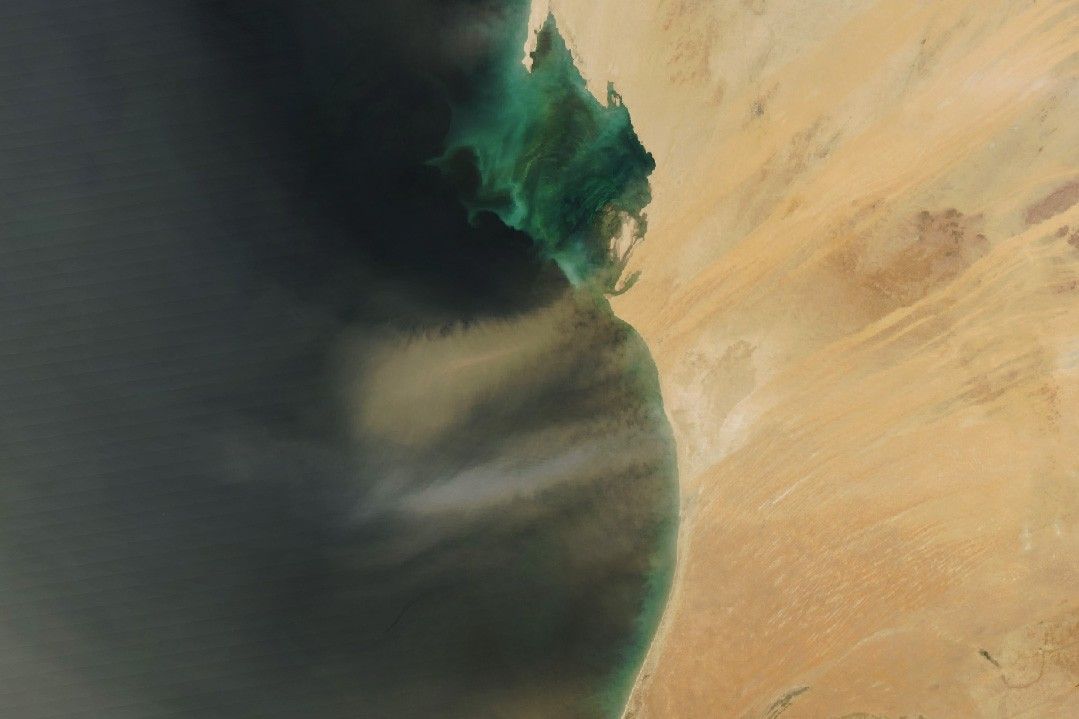
The MODIS (Moderate Resolution Imaging Spectroradiometer) on NASA’s Aqua satellite glimpsed this process when the sensor captured this image of dust streaming off the coast of Mauritania on February 25, 2025.
Although much larger and denser plumes occur in this area, the dust in this image stands out due to its distinctive coloration. Sebkhet Te-n-Dghâmcha (also called Sebkha de Ndrhamcha), a seasonal lake and salt pan northeast of Nouakchott, appears to be the source of the lighter-colored dust. The salt pan contains large amounts of gypsum, a white mineral that forms when the lake’s water evaporates.
It is also rich in other white minerals, including calcite and kaolinite, according to Sofía Gómez Maqueo Anaya, an atmospheric scientist at the Leibniz Institute for Tropospheric Research, who studies airborne particles at the Ocean Science Centre Mindelo in Cabo Verde. The darker, more yellow plumes are likely rich in hematite or goethite, iron oxide minerals known for giving dust reddish or yellowish hues.
Dried lakes and rivers are major sources of atmospheric dust because evaporating water typically leaves behind fine-grained particles that are light enough to be lifted. They also tend to lack vegetation, making the particles especially vulnerable to wind-driven erosion and transport.
Once airborne, Saharan dust particles can affect the health of people, both near and far, who breathe them and any pathogens they carry. Also, many plumes cross part or all of the Atlantic Ocean, fueling phytoplankton blooms, fertilizing soils in the Amazon, and influencing the development of hurricanes.
“This plume looks localized and relatively low,” said atmospheric scientist Holger Baars, after analyzing lidar data from the research site in Mindelo operated by the Leibniz Institute for Tropospheric Research in Germany. He said most dust plumes that pass over Cabo Verde extend about 4-5 kilometers above sea level, but this one reached just 1.5 kilometers (1 mile), meaning it was low enough to have a significant effect on local air quality.
References & Resources
- Adebiyi, A., et al. (2023) A review of coarse mineral dust in the Earth system. Aeolian Research, 60, 100849.
- Guinoiseau, D., et al. (2022) Characterization of Saharan and Sahelian dust sources based on geochemical and radiogenic isotope signatures. Quaternary Science Reviews, 293, 107729.
- Kok, J., et al. (2021) Contribution of the world’s main dust source regions to the global cycle of desert dust. Atmospheric Chemistry and Physics, 21(10), 8169-8193.
- Le Quilleuc, M., et al. (2021) Major Element Signatures of Silicate Dust Deposited on the West African Margin: Links With Transport Patterns and Provenance Regions. Journal of Geophysical Research: Atmospheres, 126(20), e2021JD035030.
- Loop (2025, February 25) Second Saharan dust surge heading to Caribbean islands. Accessed February 28, 2025.
- NASA Earth Observatory (2020, January 9) A Dusty Journey. Accessed February 28, 2025.
- NASA Goddard Space Flight Center (2025) AERONET: Mindelo OSCM. Accessed February 28, 2025.
- NASA Earth Surface Mineral Dust Source Investigation. Accessed February 28, 2025.
- NOAA AerosolWatch, via X (2025, February 24) Large plumes of Saharan dust are moving off the coast of West Africa. Accessed February 28, 2025.
- Ocean Science Centre Mindelo Cabo Verde. Accessed February 28, 2025.
NASA Earth Observatory image by Wanmei Liang , using MODIS data from NASA EOSDIS LANCE and GIBS/Worldview . Story by Adam Voiland .