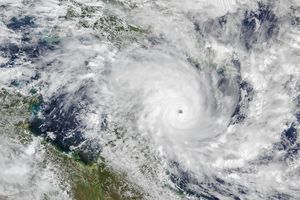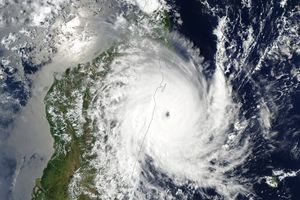
























Residents of the South Pacific island nation of Fiji are bracing for landfall from an intense tropical cyclone. Forecasters warned that the storm known as Winston could arrive on the main island of Viti Levu with sustained category 4 winds. It could be the strongest storm to cross the island since local meteorological records were first kept in 1941.
At 1:15 p.m. Fiji time (01:15 Universal Time) on February 19, 2016, the Visible Infrared Imaging Radiometer Suite (VIIRS) on Suomi NPP acquired this natural-color image of Tropical Cyclone Winston between several tropical Pacific islands. At the time, the storm had sustained winds of 110 knots (125 miles or 200 kilometers per hour). Eighteen hours later, winds had intensified to 145 knots (165 mph or 270 kmph), a category 5 storm.
The latest forecast from the Joint Typhoon Warning Center had the storm moving due west, with landfall on Viti Levu on February 20. The island is home to more than 600,000 people and the national capital, Suva. The storm track from the east to west is unusual, according to Brian Kahn of WXshift/Climate Central. Nearly all cyclones in recent records have approached Fiji from the west.
References & Resources
- NASA (2016, February 19) NASA Sees Major Tropical Cyclone Winston Approaching Fiji. Accessed February 19, 2016.
- Weather Underground (2016, February 19) Trouble in Paradise: Cat 4 Winston May be Fiji’s Strongest Tropical Cyclone on Record. Accessed February 19, 2016.
- WXshift (2016, February 19) Winston Will Be Among the Strongest Cyclones on Record to Hit Fiji. Accessed February 19, 2016.
NASA image by Jeff Schmaltz, LANCE/EOSDIS Rapid Response. Suomi NPP was developed through a partnership between NOAA, NASA, and the Department of Defense. Caption by Mike Carlowicz.