




![Request for Information – Potential [Placeholder for Prize]](https://assets.science.nasa.gov/dynamicimage/assets/science/missions/a-step/FFR_Earth_Background_20251120%20.png?w=1024)






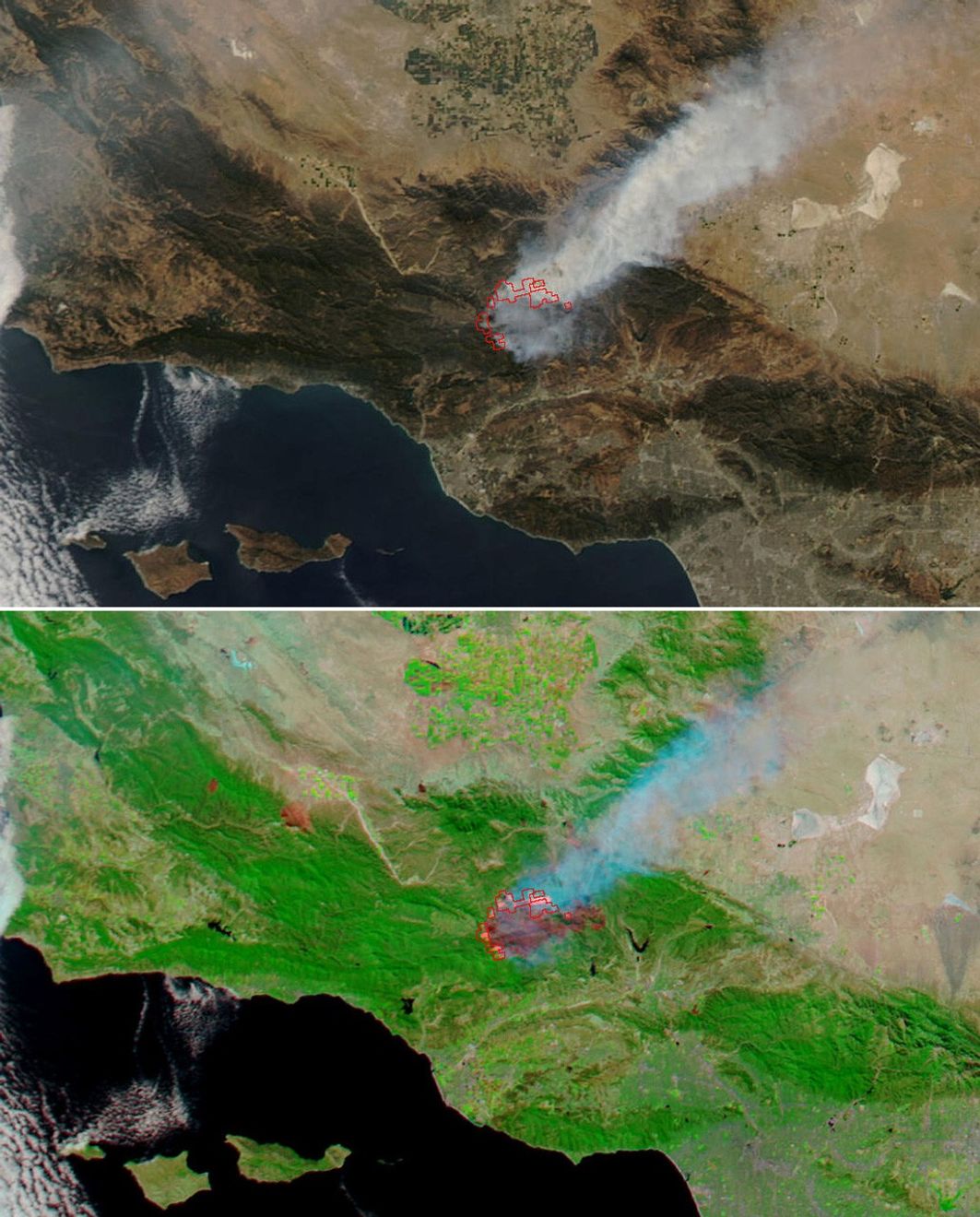
A shift in the winds affecting the Day Fire northwest of Los Angeles swept smoke to the northeast on September 19, 2006. On the previous day, winds had pushed a thick plume of smoke westward over the Pacific Ocean. This pair of images of the fire on September 19 was captured by the Moderate Resolution Imaging Spectroradiometer (MODIS) on NASA’s Aqua satellite. The natural-color image at top is similar to a digital photo, and uses only visible light. The image at bottom has been enhanced with MODIS’ observations of shortwave- and near-infrared light to make the burned areas (deep red) stand out from unburned vegetation (green). In both images the actively burning parts of the fire are outlined in red. In the false-color image, bright pink glows within the fire perimeters are probably areas of open flame.
According to the September 20 report from the National Interagency Fire Center, the Day Fire was 93,339 acres and 20 percent contained. Parts of the Angeles and Los Padres National Forests were closed, and evacuations and road closures in the area continued.
The high-resolution image provided above has a spatial resolution of 250 meters per pixel. The MODIS Rapid Response System provides daily images of the entire western United States at additional resolutions.
References & Resources
NASA image courtesy the MODIS Rapid Response Team, Goddard Space Flight Center