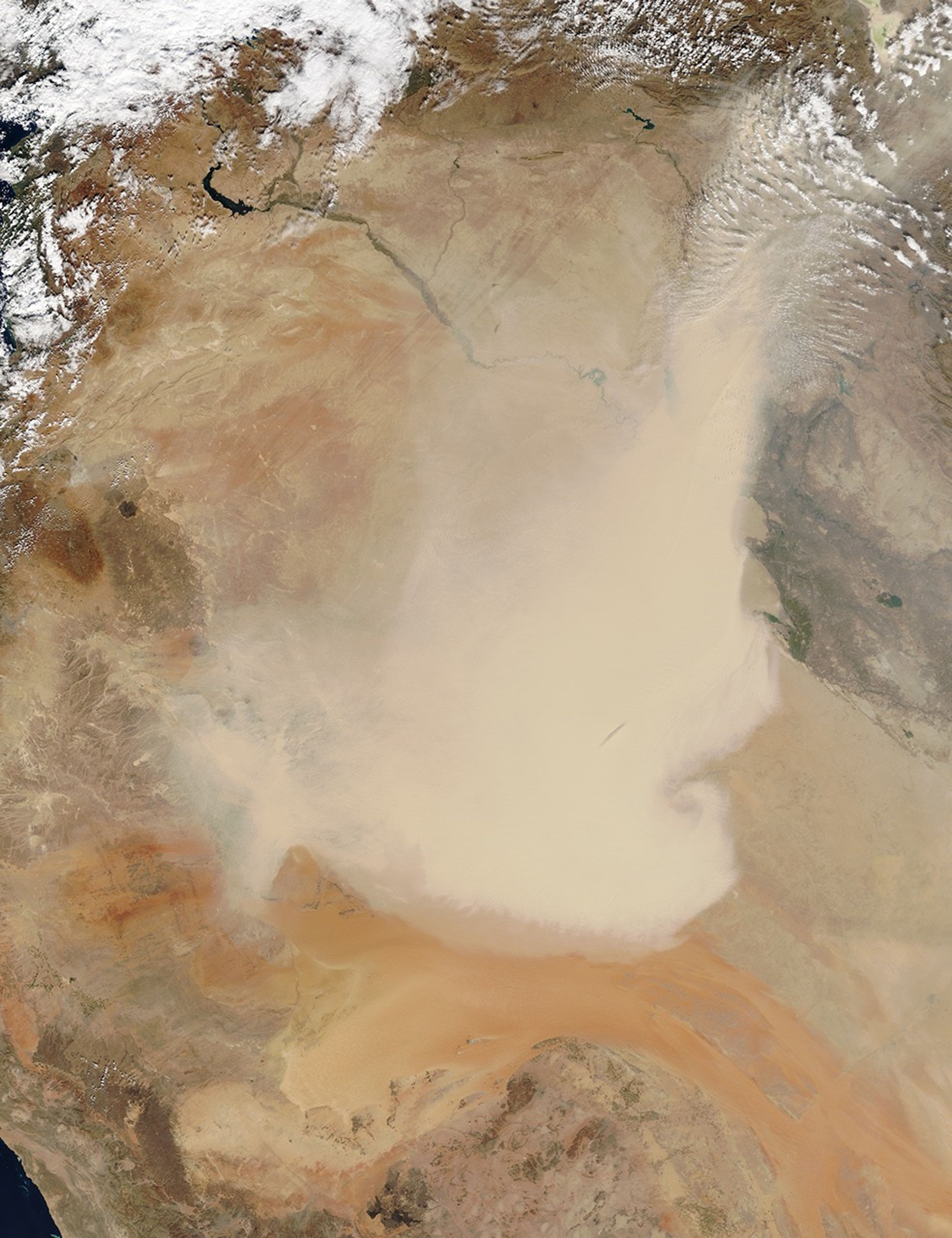
















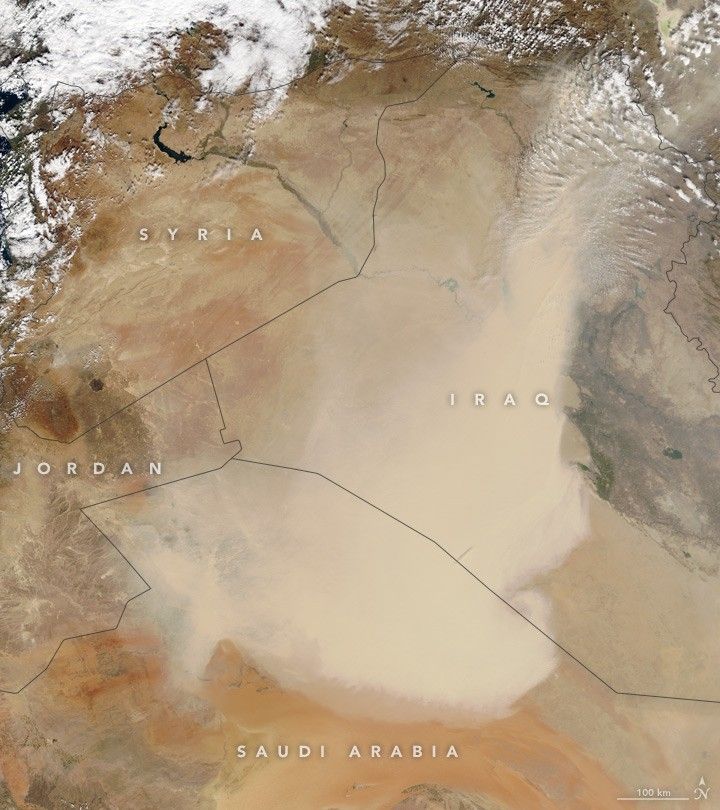
In October 2017, a large dust storm darkened skies over much of Iraq and Saudi Arabia. The Moderate Resolution Imaging Spectroradiometer (MODIS) on NASA’s Terra satellite captured this natural-color image of dust blowing over the two countries on the morning of October 29, 2017.
MODIS on NASA’s Aqua satellite observed large amounts of dust aloft on October 30 as well. At 7 a.m. local time on October 30, the storm had reduced visibility in parts of Iraq to just 600 meters, according to news reports. As a result, the Iraqi Civil Aviation Authority temporarily suspended air traffic until conditions improved. The dust was also reported to have damaged refugee shelters and spurred breathing problems in northern Iraq.
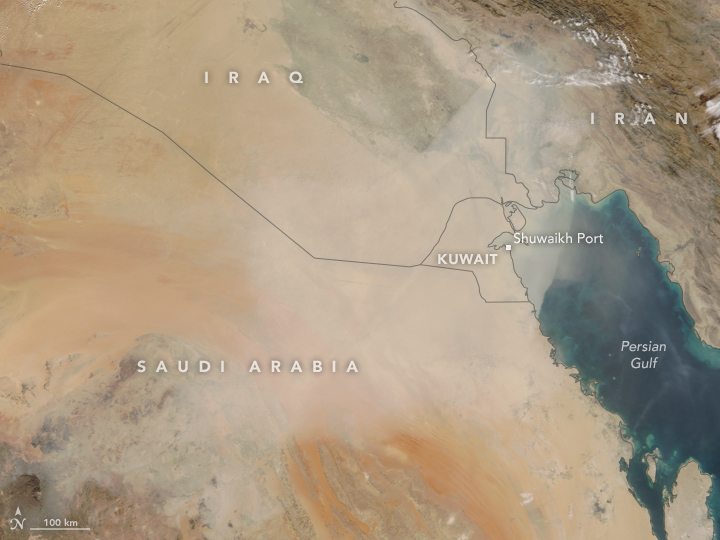
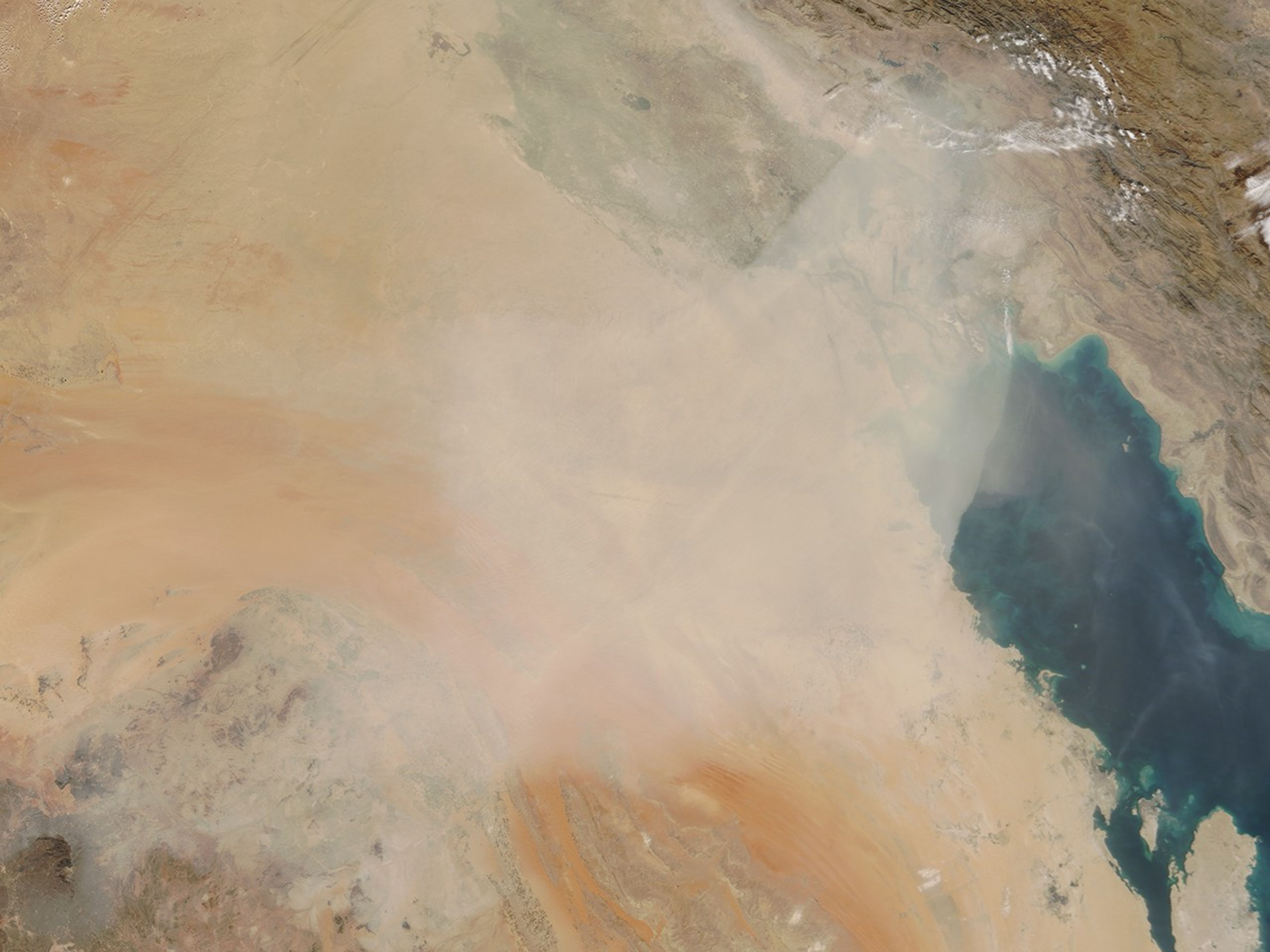
Finally, MODIS on Terra captured the second image above on October 31 as the dust storm engulfed Kuwait and the Persian Gulf. Ship traffic at Shuwaikh Port came to a halt as visibility dropped to just 500 meters. Meteorologists in Kuwait noted that pressure changes this time of year typically bring quick, dramatic shifts in the weather. This dust storm was carried by relatively cool winds. As air temperatures drop, meteorologists expected the winds and dust to slowly diminish.
Multi-day dust storms in the Middle East are often spurred by the shamal, a pattern of persistent winds that blow toward the southeast (northwesterly winds). Shamal winds are most frequent in June and July, but can happen any time of year. Conversely, the gale-force kaus, or sharki, winds blow toward the northwest (southeasterly winds) and typically occur between December and April.
According to a 2013 research paper, the frequency of dust storms in the Iraq have been increasing over the past decade. The authors cite reduced rainfall as one of the main reasons, as well as land degradation and desertification.
References & Resources
- Chudnovsky, A. et al. (2016) Spatial and temporal variability in desert dust and anthropogenic pollution in Iraq, 1997-2010. Journal of the Air & Waste Management Association, 67 (1,2017).
- Iraq’s Economic Center (2017, October 29) Iraq suspends air traffic due to dust storm. Accessed October 31, 2017.
- Kurdistan 24 (2017, October 29) PHOTOS: Warnings issued as dust storm hits Kurdistan and Iraq. Accessed October 31, 2017.
- Kuwait Times (2017, October 31) Dust hits Kuwait with cold winds. Accessed November 1, 2017.
- Rudaw (2017, October 29) Major dust storm sweeps across Kurdistan Region. Accessed October 31, 2017.
- Sissakian, V. et al. (2013) Sand and dust storm events in Iraq. Natural Science, 5 (10), 1084-1094.
NASA image by Jeff Schmaltz, LANCE/EOSDIS Rapid Response. Story by Adam Voiland and Kathryn Hansen.