













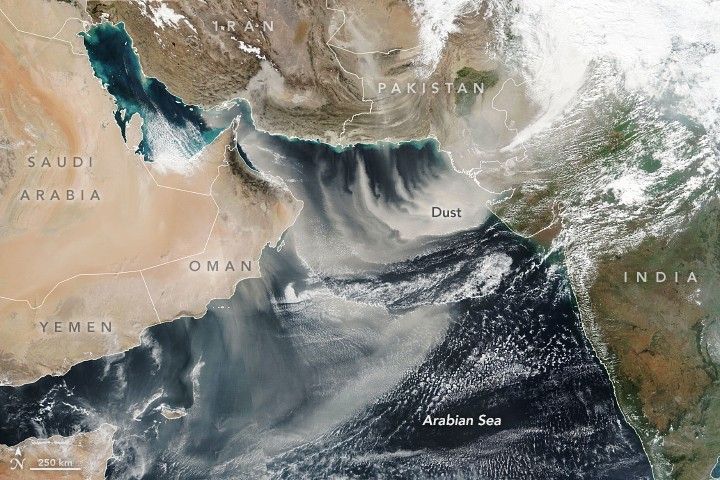
In late January 2022, a substantial dust storm enveloped the Arabian Sea. Plumes of desert dust affected populated areas around the basin, as winds carried the particles over Karachi, Mumbai, and numerous other cities and degraded air quality.
The Visible Infrared Imaging Radiometer Suite (VIIRS) on the NOAA-NASA Suomi NPP satellite acquired this image on January 22, 2022, as plumes of dust streamed from Oman, Pakistan, and Iran. Notice the especially thick plumes near Pakistan’s coast. Visibility in Karachi—the largest city in Pakistan—fell to about 500 meters (1600 feet).
Dust arose from three different countries but merged into a large plume that cast a pall over much of the Arabian Sea. According to Hiren Jethva, a Morgan State University scientist based at NASA’s Goddard Space Flight Center, the size of the plume was “quite remarkable,” as was its unusual path.
Initially on January 21, high winds associated with a low-pressure system whipped up dust and carried it toward the southeast. On January 22, the dust blew over the sea and then hooked toward the east. By January 23, dust blanketed western India, shrouding the states of Maharashtra, Gujarat, and Rajasthan.
According to Jethva, winter winds usually blow out from India toward the Arabian Sea, carrying various aerosols from local pollution and biomass burning. “However, the reversal of wind direction has likely occurred, bringing dust from the ocean to the Indian subcontinent,” Jethva said.
The dust hung in the air for days. In Mumbai, the air quality index on January 24 was “severe,” the highest of six categories in the country’s index. According to news reports, an air quality index that high in Mumbai is “unprecedented.” Toward the southeast, the city of Pune saw air quality in the “very poor” category, ranking worse that day than Delhi, where winter air quality is often affected by temperature inversions.
The dust storm was accompanied by chilly weather. According to news reports, the dust in Mumbai contributed to the lowest daytime January temperature recorded in the city in a decade, reaching just 23.8°C (74.8°F) on January 23. On average, daytime temperatures in January reach 31°C (88°F).
References & Resources
- Hindustan Times (2022, January 24) Mumbai air quality drops to poor as dust from Pakistan, Iran shrouds city. Accessed January 25, 2022.
- India.com (2022, January 23) Massive Dust Storm Heads Towards Gujarat, Rajasthan: IMD Issues Alert For 12 Hours. Accessed January 25, 2022.
- India Today (2022, January 24) Dust storm from Balochistan causes haze over Mumbai, air quality drops to âsevere.â Accessed January 25, 2022.
- The Indian Express (2022, January 24) Mumbai, north Konkan to be hit by dust storm in next 12 hrs: IMD. Accessed January 25, 2022.
- The Indian Express (2022, January 25) Pune records air quality worse than Delhi as dust storm continues to affect Maharashtra for third day. Accessed January 25, 2022.
- SAFAR-India Air Quality Index. Accessed January 25, 2022.
- The Times of India (2022, January 24) Mumbai records lowest January day temperature in a decade due to Balochistan dust storm. Accessed January 25, 2022.
- Twitter (2022, January 23) Akshay Deoras. Accessed January 25, 2022.
- The Weather Channel (2022, January 23) Mumbaiâs Air Quality Drops to âSevereâ as Dust Storm from the Middle East Envelops Western India. Accessed January 25, 2022.
NASA Earth Observatory image by Lauren Dauphin, using VIIRS data from NASA EOSDIS LANCE , GIBS/Worldview , and the Suomi National Polar-orbiting Partnership . Story by Kathryn Hansen .





