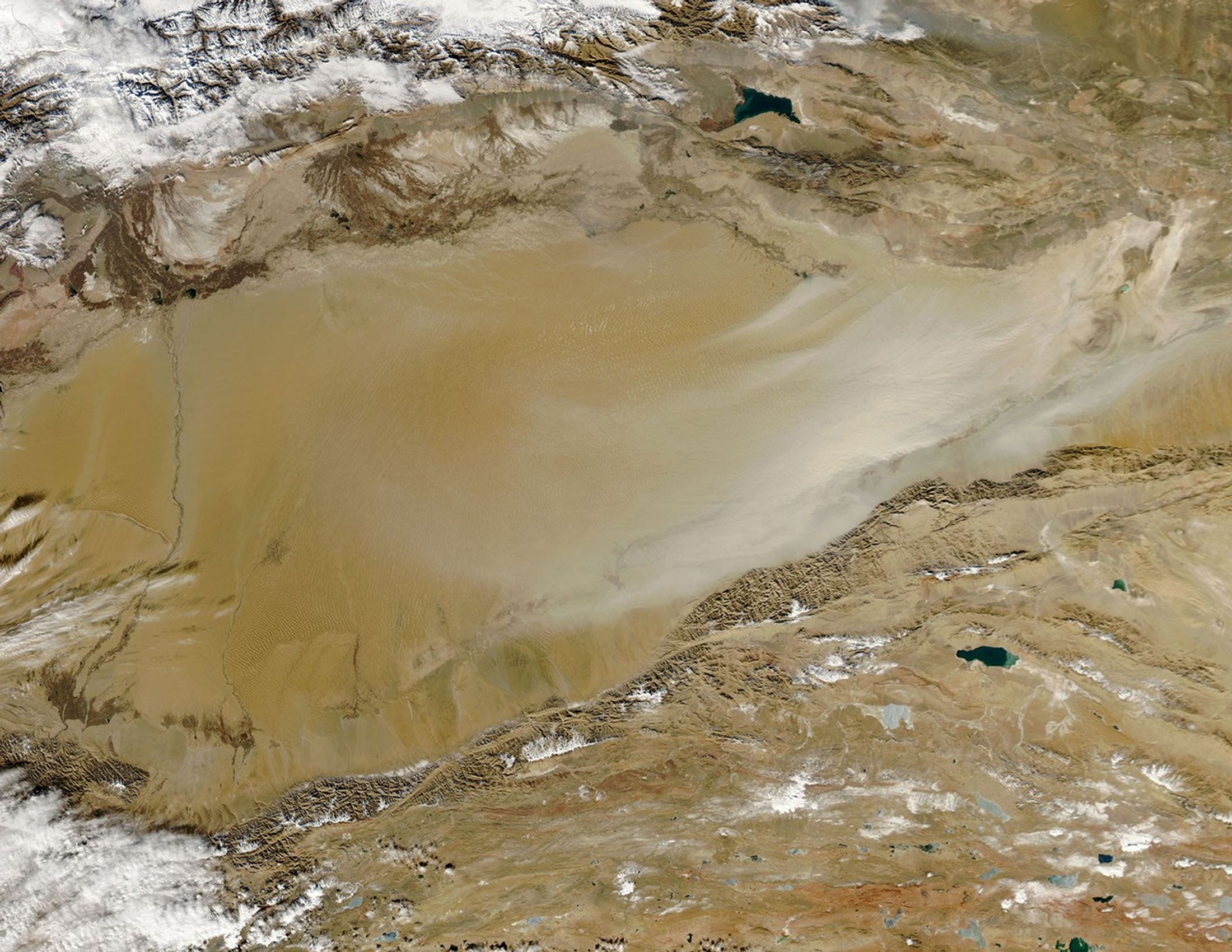












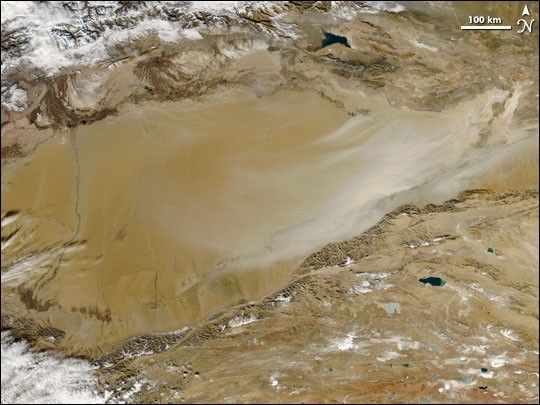
A large dust storm struck China’s Taklimakan Desert in early December 2005. Big, dry, hot, and about as far from the ocean as anyplace on Earth, the Taklimakan Desert provides plenty of material for dust storms. Such storms have been on the rise in the region, posing a health hazard for China’s people.
The Moderate Resolution Imaging Spectroradiometer (MODIS), flying onboard the Aqua satellite, took this picture on December 3, 2005. In this image, the dust storm appears in pale beige, and sweeps toward the northeast. Clouds hover to the northwest and southwest, and mountains fringe the sandy basin where the dust storm originated.
The Taklimakan Desert occupies the Tarim Basin between the Tien Shan Mountains in the north, and Kunlun Mountains in the south. The lowest point of this basin is about 150 meters below sea level, and because the area has no drainage, a great deal of salt has collected in the basin. The mountains to the north block cold air from the Arctic, and the location’s distance from the ocean eliminates monsoon-related precipitation, so the area remains warm and dry. This desert is one of the largest shifting-sand deserts on Earth, and it supports very little vegetation.
Dust storms from this region can spread all over the world, turning up in places as far away as Greenland. Closer to home, the dust poses risks to the Chinese. As reported in the scientific magazine Nature, between AD 300 and 1949, northwestern China witnessed a major dust storm on average every 31 years. Since 1990, the same region has seen a major dust storm almost every year. Besides posing visibility hazards, these storms cause respiratory illness. The storms have become more common at the same time that roughly 75 percent of China’s urban population lives below the country’s air-quality standard. In some areas China is taking aggressive steps to combat people’s exposure to dust, including the investment of several billion dollars in a reforestation effort in the terrain around the outskirts of Beijing.
- Further Reading:
- Taklimakan Desert from the World Wildlife Fund
- Liu, J. and Diamond, J. (2005) China's environment in a globalizing world. Nature, 435(7046), 1179-1186. doi:10.1038/4351179a
References & Resources
NASA image courtesy of Jeff Schmaltz, MODIS Rapid Response Team , NASA-Goddard Space Flight Center.