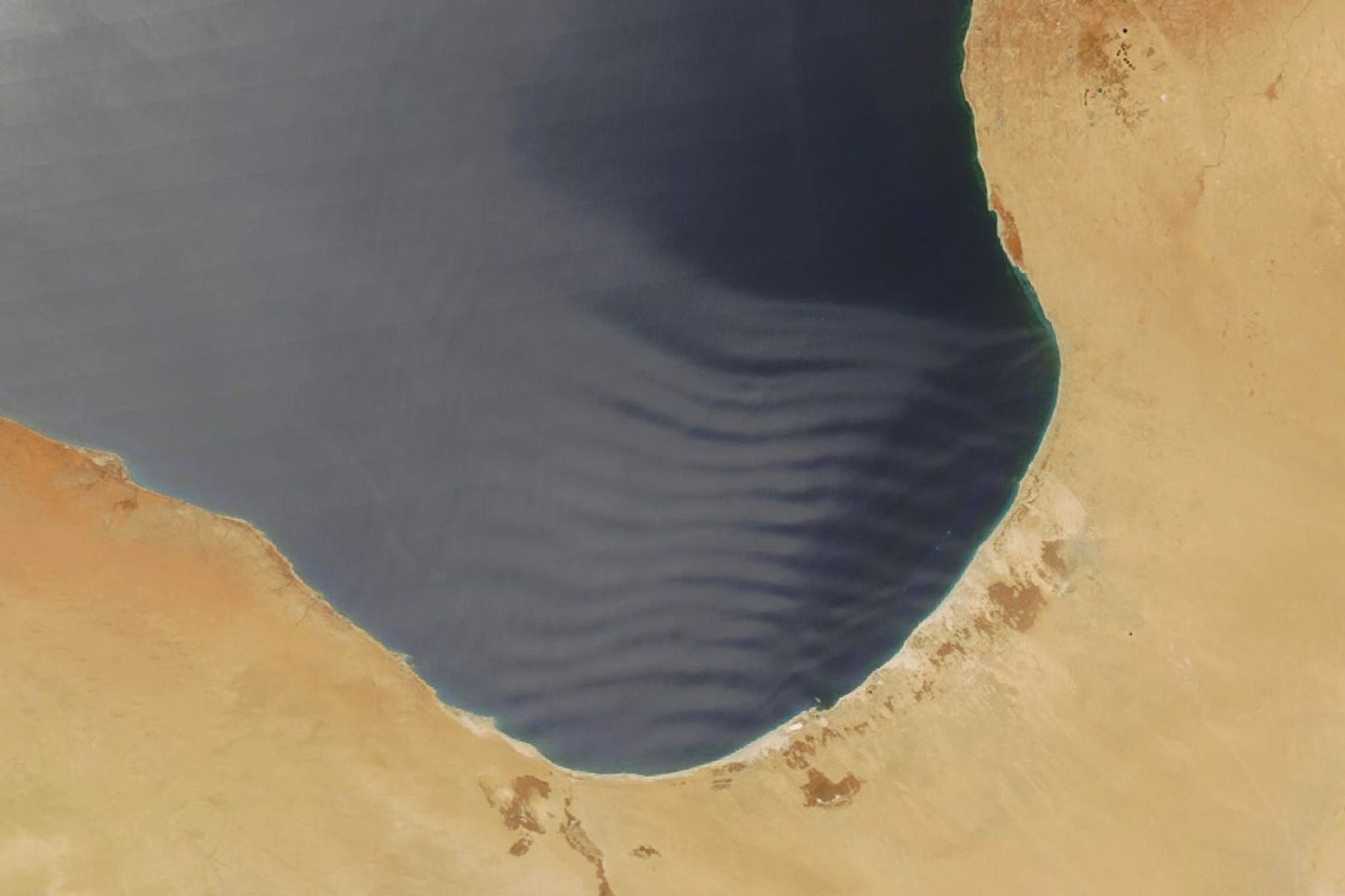















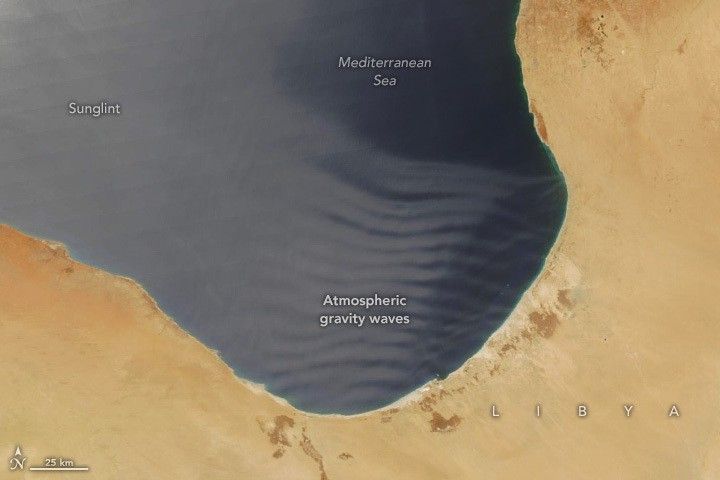
When NASA’s Aqua satellite passed over the Gulf of Sidra on July 9, 2023, it was positioned such that sunlight reflected off the ocean at the same angle that the satellite’s sensor viewed it. The result was an optical phenomenon that gave ocean surfaces a bright gleam known as sunglint.
On the edge of the sunglint region, the sensor also observed long curved bands of alternating light and dark stripes caused by atmospheric gravity waves. Such waves form when stratified air layers are disturbed by topography, or when different air masses interact.
The phenomenon usually shows up in satellite images with the help of clouds and dust. A famous example is the morning glory clouds known to form along atmospheric gravity waves over northern Australia. But the waves can occur anywhere. In this image, waves off the coast of Libya were exposed when they collected dust from the Sahara Desert.
A similar phenomenon can occur in water. Oceanic internal waves are the surface manifestation of waves that propagate along the interface of water layers tens of meters beneath the sea surface.
See other examples of atmospheric gravity waves over the Indian Ocean and near Western Australia and examples of oceanic internal waves in the Andaman Sea and Northern Trinidad.
References & Resources
- Jackson, C. (2007) Internal wave detection using the Moderate Resolution Imaging Spectroradiometer (MODIS). Journal of Geophysical Research, 112, C11012.
- Jackson, C. & Alpers, W. (2010) The role of the critical angle in brightness reversals on sunglint images of the sea surface. Journal of Geophysical Research, 115, C9.
- NASA Earth Observatory (2016, February 17) Waves Above and Below the Water. Accessed July 20, 2023.
- NASA Earth Observatory (2013, August 9) Ocean Revealed. Accessed July 20, 2023.
- NASA Earth Observatory (2018, June 15) Waves of Dust Over the Red Sea. Accessed July 20, 2023.
NASA Earth Observatory images by Wanmei Liang , using MODIS data from NASA EOSDIS LANCE and GIBS/Worldview . Story by Adam Voiland .