


















November 29, 2000-December 31, 2023
Dynamic Dauphin Island
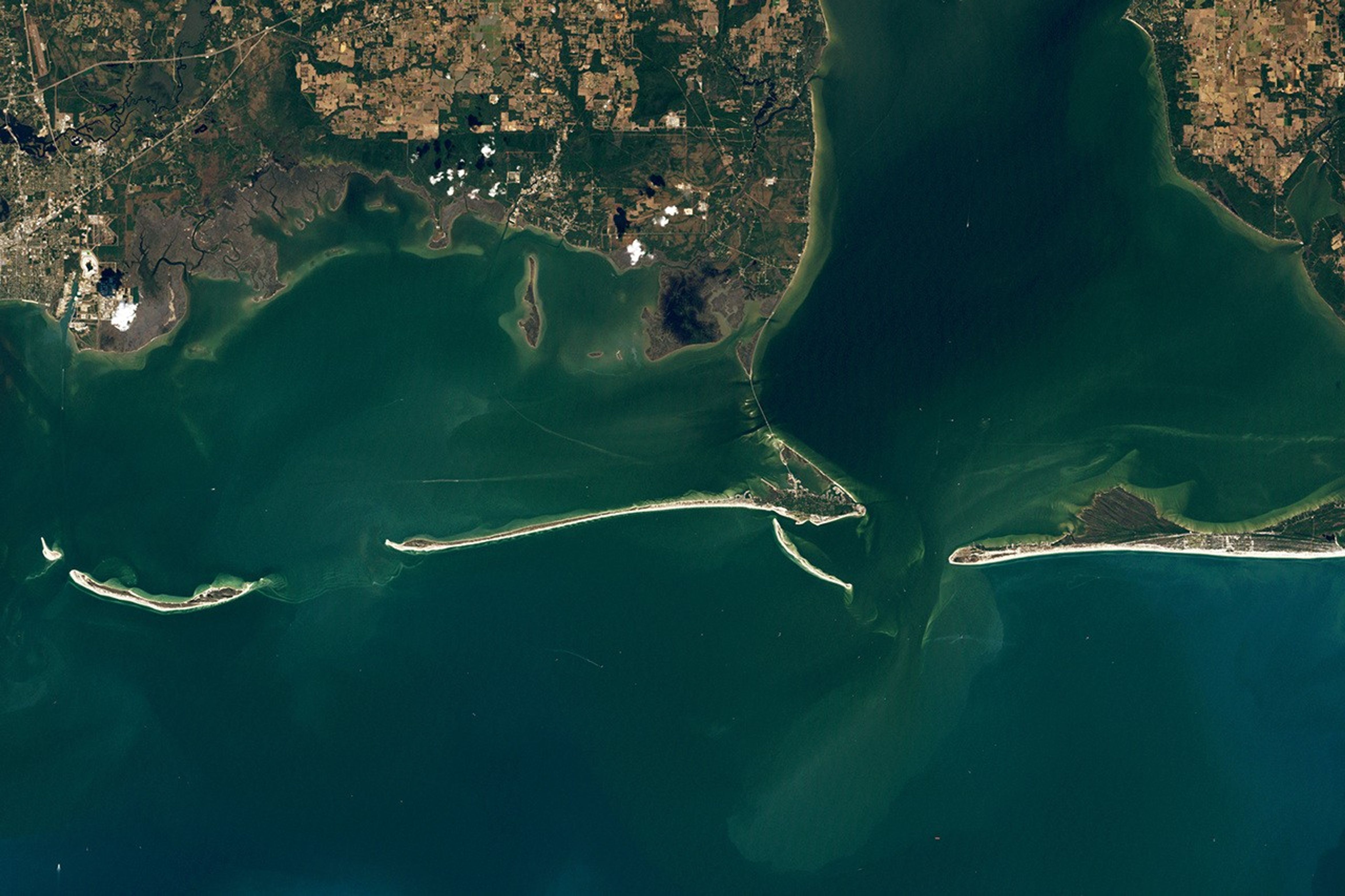
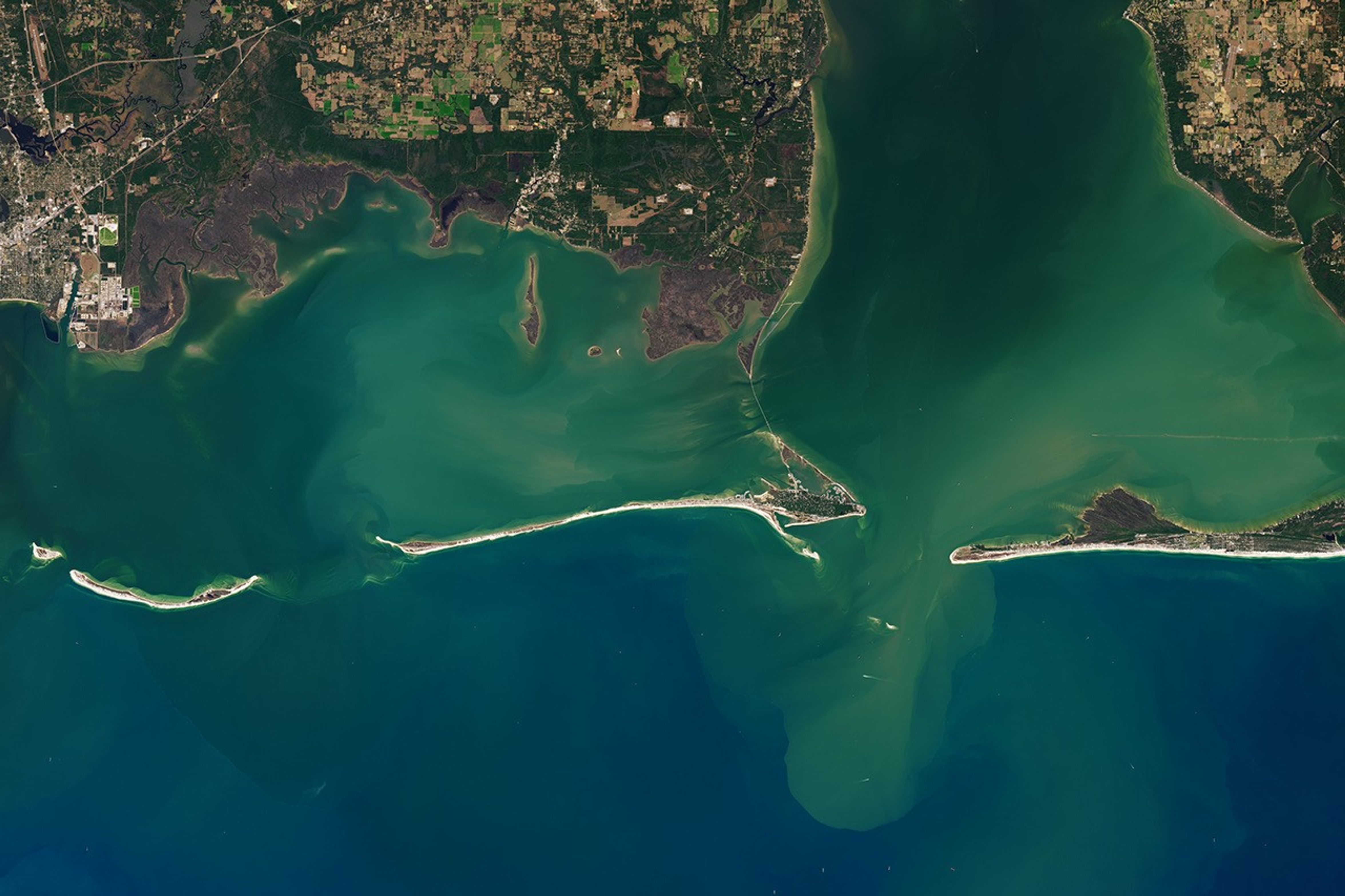
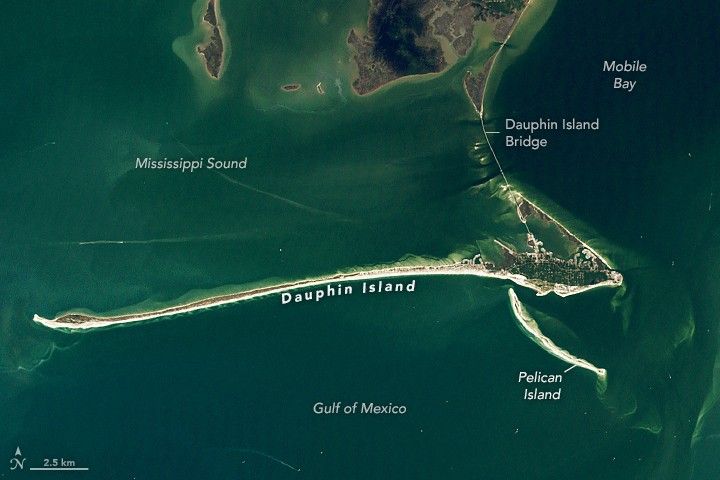
A fringe of barrier islands runs parallel to the coast of Mississippi and Alabama, protecting the mainland from the pounding waves of the Gulf of Mexico. The easternmost of these islands, Dauphin Island, is a 14-mile-long landmass that guards the mouth of Mobile Bay, Alabama. It serves as a stopping place for migratory birds and frequently changes shape.
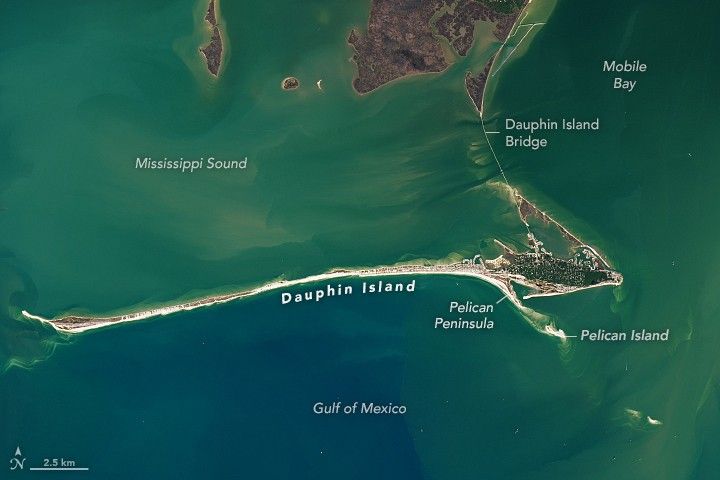
Barrier islands are constantly evolving. Their beaches and spits get shifted, built up, and torn down by the natural ebb and flow of currents and tides. In 2005, powerful storm surge from Hurricane Katrina cut a hole through the western side of Dauphin Island. A 2023 image of the island (above-right), acquired with the OLI-2 (Operational Land Imager-2) on Landsat 9, shows a sandy peninsula extending into the Gulf from the eastern part of the landmass. This peninsula did not exist 20 years ago.
“We could call it the peninsula-formerly-known-as-Pelican-Island, but I think Pelican Peninsula sounds better,” said Scott Douglass, a coastal engineer and emeritus professor at the University of South Alabama. Although Pelican Island has moved around for centuries in the same general location, in 2008, the island moved so far north that it welded onto Dauphin Island.
The joining of these two islands was no surprise to Douglass. In 1994, Douglass documented tidal currents pushing the sand of Pelican Island northwest, onto the western beaches of Dauphin Island, and he projected that the two islands would likely merge in the next decade or two.
Barrier islands in this region have crashed into Dauphin Island before. Douglass studied maps and charts dating back to the early 18th century, which show small barrier islands have collided with Dauphin Island twice in the past: in the early 1700s and again in 1852. Douglass hypothesizes that this kind of collision occurs at roughly 150-year intervals. As sediment builds up on the sandy shoals offshore in the Gulf of Mexico, a new island eventually forms and gets pushed north until it joins the larger Dauphin Island.
“This is geology happening right before our very eyes,” Douglass said after reviewing the satellite images. “And because this phenomenon is so rare, it’s something that your grandparents probably didn’t see, but maybe your great grandparents.”
The joining of these two barrier islands has replenished sand on Dauphin Island’s beaches, which have been receding in recent years from erosion. According to Douglass, who has been helping to inform and assess projects aimed at protecting the island, the merger has essentially been a natural form of beach nourishment.
References & Resources
- Alabama Political Reporter (2019) Opinion: Dauphin Island has one of the world’s newest and best beach walks. Accessed February 15, 2024.
- Douglass, S. L. (1994) Beach erosion and deposition on Dauphin Island, Alabama, USA. Journal of Coastal Research, 306-328.
- NASA Earth Observatory World of Change: Coastline Change. Accessed February 15, 2024.
- NASA Earth Observatory (2005, September 10) Hurricane Katrina Erodes the U.S. Gulf Coast. Accessed February 15, 2024.
- NOAA (2021) Researchers Evaluate Long-term Effect of Adding Sand to Dauphin Island Beaches. Accessed February 15, 2024.
- South Coast Engineers (2022) “Coastal Processes and Geomorphology of the East End of Dauphin Island.” Report to the Town of Dauphin Island, 182 pp., January 20, 2022.
- Town of Dauphin Island Audubon Bird Sanctuary. Accessed February 15, 2024.
NASA Earth Observatory images by Lauren Dauphin, using Landsat data from the U.S. Geological Survey . Story by Emily Cassidy .