












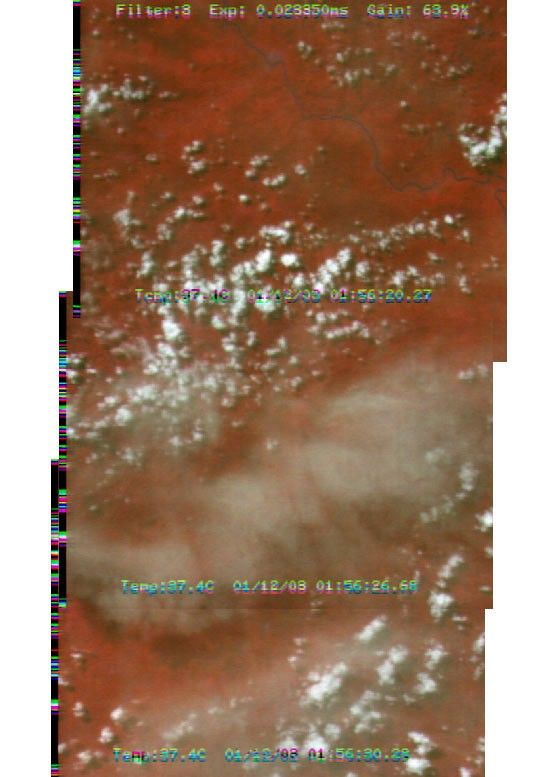
Between two banks of clouds, a pall of gray smoke hangs above the Amazonrainforest in this image that illustrates how complex interactions betweensmoke and the atmosphere can influence weather and climate. Few clouds arepresent in the smoke between the cloud banks. Dark soot particles in thesmoke absorb sunlight, which heats up the surrounding air. Water vapor ismore likely to condense into liquid water droplets—clouds—in cooler air,so clouds are less likely to form in areas with smoke-warmed air. As aresult, fires in the Amazon reduce cloud cover.
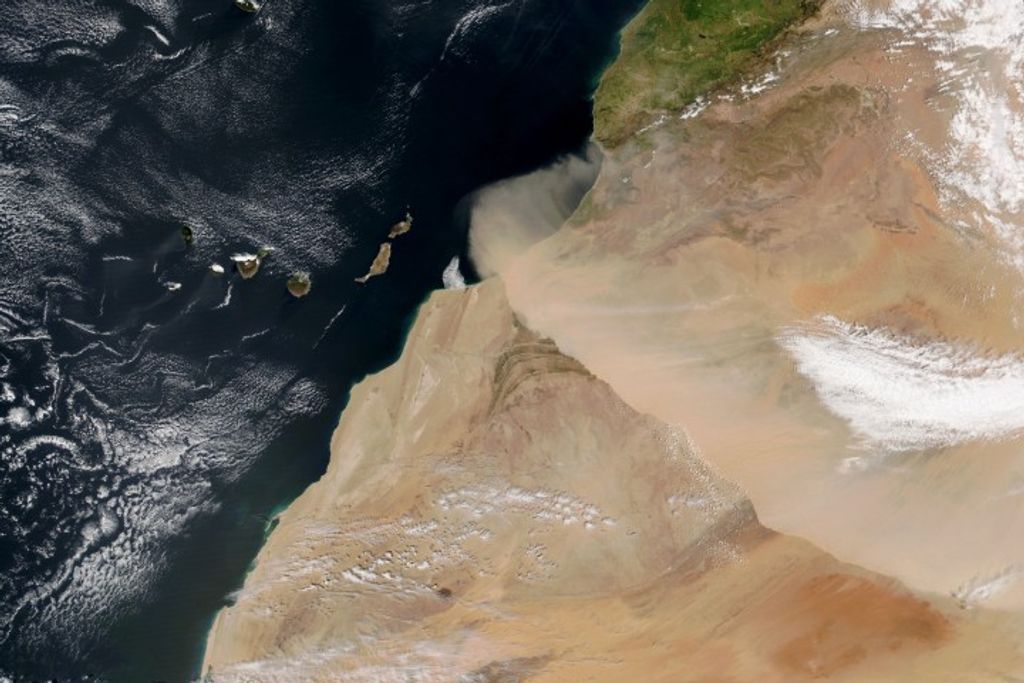
The Mediterranean Israeli Dust Experiment (MEIDEX), an instrument thatflew aboard Space Shuttle Columbia’s final flight from January 16 toFebruary 1, 2003, acquired this image and measured smoke and other typesof aerosols from the Shuttle’spayload bay. MEIDEX also observed a duststorm that originated in the Sahara Desert and carried dust over theMediterranean Sea. This is a false-color image in which clouds appearwhite, smoke appears gray, and the Amazon Rainforest appears red.
Several instruments aboard Space Shuttle Columbia, including MEIDEX, weredesigned to study the Earth from above. Instruments aboard manned spacecraftlike the Space Shuttle and International Space Station form an importantcomplement to orbiting satellites and ground-based measurements. Once asatellite is launched into orbit, scientists are limited in their ability tomeasure exactly how the instrument is changing or degrading over time.Instruments flying aboard the shuttle can be calibrated before and afterlaunch, so their measurements can be more accurate than those fromsatellites. Using the shuttle instruments to collect observations similar tothose made by long-term satellite missions permits scientists to monitor anaging satellite’s accuracy over time. Shuttle-carried instruments arerelatively inexpensive because they utilize the Shuttle’s power, data, andcommunications equipment. Astronauts are also able to aim the sensorsaboard, enabling them to capture unique and unpredictable events.
References & Resources
Image courtesy MEIDEX science team, Tel-Aviv University and NASA Goddard Space Flight Center
None