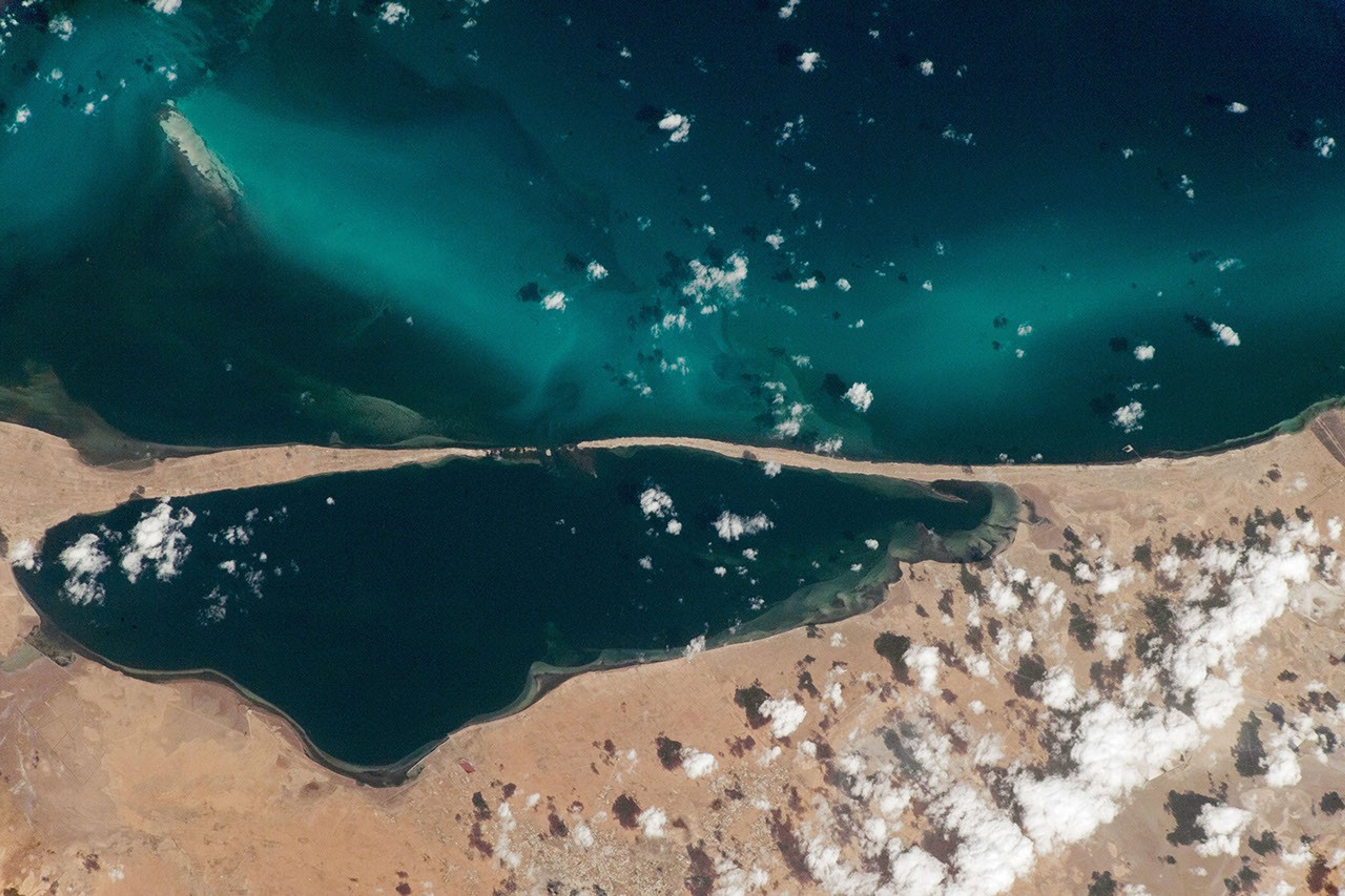















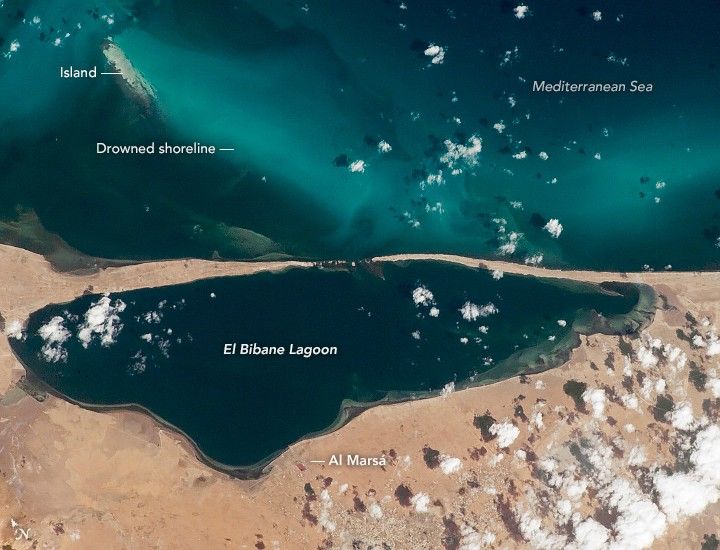
An astronaut aboard the International Space Station (ISS) took this photograph of a 30-kilometer (20-mile) long lagoon on the eastern shore of Tunisia. A narrow sand bar separates it from the Mediterranean Sea. The small town of Al Marsá appears as a slightly darker zone at the head of the lagoon.
The lagoon is ecologically important. Fish grow to maturity in this protected nursery and then swim out to sea via narrow openings near the middle of the sand bar, making Bibane one of the best known fishing grounds in Tunisia. It is also an important breeding site for migratory shore birds and has been consequently declared a RAMSAR site, a designation for protected wetlands of international ecological significance.
Bathymetric maps show that the long line of lighter-toned shallow water offshore is a drowned shoreline. A small island, barely above sea level, marks the end of this shoreline. This shore was exposed to active wave action when sea level was lower on several occasions in the past million years.
This area has featured in studies of microtopography on Mars. Although not visible from the space station, thin layers of algae form on the salt flats surrounding these coastal lagoons. Known as algal mats, these features have been suggested as possible analogs for small features observed on Mars by the Curiosity rover.
References & Resources
Astronaut photograph ISS064-E-424 was acquired on October 25, 2020, with a Nikon D5 digital camera using a 460 millimeter lens and is provided by the ISS Crew Earth Observations Facility and the Earth Science and Remote Sensing Unit, Johnson Space Center. The image was taken by a member of the Expedition 64 crew. The image has been cropped and enhanced to improve contrast, and lens artifacts have been removed. The International Space Station Program supports the laboratory as part of the ISS National Lab to help astronauts take pictures of Earth that will be of the greatest value to scientists and the public, and to make those images freely available on the Internet. Additional images taken by astronauts and cosmonauts can be viewed at the NASA/JSC Gateway to Astronaut Photography of Earth. Caption by Justin Wilkinson, Texas State University, JETS Contract at at NASA-JSC.