


















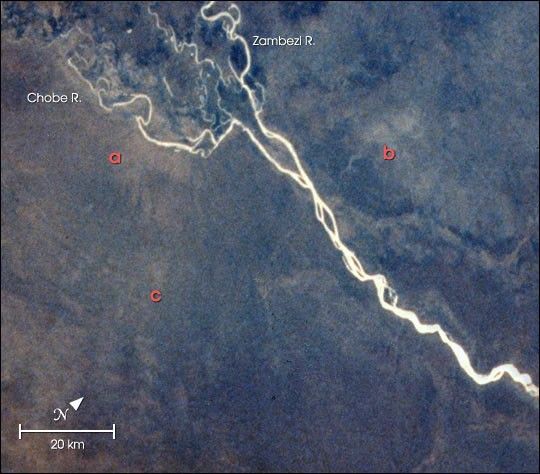
At the junction of the Chobe and Zambezi Rivers, Botswana, increasing elephant populations are having large impacts on local vegetation. Scientists working in the region used spectral analysis of an astronaut photograph digitized from film to identify areas where woodland vegetation had been heavily damaged by the elephants. The technique used the analysis of texture of the red band (or channel) in the image. In the image above, the natural color photo has been combined with a texture analysis of the red band. The lighter colored areas near the labels a, b and c represent the areas with the heaviest elephant damage. Field teams working on the ground verified the presence of damage.
This image is one of the examples of the applications of astronaut photography to conservation biology presented in a paper by Robinson et al. in the August 2001 issue of the scientific journal Conservation Biology. The paper is part of a special section on “Contributions of Remote Sensing to Biodiversity Conservation” featuring a number of different NASA-sponsored studies.
References & Resources
- Robinson, J. A., K. P. Lulla, M. Kashiwagi, M. Suzuki, M. D. Nellis, C. E. Bussing, W. J. Lee Long, and L. J. McKenzie. 2001. Conservation applications of astronaut photographs of Earth: tidal flat loss (Japan), elephant impacts on vegetation (Botswana), and seagrass and mangrove monitoring (Australia). Conservation Biology 15:876-884.
Astronaut photograph STS008-33-993 was taken from the Space Shuttle in September 1983 and was provided by the Earth Sciences and Image Analysis Laboratory at Johnson Space Center. Results and field photograph courtesy of J. A. Robinson and K. P. Lulla (Johnson Space Center), M. D. Nellis (West Virginia University), and C. E. Bussing (Kansas State University). Another astronaut photograph example used in the Robinson et al. paper showed tidal flats in the Ariake Sea, Japan, and was previously posted to Earth Observatory. Additional images taken by astronauts and cosmonauts can be viewed at the NASA-JSC Gateway to Astronaut Photography of Earth.
None