












As reported by the Saipan Tribune Website, the Anatan Volcano spewed volcanic ash to an altitude of nearly 13,000 meters (42,000 feet) in early August, prompting officials to issue a volcanic ash advisory for Saipan and Tinian in the Northern Mariana Islands. The volcano has emitted something besides ash: sulfur dioxide.
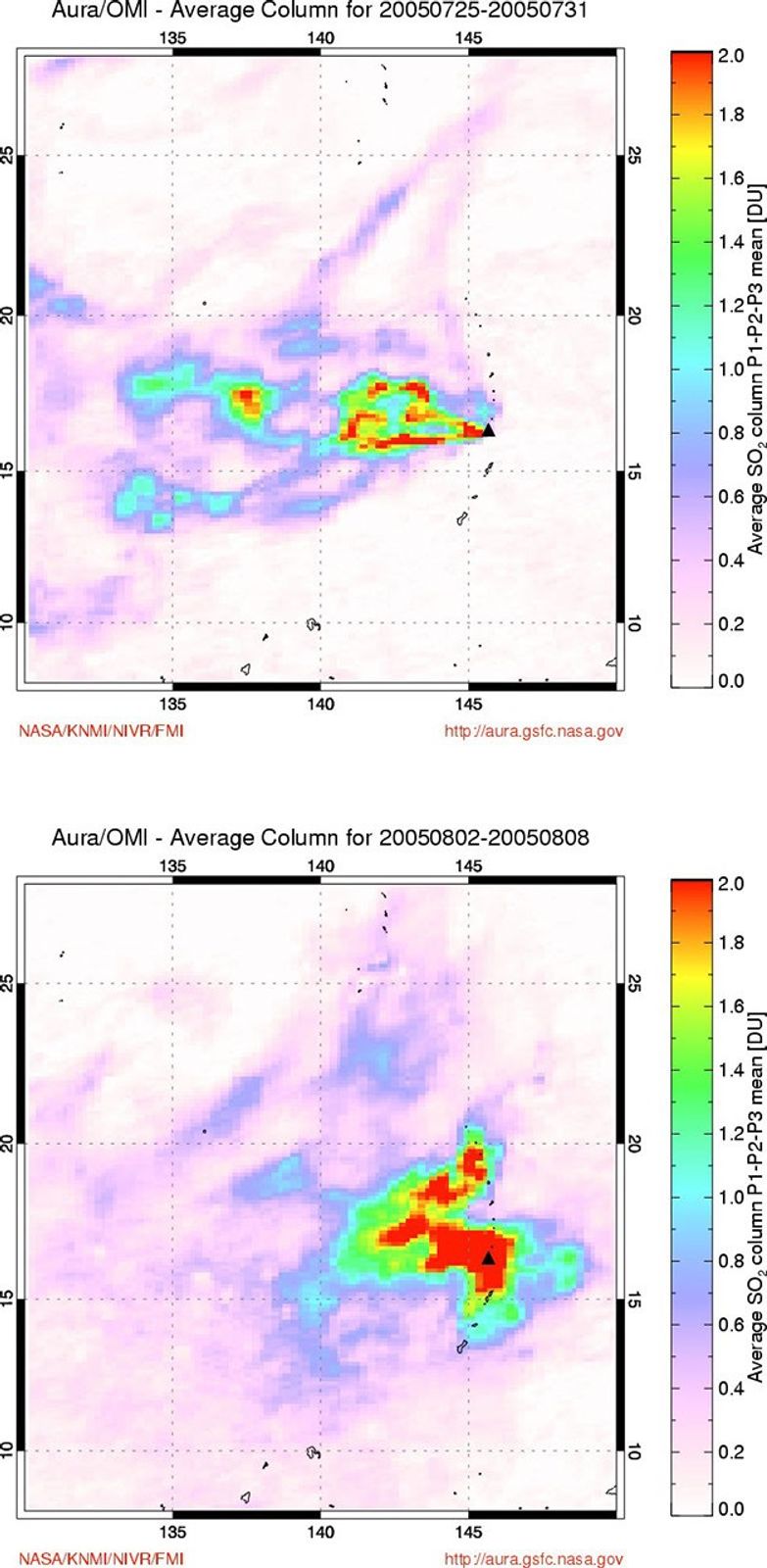
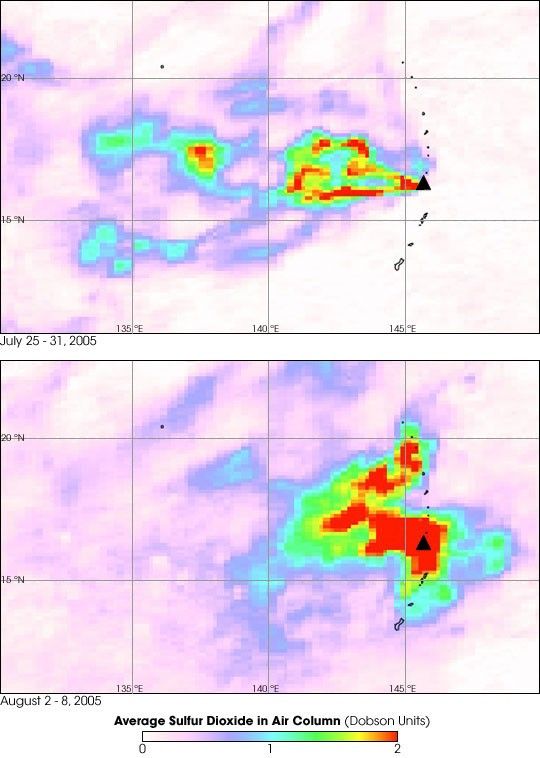
Sulfur dioxide is colorless, so its presence must be monitored with sensors specially designed to find it. The Ozone Monitoring Instrument (OMI) on NASA’s Aura satellite collects data on atmospheric chemistry. OMI monitors sulfur dioxide emissions from Anatahan, and collected data shown in these images between July 25 and 31 (top), and August 2 and 8 (bottom). Highest concentrations appear in red, and lowest concentrations appear in pale pink. In each image, the arrow indicates the volcano’s summit. OMI measures sulfur dioxide in terms of molecules per square centimeter of atmosphere, known as Dobson Units. A single Dobson Unit equals 0.0285 grams of sulfur dioxide per square meter of vertical column of atmosphere.
The images show different dispersion patters for sulfur dioxide in late July and early August. Between July 25 and 31, predominantly easterly winds carried the noxious emissions away from the populated islands. Between August 2 and 8, however, changing winds allowed sulfur dioxide to accumulate over the Southern Mariana Islands and Guam.
Although invisible to human eyes, sulfur dioxide can still make its presence known—by irritating them. Sulfur dioxide can inflame mucous membranes of the eyes, nose, and throat, and even skin. The upper respiratory tract is the most susceptible to sulfur dioxide irritation. Sulfur dioxide also leads to acid rain and volcanic smog (vog) that interferes with air transport.
The OMI instrument is a Dutch-Finnish Instrument, provided to the EOS/Aura mission by The Netherlands and Finland. NIVR (the Dutch space agency) is the overall program manager, in coordination with FMI (the Finnish Meteorological Institute). The Royal Netherlands Meteorological Institute (KNMI) is the Principal Investigator institute.
- Recommended Further Reading:
- Volcanic Gases and Their Effects from the U.S. Geological Survey
References & Resources
NASA image courtesy Simon Carn, Joint Center for Earth Systems Technology (JCET), University of Maryland Baltimore County (UMBC)