


















In August and September, accumulated smoke and smog from seasonal agricultural burning and charcoal production in southern Africa gets “recycled”across many southern Africa countries, including Angola, Democratic Republic of Congo, Zimbabwe, and Zambia. At that time of year, a semi-permanent area of high atmospheric pressure takes up residence over that part of the continent, and the air re-circulates in a counterclockwise spin around the high.
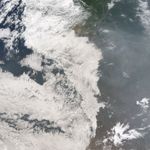
Air does escape from this spin-cycle at times and spreads out over the Indian Ocean to the east, or the Atlantic Ocean to the west, as it does in this Moderate Resolution Imaging Spectroradiometer (MODIS) image captured by NASA's Terra satellite on August 28, 2004. At right are of parts of (top to bottom) Gabon, Congo, Democratic Republic of Congo, and Angola. Haze spreads out over the Atlantic, giving the clouds a dirty appearance. Contrast their color with the brightness of the cloud over Angola, at the bottom of the image to the right of center. MODIS also detected numerous fires, which have been marked in red.
NASA scientists studied this atmospheric phenomenon in 2000 in a field campaign called SAFARI. To learn more, read “Red Alert! ‘Recycled Ozone’ Adds to Health Hazards in Zambia” in the Earth Observatory’s NASA News Archive.
References & Resources
NASA image by Jesse Allen, based on data from the MODIS Rapid Response Team, NASA-GSFC