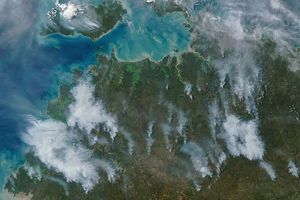













North of the equator in Africa, the annual fire season occurs throughout winter and spring. People set fires to manage farming and grazing lands across the tropical savannas and the semi-arid Sahel, a zone of transitional vegetation between the rainier savannas and the Sahara Desert. This image from the Moderate Resolution Imaging Spectroradiometer (MODIS) on NASA’s Aqua satellite shows the location of hundreds, probably thousands, of fires detected by the sensor on November 29, 2005, marked in red.
People have been using fire as a land management tool in Africa for thousands of years, and fires also occur naturally, triggered by lightning. Many native plants have reproductive cycles that are linked to fire occurrence. However, fires that are too frequent or too widespread can degrade the land, and they also contribute to poor air quality sometimes for weeks during the burning season. To read more about the impact of the burning season on Africa’s air quality, see the feature article Savanna Smog. The MODIS Rapid Response System provides daily images of Africa.
References & Resources
NASA image courtesy the MODIS Rapid Response Team, Goddard Space Flight Center