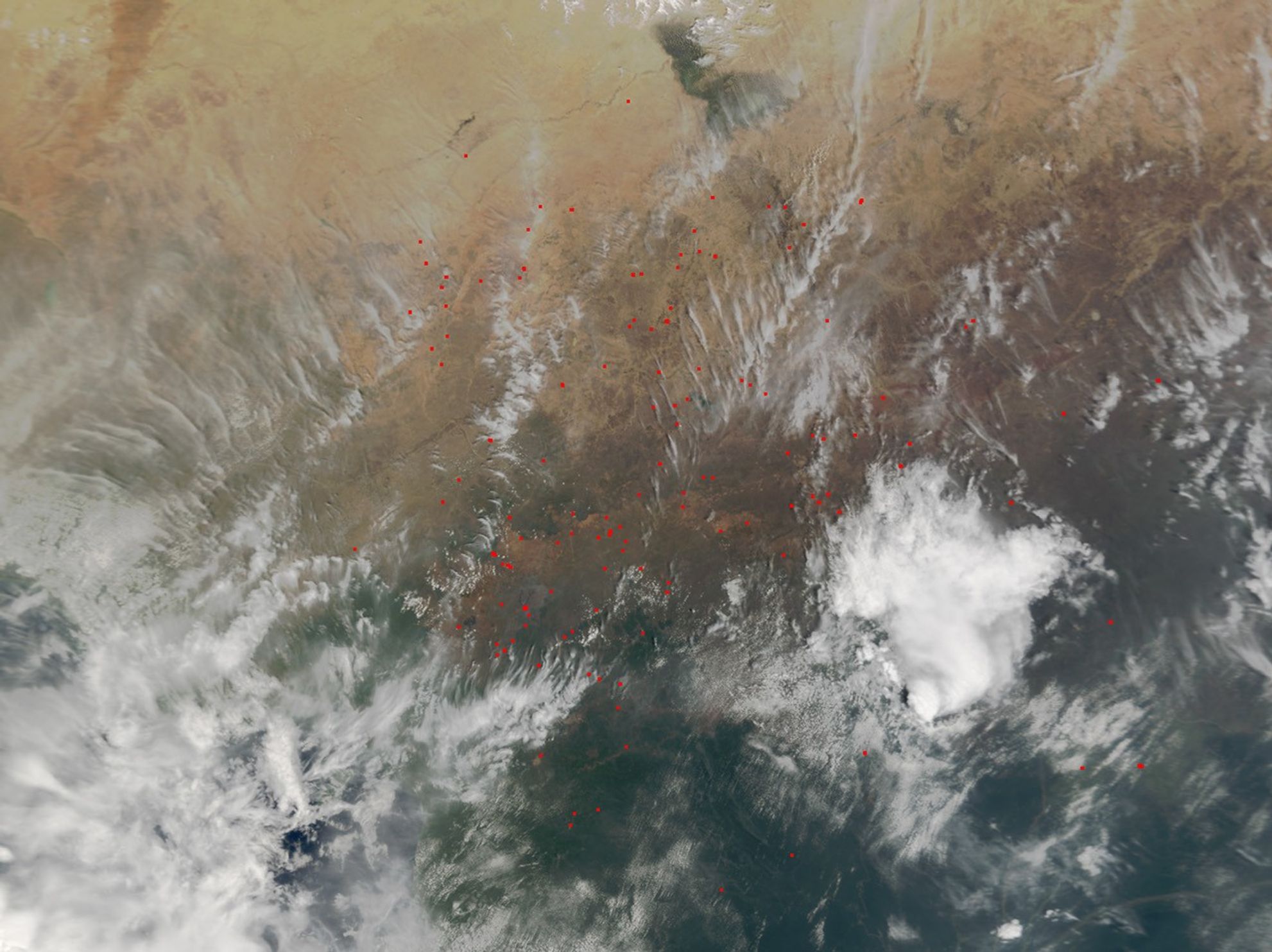






















Each year in March and April thousands of fires smolder in thegrasslands, scrub, and dry forests of the West African Sahel andSoudanian woodlands. NASA’s Moderate-resolution ImagingSpectroradiometer (MODIS), flying aboard the Terra spacecraft,captured this true-color image on March 2, 2001. Data from MODIS'infrared detectors were used to locate areas where fires areburning, shown by red dots. The arid grasslands of the Sahel areto the north (top) of the image. The fan-shaped green area isLake Chad. To the center and south of the region, in northernNigeria, northern Cameroon and southern Chad, increasing annualrainfall results in the gradually increasing tree cover anddarker appearance of the Soudanian woodlands.
The Sahel of West Africa is of great importance to regionaleconomies and human welfare. While water is always scarce in theSahel, even during the brief rainy season between June andSeptember, the grasslands provide high-quality grazing fordomestic livestock (cattle, sheep and goats). Thus the humanpopulations to the south rely on the Sahelian grasslands assummer grazing for their herds in a landuse system known astranshumance. In this system, large numbers of animals travelnorth into the Sahel every year. The grasslands and woodlands ofthe Soudanian zone are less nutritious for domestic animals, butthe higher rainfall allows more agriculture. Fire is used toclear new agricultural land and to improve grazing potential ofthe natural vegetation by removing dead grass and promoting newgrowth. Many fires in the Soudanian zone are also ignited bylightning strikes. During the long Sahelian dry season watersupplies limit cattle numbers and many herds travel south againto winter on crop residues in the south. In so-doing they providemuch-needed fertilizer to the fields.
Fire has been used for centuries as a management tool in WestAfrican agricultural and pastoral systems. However, increasinghuman populations and food production requirements can reduce thelength of fallow periods and increase the frequency of fireusage. In this situation, the benefits of fire as a managementtool can be outweighed by the negative impacts of fire on soilfertility, leading to long-term declines in productivity.
References & Resources
Image courtesy Jacques Descloitres, MODIS Land Rapid Response Team.