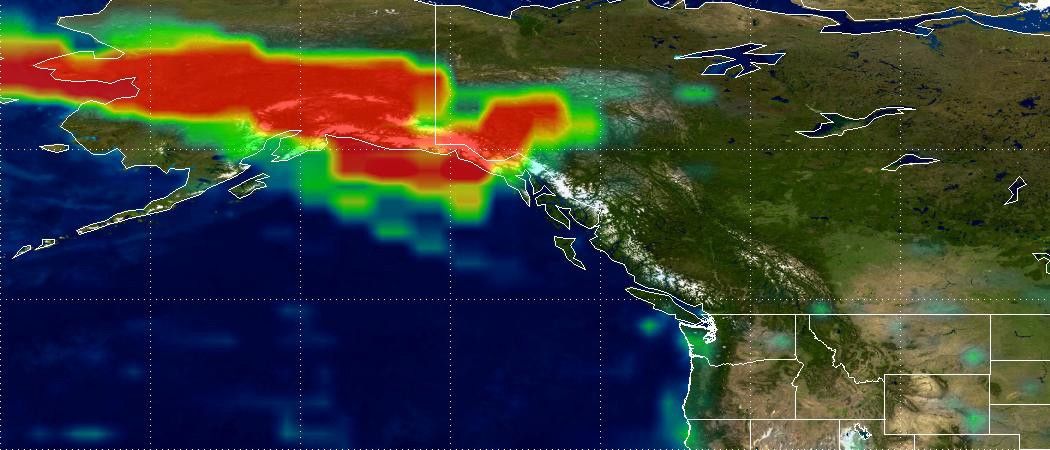
The smoke from dozens of forest fires raging across eastern Alaska and western Canada continued to spread on June 30, 2004. The areas of highest aerosol optical thicknessâindicating the greatest amounts of particles and the least amount of light able to penetrate the atmosphereâare spread over a wide area of southern Alaska, and are colored red in this image from the Total Ozone Mapping Spectrometer (TOMS). Decreasing smoke thickness appears in orange, yellow, and green. The thick haze stretches across the Bering Strait (upper left) and over to Siberia; it also stretches southward well out over the Gulf of Alaska. The smoke is causing visibility problems not just for travelers in the region, but also for firefighters trying to combat the fires and monitor their spread from the ground and from the air.
References & Resources
NASA images courtesy Dr. Jay Herman and David Larko, TOMS Science Team at Goddard Space Flight Center