













With millions of hectares of corn, rice, and beans sown in Heilongjiang each year, the province in northeastern China is one of the country’s most important food-producing areas. For many Heilongjiang farmers, one of the first steps in raising this year’s crop involves burning off the remaining bits of last year’s plants to remove debris from the fields and get them ready for planting in May.
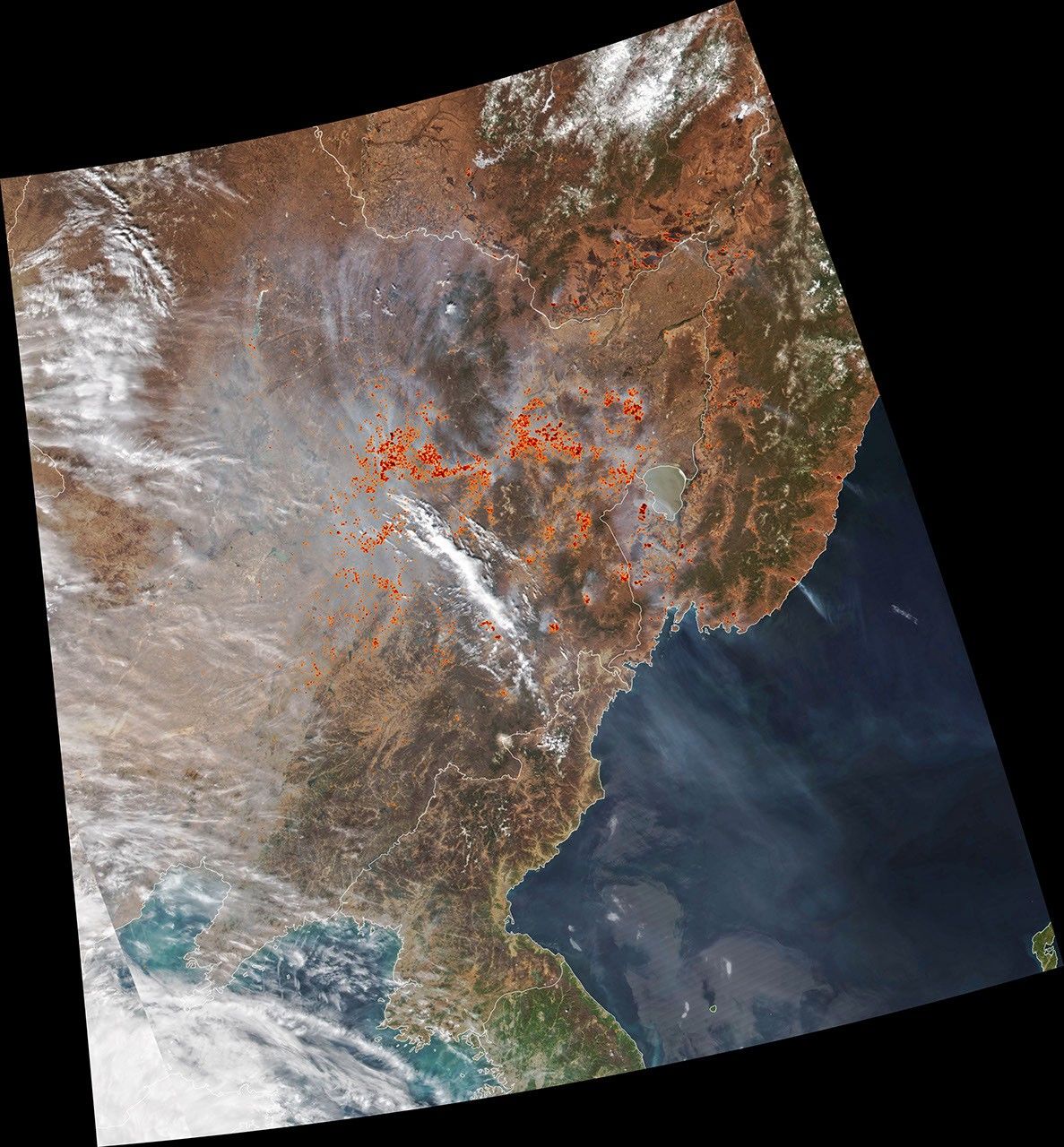
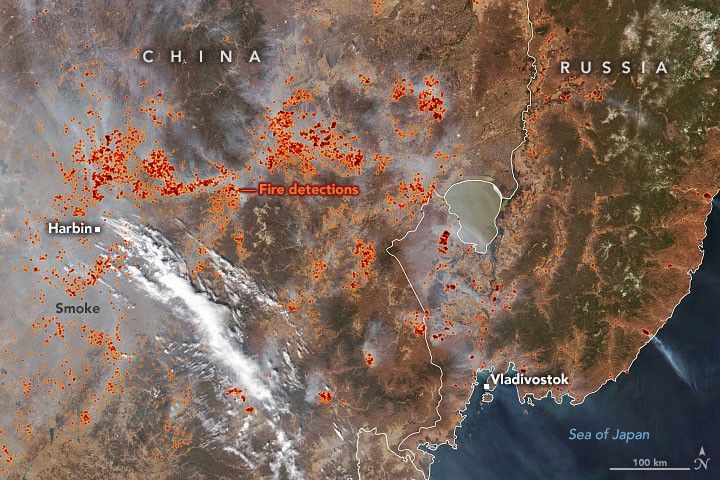
This practice sometimes leads to hazy, smoke-filled skies, as shown by this natural-color satellite image from the Visible Infrared Imaging Radiometer Suite (VIIRS) on the NOAA-NASA Suomi NPP satellite. Throughout the spring, VIIRS has detected large numbers of “hotspots” associated with fires. These hotspots appear red and orange in the image above.
VIIRS began detecting sporadic fire activity in the region in mid-March 2021, as soon as warmer weather melted the snow cover. The number of fire detections then ballooned in mid-April, particularly around Harbin, as the spring burning season reached its peak.
Most straw burning in this area used to happen in the fall, but satellite observations collected over several years show that there has been a strong shift toward spring fires since 2015. That was the year that local authorities enacted fall burning restrictions—part of an effort to limit air pollution—and started encouraging farmers to find other uses for leftover straw. Most crop fires in Heilongjiang now happen in March and April, a change that has coincided with a reduction in overall greenhouse gas and particulate pollution emissions from the area’s fires, according to one recent study.
Fire activity has not been limited to China. Across the border in Russia, fires—many likely lit by farmers for similar reasons—have also been common along the Amur River. In some areas, including near Vladivostok, Russian authorities and news media reported significant numbers of grass and forests. While some of these likely began as crop fires that spread into forests, Russian authorities pointed to a mix of human activities‐ranging from cooking outdoors to stray cigarettes—for triggering wildfires.
References & Resources
- Chen, Z. et al. (2017) Examining the Influence of Crop Residue Burning on Local PM2.5 Concentrations in Heilongjiang Province Using Ground Observation and Remote Sensing Data. Remote Sensing, 9(10), 971.
- Hayasaka, H. et al. (2020) Classification of Active Fires and Weather Conditions in the Lower Amur River Basin. Remote Sensing, 12 (19), 3204.
- Russian Emergency Situations Ministry (2021) The Ministry of Emergency Situations of Russia intensifies the work on prevention the counter fire of dry vegetation . Accessed April 23, 2021.
- Russian Emergency Situations Ministry (2021) Primorsky Territory. Accessed April 23, 2021.
- Wang, Z. et al. (2019) Influence of Straw Burning on Urban Air Pollutant Concentrations in Northeast China. Int. J. Environ. Res. Public Health, 16 (8), 1379.
- YC News (2021, April 21) Forest fires in Russiaâs Far East and Siberia are ravaging the city of Vladivostok. Accessed April 23, 2021.
- Zhuang, Y. et al. (2018) Interannual and Seasonal Variability of Greenhouse Gases and Aerosol Emissions from Biomass Burning in Northeastern China Constrained by Satellite Observations. Int. J. Remote Sensing, 10 (3), 390.
NASA Earth Observatory image by Joshua Stevens , using VIIRS data from NASA EOSDIS LANCE , GIBS/Worldview , and the Joint Polar Satellite System (JPSS). Story by Adam Voiland .