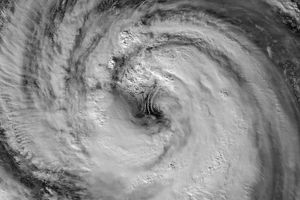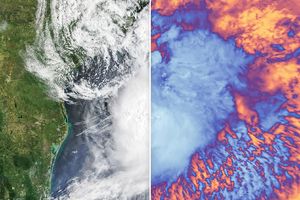





















Melor became a tropical depression a few hundred miles east of the centralPhilippines on October 30, 2003. Moving towards the northwest,Melor strengthened into a minimal typhoon on October 31, just east of theNorthern Philippine island of Luzon. Melor crossed over the northern partof Luzon with winds estimated at up to 85 miles per hour. At least four people losttheir lives as a result of flooding due to the storm.
The TRMM-based, near-real time Multi-satellite Precipitation Analysis (MPA) at the NASA Goddard Space Flight Center shows the rainfall totals associated with Melor’s passage. A wide area of 6 inch plus rainfall (red areas) occurredover the northeastern part of the island along the coastline and east ofthe Cordillera Central mountains. After crossing the northern coastline,Melor headed north and weakened into a tropical storm before brushing thesoutheast coastline of Taiwan. White crosses show the track of Melor withtropical storm and typhoon symbols denoting the 00Z positions. Rainfall accumulationsare for the period October 30 to November 4, 2003.
TRMM is a joint mission between NASA and the Japanese space agency NASDA.
References & Resources
Image generaged by Hal Pierce (SSAI/NASA GSFC) and caption by Steve Lang (SSAI/NASA GSFC)