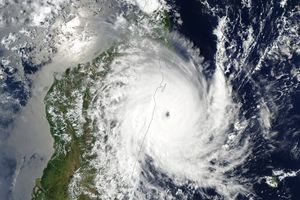
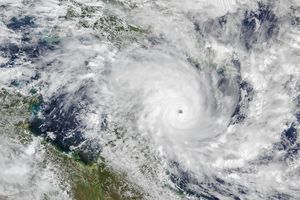
For more than a month, Tropical Cyclone Freddy has cast about in the Indian Ocean, bringing powerful winds and downpours to anything in its long and wandering path.
The storm first developed off the North Australian coast on February 6, 2023, and then tracked across the entire Indian Ocean before striking the east coast of Madagascar on February 21, 2023. It then crossed the Mozambique Channel and made landfall in Mozambique’s Inhambane province near Vilankulo, where it stalled and dropped a huge amount of rain before doubling back and nearly hit the west coast of Madagascar again. As of March 8, 2023, the weakening storm was following a northwesterly track toward a likely second landfall in Mozambique—this time in the Zambezia province.
The Visible Infrared Imaging Radiometer Suite (VIIRS) on the NOAA-20 satellite acquired this image of the storm at 1:10 p.m. local time (11:10 Universal Time) on March 8, 2023. An infusion of dry air and the storm’s position over relatively cool waters meant Freddy was weakening and the eye had broken down when the image was acquired. However, forecasters at the Joint Typhoon Warning Center warned that Freddy will likely still hit Mozambique with sustained winds of 139 kilometers (86 miles) per hour, making it the equivalent of a category 1 hurricane.
Over the course of Freddy’s 32-day journey, the World Meteorological Organization says the storm likely became the longest-lasting tropical cyclone on record. The previous record holder, Hurricane John, persisted for 31 days in the Central Pacific in 1994.
Meteorologists tracking Freddy’s accumulated cyclone energy (ACE)—a metric that incorporates both intensity and duration—say the storm had an ACE of 72 as of March 7, 2023. That put it in second place for the most accumulated cyclone energy generated by a single storm since 1980, according to Colorado State University atmospheric scientist Philip Klotzbach. Ioke, a 2006 hurricane in the central Pacific, holds the record with an ACE of 85.
References & Resources
- NASA Global Precipitation Measurement (2023, March 3) Tropical Cyclone Freddy Brings Heavy Rain and Flooding to Madagascar and Mozambique. Accessed March 8, 2023.
- Joint Typhoon Warning Center (2023, March 8) Tropical Cyclone 11S (Freddy) Warning #53 Issued at 08/1500Z. Accessed March 8, 2023.
- NASA Earth Observatory (2023, February 21) Cyclone Freddy Hits Madagascar. Accessed March 8, 2023.
- NASA Earthdata (2023) Tropical Cyclones Data Pathfinder. Accessed March 8, 2023.
- United Nations (2023, March 7) Tropical Cyclone Freddy on track to become record-breaking storm. Accessed March 8, 2023.
- The Washington Post (2023, March 8) Deadly cyclone Freddy has become Earth’s longest-lived tropical storm. Accessed March 8, 2023.
- World Meteorological Organization (2023, March 7) Tropical Cyclone Freddy may set new record. Accessed March 8, 2023.
NASA Earth Observatory image by Lauren Dauphin, using VIIRS data from NASA EOSDIS LANCE , GIBS/Worldview , and the Joint Polar Satellite System (JPSS). Story by Adam Voiland .