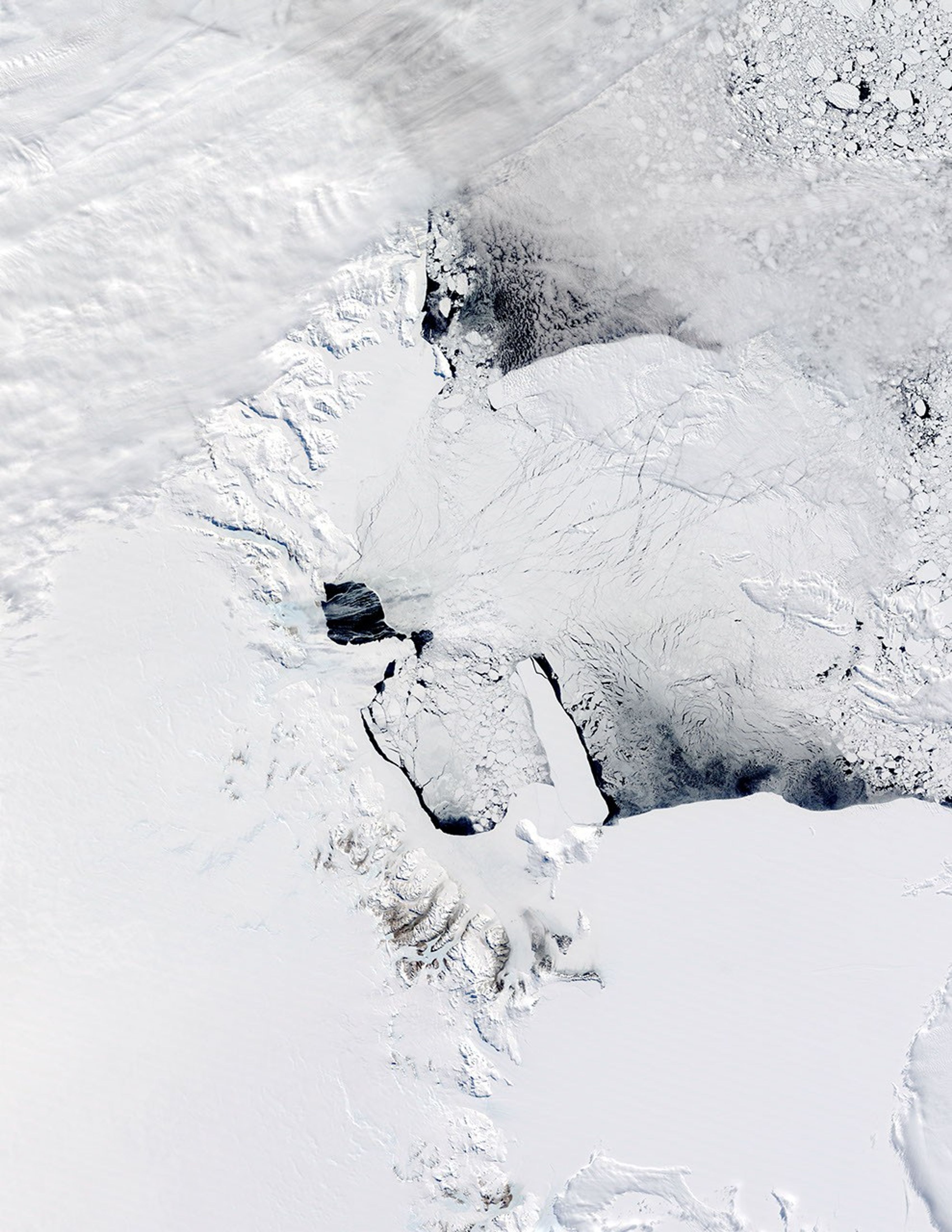














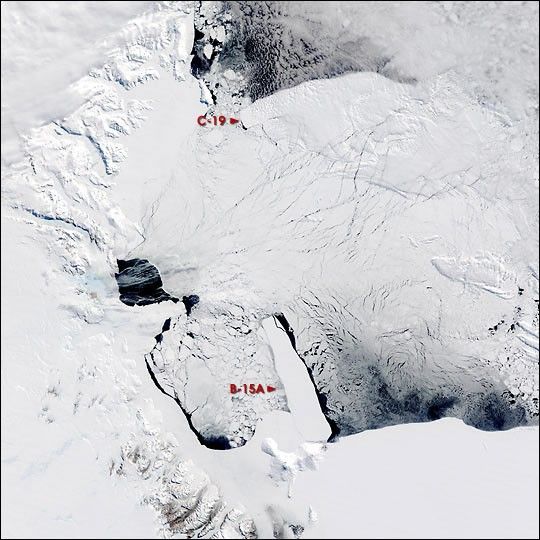
Over the past two and a half years, several unusually large icebergshave calved off of the Ross Ice Shelf in Antarctica. While some havemade their way out into the Pacific Ocean to melt, others continue toshift and float slowly through the Ross Sea. Three of these icebergscan be seen in the above image, taken on November 17, 2002, by theModerate Resolution Imaging Spectroradiometer (MODIS) aboard NASA’sTerra satellite.
Mainland Antarctica lies across the left side of the image. A broadmountain range extends along its coast. The Ross Ice Shelf is the solid,uniform white mass on the lower righthand corner of the image. Theicebergs, which broke off from the shelf, can be seen clustered togetherat the southern edge of the gray, mottled Ross Sea north of the iceshelf.
Iceberg B-15A is in the center of the image about a third of the wayup into the image and resembles a tall bottle resting on the Ross IceShelf. B-15A was part of the larger B-15 iceberg that was the size ofConnecticut when it calved from the Ross Ice Shelf in March 2000. Sincethen, the iceberg split into several sections. B-15A is now trapped bywater currents against Ross Island—the small, L-shaped mountainousoutcropping near the edge of the Ross Ice Shelf. Nestled between B-15Aand the island is iceberg C-16, which also calved from the ice sheet inMarch 2000. Both icebergs could become dislodged when the weatherwarms.
Iceberg C-19 formed most recently, breaking free of the shelf in Mayof this year. The iceberg resembles a solid white finger pointing towardAntarctica, parallel to the edge of the ice sheet and about two thirdsof the way up in the image. Two months ago C-19 sat right next to B-15A.C-19 has been moving north away from the ice shelf slowly since. Shouldthe iceberg continue its trek, it may reach the Pacific, splinter, andbecome a hazard for shipping in the southernmost Pacific.
Though all three of the icebergs are larger than normal, the calvingof icebergs is a natural process. Ice shelves form when slow movingglaciers on land flow into the sea. The stiff ice stretches out on thesea as a thick sheet. The more rapidly ice is fed to the shelves, thelarger they become. The ice shelf gradually grows thinner farther fromshore until cracks within the ice and tidal forces succeed in breakingoff pieces, creating icebergs.
The calving of these icebergs does not cause the seas to rise sincethe ice shelf already floats on the sea. Scientists are concerned,however, if the Ross Ice Shelf becomes unstable, it could disintegratein much the same way as the Larson B Ice Shelf did last spring. There isevidence to suggest that ice shelves act as a brake for the glaciersthat pour into them. Without the Ross Ice Shelf in place, the glaciersthat feed it may begin pumping ice into the sea at a faster rate, whichcould raise sea levels. Scientists will be watching the Ross Ice Shelfand the loose icebergs as summer approaches in the Antarctic.
References & Resources
Image courtesy Jacques Descloitres, MODIS Land Rapid Response Team at NASA GSFC