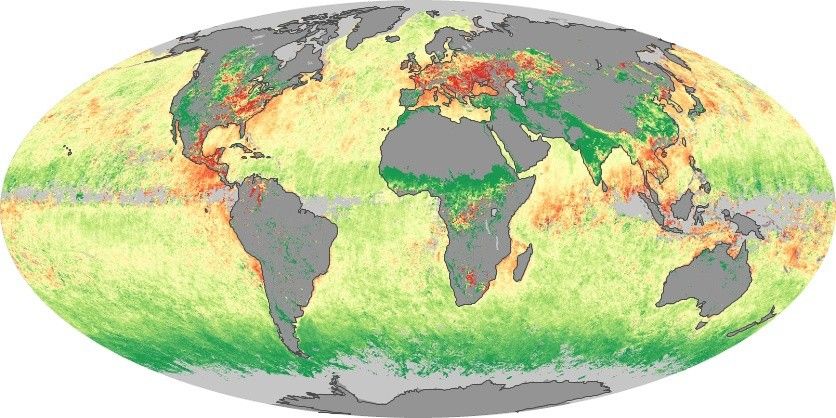
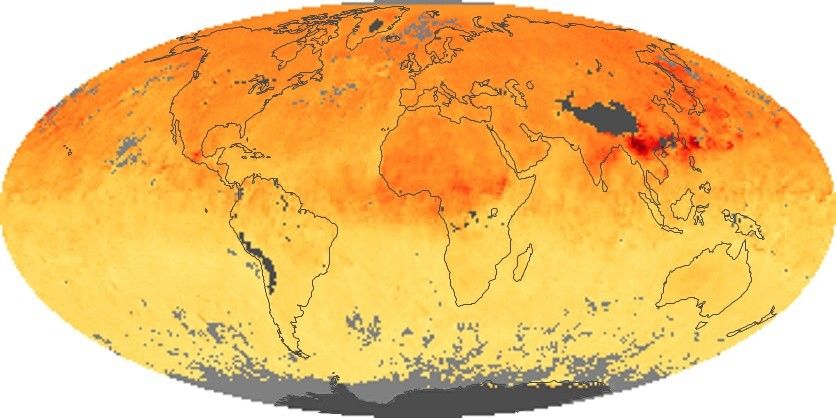
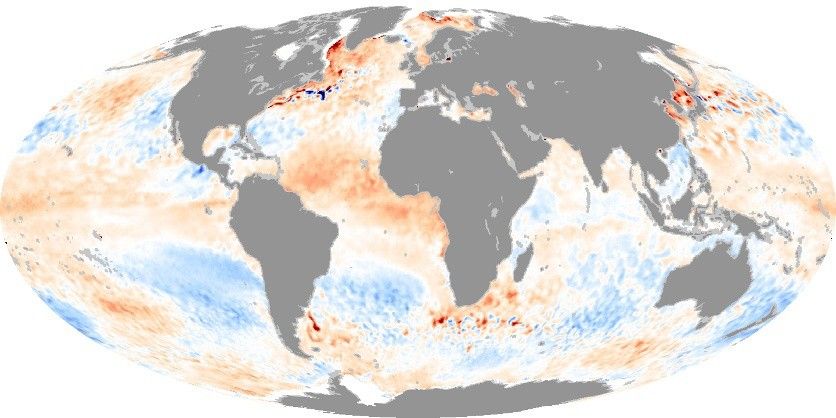
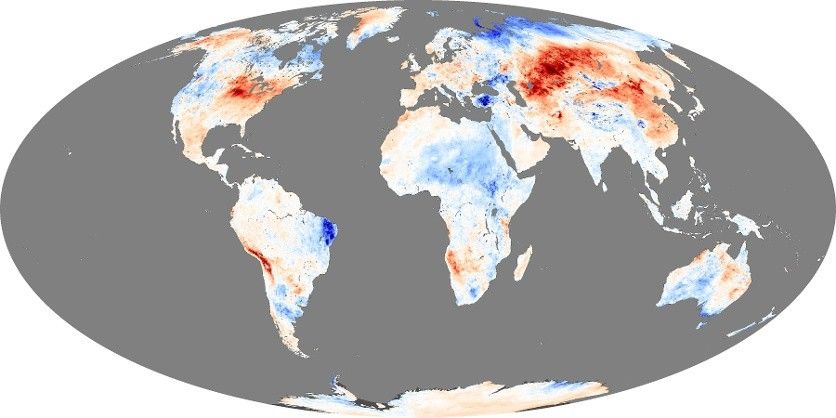
One of the most important ingredients for plant growth is water. In many ecosystems, particularly grasslands and cropland, seasonal plant growth occurs in perfect synch with the rainy season. In times of drought, vegetation in these ecosystems grows poorly, if at all. Abundant rain leads to a burst of green. Other ecosystems, such as the boreal forests of northern Russia, Europe, and North America, draw on ground water and so respond more slowly to changes in rainfall.
The rainfall maps show total monthly rainfall in millimeters from NASA’s Integrated Multi-satellitE Retrievals for GPM (IMERG) dataset. High rain totals are represented in dark blue, while small rainfall totals are shown in white.
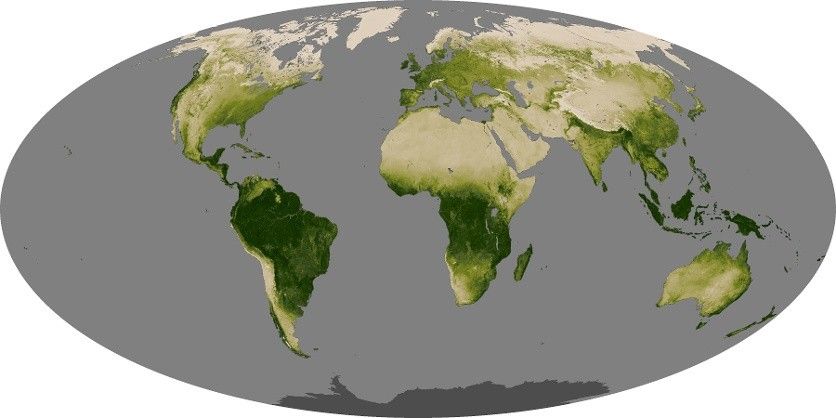
On these maps, vegetation is pictured as a scale, or index, of greenness. Greenness is based on several factors: the number and type of plants, how leafy they are, and how healthy they are. In places where foliage is dense and plants are growing quickly, the index is high, represented in dark green. Regions where few plants grow have a low vegetation index, shown in tan. The index is based on measurements taken by the Moderate Resolution Imaging Spectroradiometer (MODIS) on NASA’s Terra satellite. Areas where the satellite did not collect data are gray.
The relationship between rainfall and vegetation is pronounced in southern Africa and southern Asia. A belt of seasonal rains encircles the globe near the Equator. In, June, July, and August, when the rains move north of the equator, Africa's Sahel region (a grassland-savanna landscape south of the Sahara Desert) is dark green, alive with growing plants. As the rains move south in September, the vegetation follows. The plants that had been growing in the Sahel fade, while southern Africa comes to life. Likewise, the Asian monsoon controls plant growth in India and Southeast Asia. The seasonal rains and accompanying green-up begin first in Southeast Asia in April or May, and extend westward into India by June or July. Rains and vegetation begin to fade in late autumn.
In other ecosystems the connection between rain and plant growth seems counterintuitive. In South America, savannas and grasslands of the southern part of the continent are greener when it rains. But in the heart of the continent, the Amazon Rainforest is greenest during the driest months (June-September). This pattern is because the forest has a steady supply of groundwater all year, so it grows best when the rain clouds thin enough to let sunlight through.
View and download more of these data from NASA Earth Observations (NEO):
Total Rainfall
Vegetation