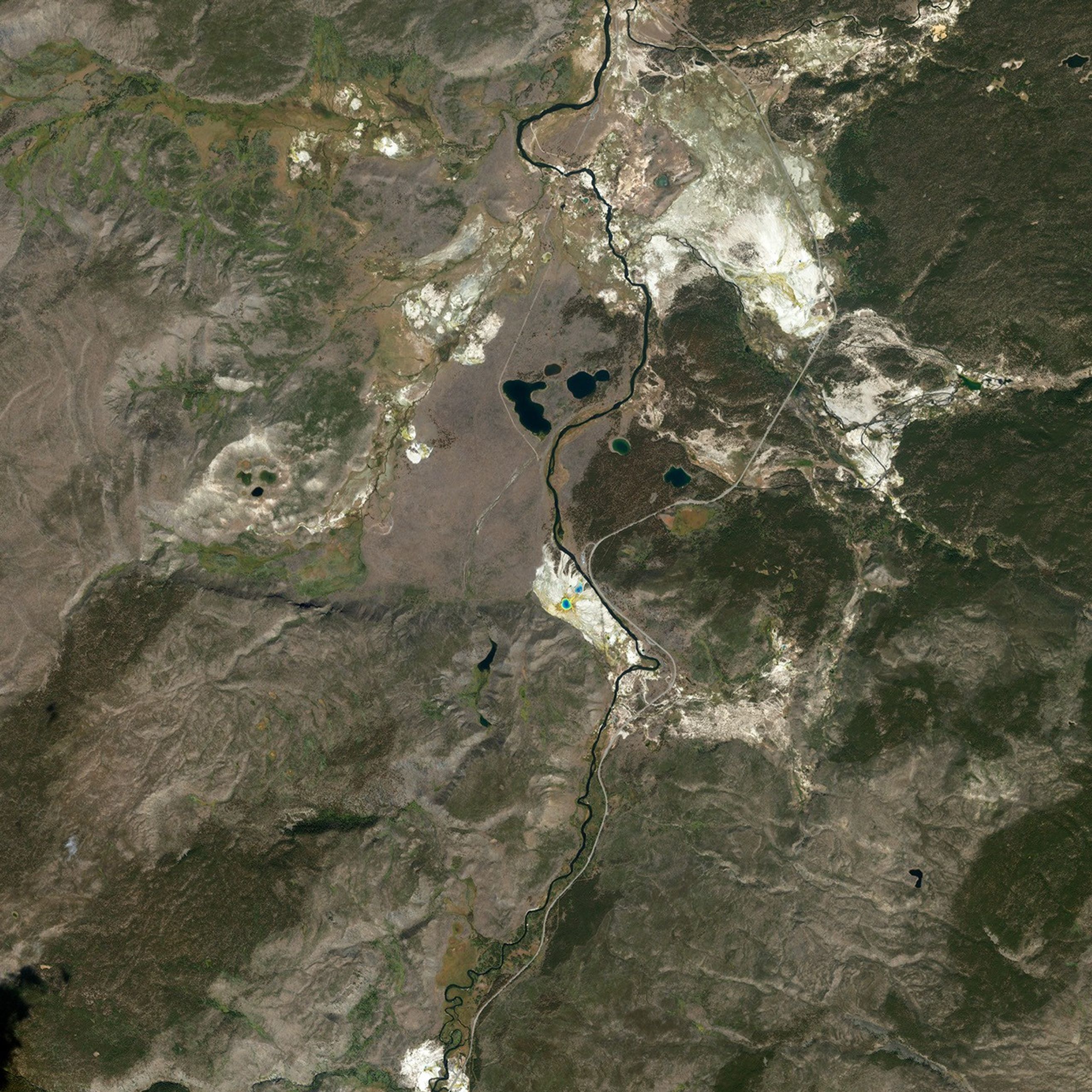



















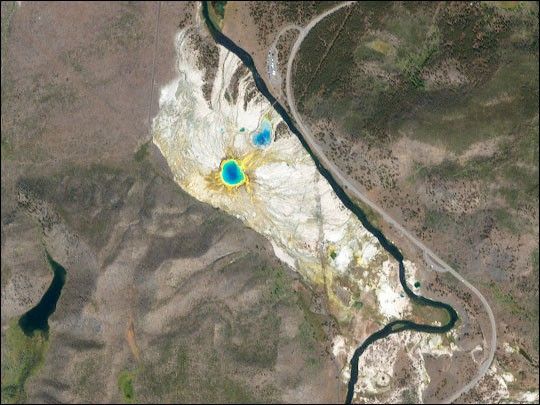
Yellowstone National Park contains the most concentrated array of hot springs and geysers in the world. The largest, and one of the most spectacular, springs in the park is the Grand Prismatic Spring. It is 90 meters (300 feet) across and 50 meters (160 feet) deep. In the center of the pool the water is 87° C (188° F)—too hot to support life. In the cooler water along the edges of the pool, however, colonies of thermophilic (heat-loving) cyano-bacteria and algae thrive. Yellow, orange, and red pigments are produced by the bacteria as a natural sunscreen. As a result, the pool displays a spectrum of colors from the bright blue of the center to the orange, red, and brown algal mats along the edges.
NASA scientists study Yellowstone’s hot springs because they may be similar to the environments where life first evolved on Earth. Other bodies in the solar system, such as Europa and Mars, could have hot springs, too, possibly full of life.
This image was acquired by Space Imaging’s IKONOS Satellite on August 17, 2001.
References & Resources
© All Rights Reserved: Use of IKONOS, GeoEye, QuickBird and WorldView imagery must be coordinated with Maxar.
Image by Robert Simmon, SSAI/NASA GSFC, based on data copyright DigitalGlobe © All Rights Reserved: Use of IKONOS, GeoEye, QuickBird, WorldView, and Digital Globe imagery must be coordinated with Maxar .