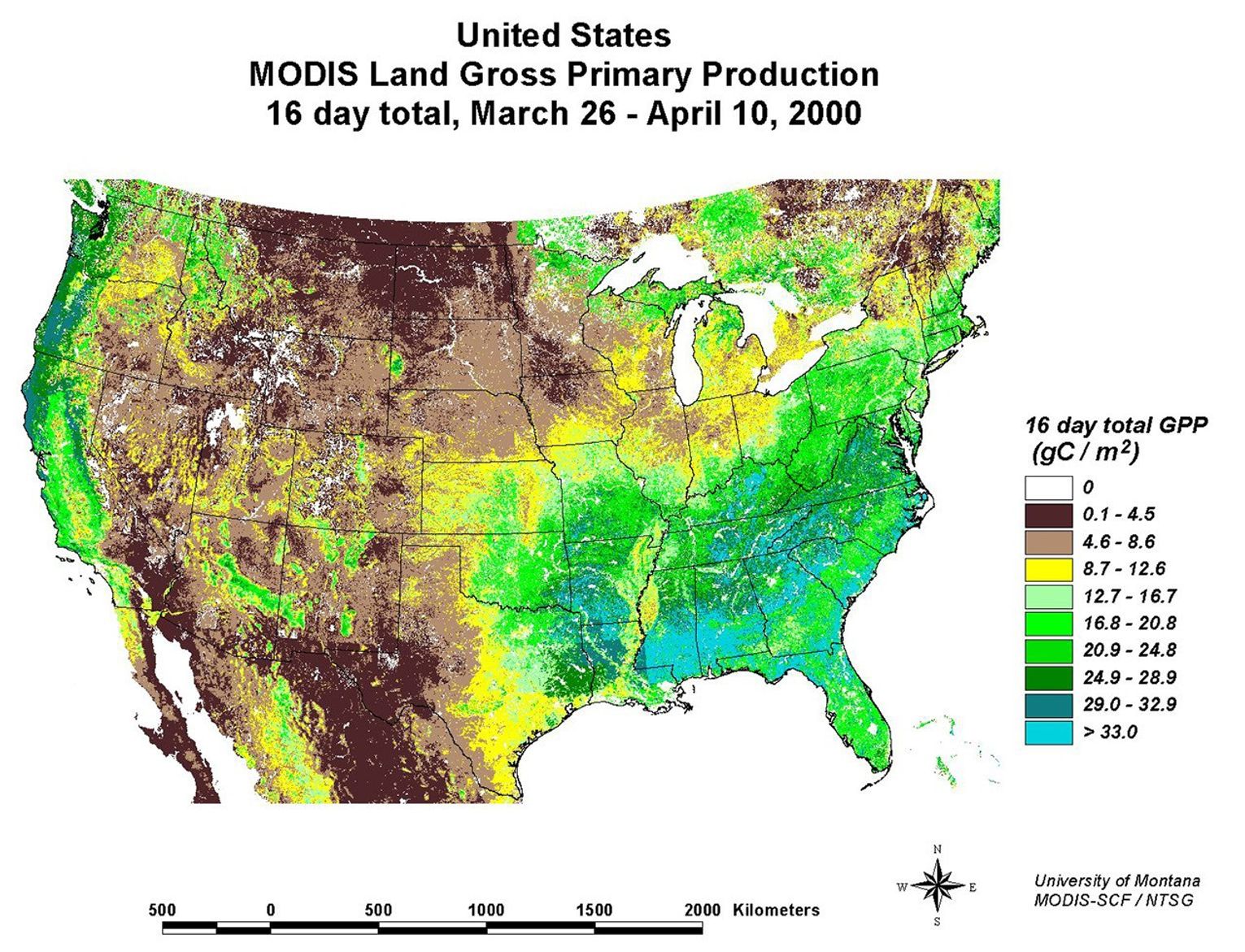














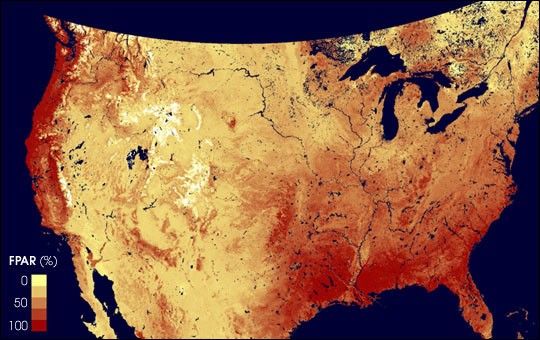

NASA’s new Moderate-resolution Imaging Spectroradiometer (MODIS)allows scientists to gauge our planet's metabolism on an almost dailybasis. GPP, gross primary production, is the technical term for plant photosynthesis.This composite image over the continental United States,acquired during the period March 26–April 10, 2000, showsregions where plants were more or less productive—i.e., where they“inhaled” carbon dioxide and then used the carbon fromphotosynthesis to build new plant structures.
This false-color image provides a map of how much carbon was absorbedout of the atmosphere and fixed within land vegetation. Areascolored blue show where plants used as much as 60 grams of carbon persquare meter. Areas colored green and yellow indicate a range ofanywhere from 40 to 20 grams of carbon absorbed per square meter.Red pixels show an absorption of less than 10 grams of carbon persquare meter and white pixels (often areas covered by snow or masked as urban) showlittle or no absorption.
This is one of a number of new measurements that MODIS provides tohelp scientists understand how the Earth’s landscapes are changingover time. Scientists’ goal is use of these GPP measurements to refinecomputer models to simulate how the land biosphereinfluences the natural cycles of water, carbon, and energy throughoutthe Earth system. The GPP will be an integral part of global carboncycle source and sink analysis, an important aspect of Kyoto Protocol assessments.
This image is the first of its kind from the MODIS instrument, whichlaunched in December 1999 aboard the Terra spacecraft. MODIS beganacquiring scientific data on February 24, 2000, when it first openedits aperture door. The MODIS instrument and Terra spacecraft areboth managed by NASA's Goddard Space Flight Center, Greenbelt, MD.
References & Resources
Image courtesy Steven Running, MODIS Land Group Member, University of Montana