

















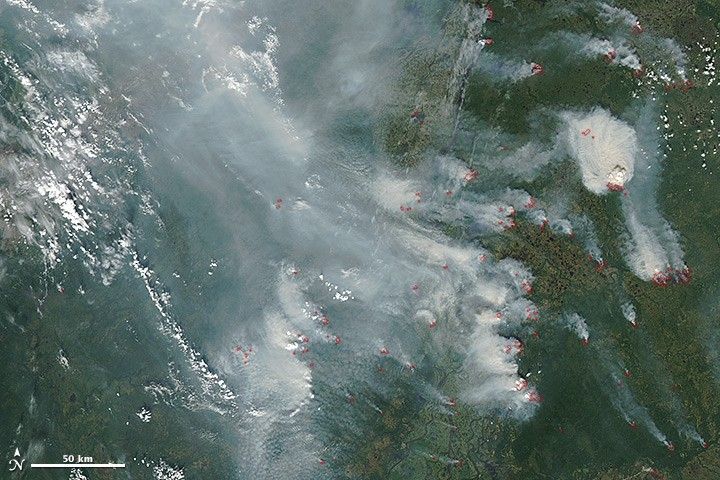
The summer of 2012 was the most severe wildfire season Russia had faced in a decade. 2013 might be headed in the same direction after an unusual heat wave brought a surge of fire activity in northern Siberia in July.
A persistent high-pressure weather pattern in the Russian Arctic—a blocking high—contributed to the heat wave, which saw temperatures reach 32° Celsius (90° Fahrenheit) in the northern city of Norilsk. For comparison, daily July highs in Norilsk average 16° Celsius (61° Fahrenheit). Blocking highs are so named because they block the jet stream from moving rain-bearing weather systems along their normal west-to-east path; this leads to “stuck” weather patterns with long periods of stable air and exceptional heat.
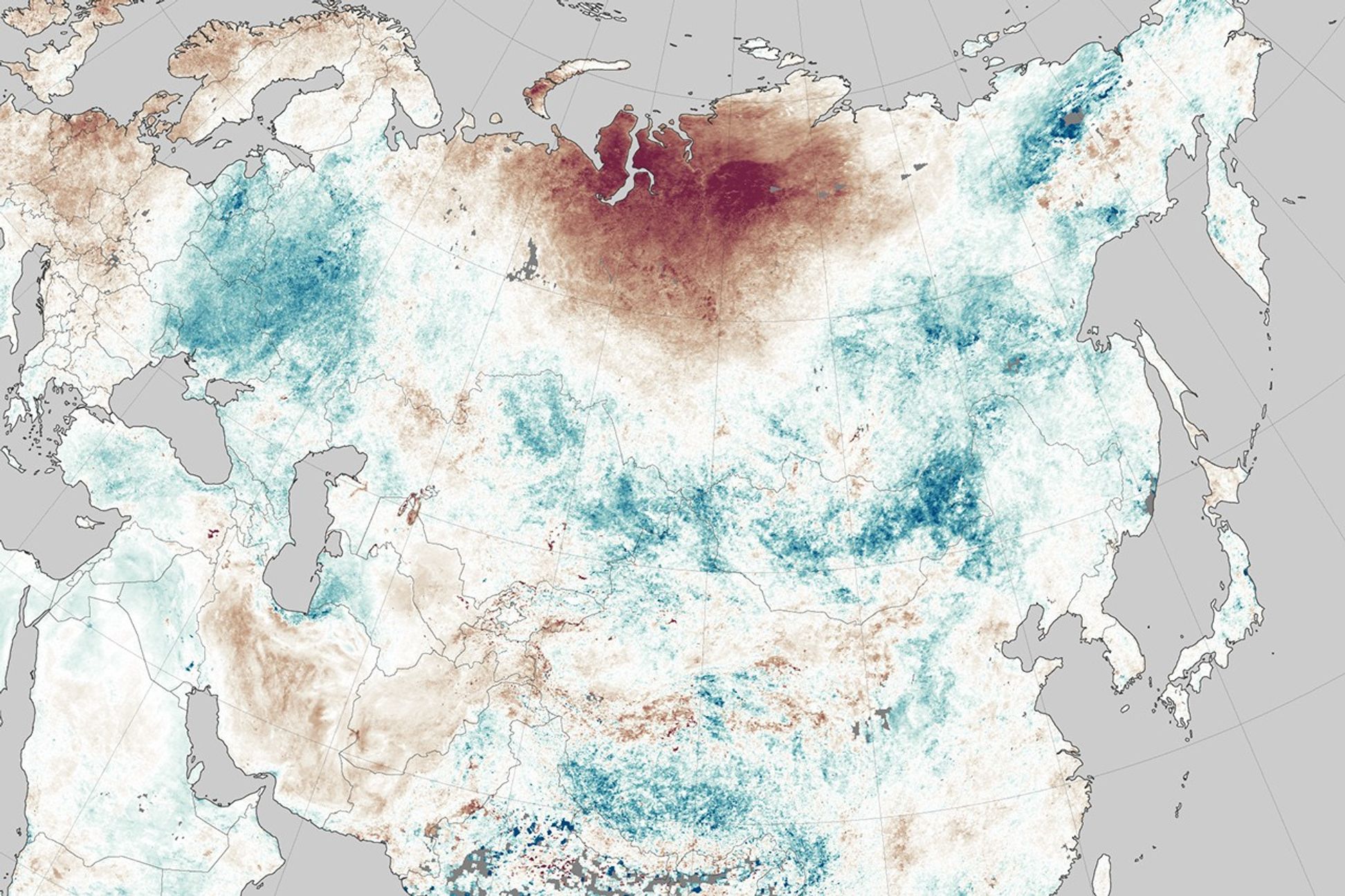
The map above shows land surface temperature anomalies for July 20–27, 2013. Rather than depicting absolute temperatures, the map shows how much the temperatures for that week differed from the long-term average for the area. The measurements were collected by the Moderate Resolution Imaging Spectroradiometer (MODIS) on NASA’s Terra satellite. Shades of red indicate temperatures that were warmer than average; blues are below average. Oceans, lakes, and areas with insufficient data (usually because of persistent clouds) appear in gray.
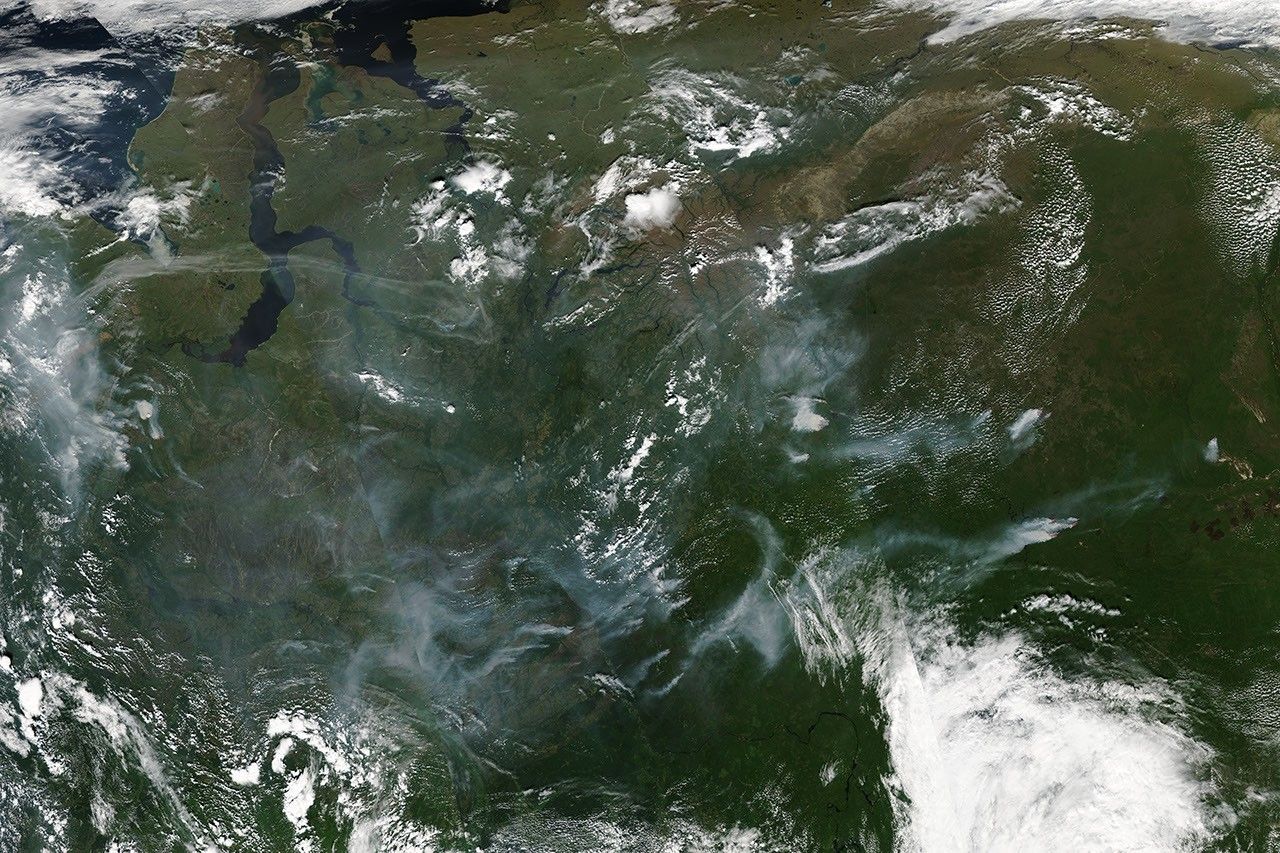
The small inset box toward the upper left marks the area shown in the lower image. Acquired by MODIS on July 25, 2013, the natural-color image shows smoke billowing from fires in the Khanty-Mansiyskiy and Yamal-Nenetskiy districts. Red outlines indicate hot spots where MODIS detected abnormally warm surface temperatures associated with fire.
The fires are burning in an unusual area. Most summer wildfires in Siberia occur south of the 57° North latitude line, along the southern edge of the taiga. The July 2013 fires are significantly north of that, raging in woodlands near the 65° North line.
High temperatures play an important role in promoting wildfires. Warm fuels burn more readily than cooler fuels because less energy is required to raise their temperature to the point of ignition. With temperatures soaring in northern Russia, it was easier for previously active fires to continue burning and for lightning to spark new ones.
This summer’s heat wave, like all extreme weather events, had its direct cause in a complex set of atmospheric conditions that produce short-term weather. However, weather occurs within the broader context of the climate, and there’s a high level of agreement among scientists that global warming has made it more likely that heat waves and wildfires of this magnitude will occur.
While temperatures are increasing globally, the warming in Russia since the mid-1970s has been more rapid than most areas—about .51°C per decade compared to about .17°C globally—according to a study by Anatoly Shvidenko of the International Institute for Applied Systems Analysis. Researchers expect a doubling in the number of forest fires in Russia’s taiga forests by the end of the century, as well as increases in the intensity of those fires.
Further Reading
- Ranson, J. (2012, July) Siberia 2012: A Slow and Smoky Arrival. Notes from the Field.
References & Resources
- Discover (2013, July 28) North Pole Isn't Melting. But Parts of Siberia Baking & Burning. Accessed August 1, 2013.
- Huffington Post (2013, July 28) Siberia Heat: Did the Arctic Region Break a Heat Record. Accessed August 1, 2013.
- ITAR-TASS (2013, July 29) Forest Fires in Russia reach about 53,000 hectares radius. Accessed August 1, 2013.
- The Atlantic (2013, July 31) A Giant Vortex of Wildfire Smoke is Hovering Over Russia. Accessed August 1, 2013.
- Shvidenko, A. et al (2011, May 17) Impact of Wildfire in Russia between 1998-2010 on Ecosystems and the Global Carbon Budget. Geography, 441 (2), 1678-1682.
- Vivchar, A. (2010, July 13) Wildfires in Russia in 2008-2008: Estimates of Burn Areas Using Satellite MODIS MCD45. Remote Sensing Letters, 2 (1), 81-90.
NASA image courtesy Jeff Schmaltz, LANCE/EOSDIS MODIS Rapid Response Team at NASA GSFC. Caption by Adam Voiland.