

















January 28, 2022-January 20, 2025
Himalayan Snow Lines on the Rise
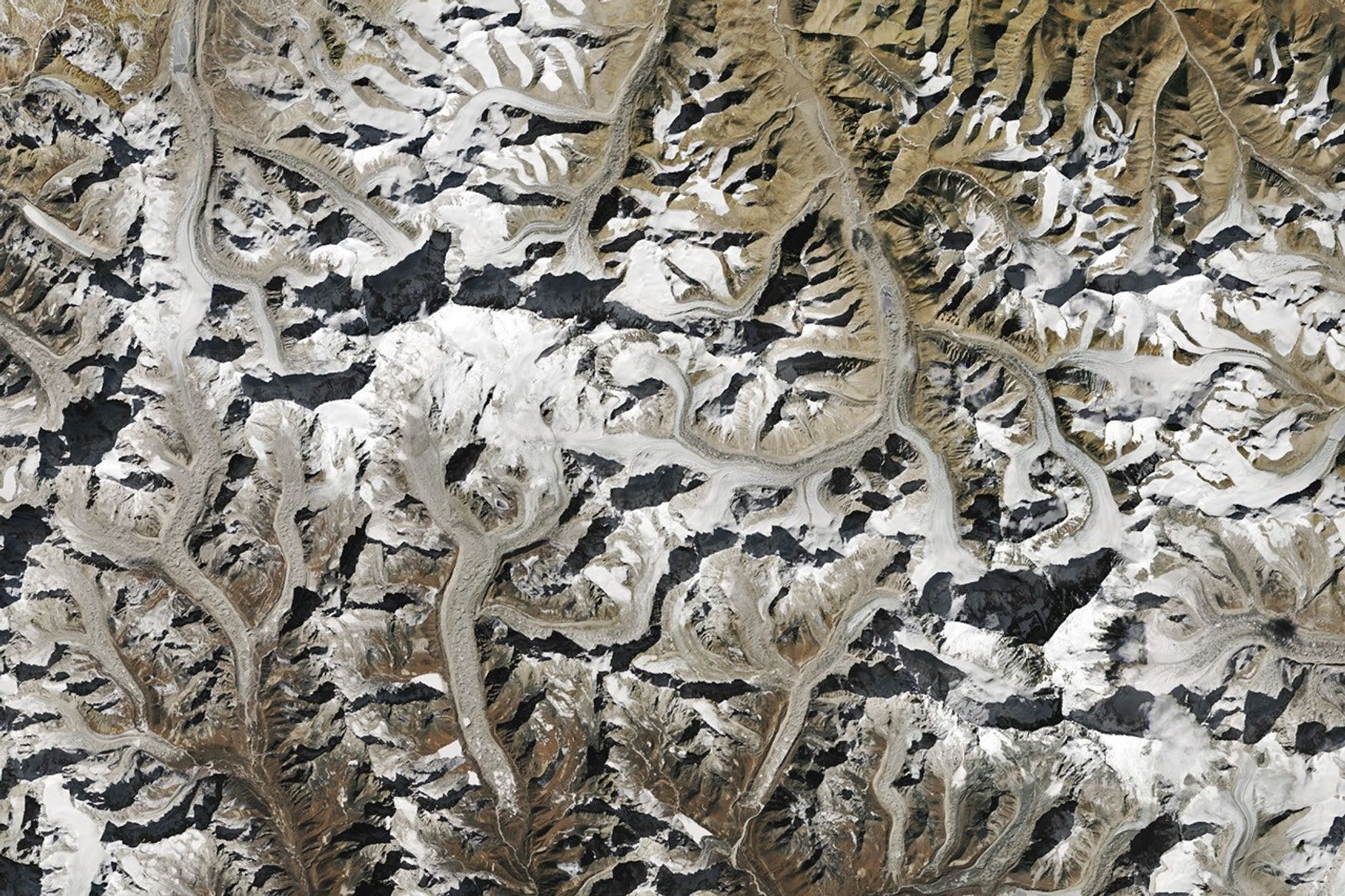
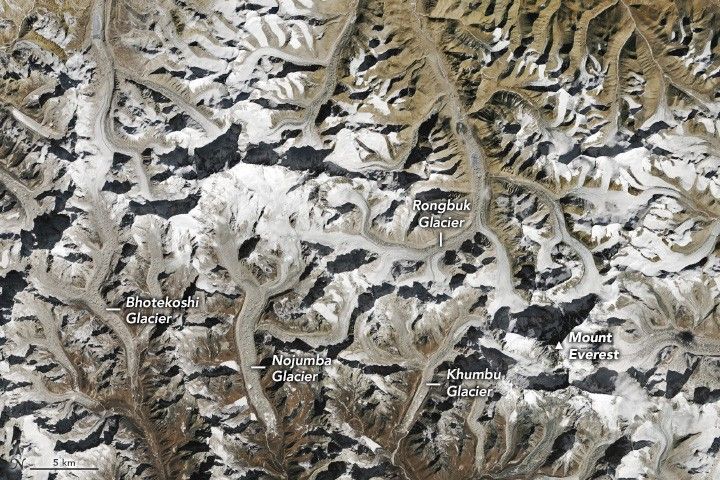
Winters are bitterly cold at “the roof of the world,” the high-altitude region of Asia that includes the Himalaya mountains. And yet, on the glaciated landscape around Mount Everest, snow cover in recent winters has been limited to the mountains’ higher elevations. According to scientists tracking the region’s snow and ice, a combination of warmer and drier conditions has contributed to this upward creep of the winter snow line—the elevation at and above which seasonal snow persists on glacial ice. The shift has implications for regional water security and fire activity.
The average elevation of the snow line was unusually high on January 20, 2025, when the OLI-2 (Operational Land Imager-2) on Landsat 9 acquired this image (right). For comparison, conditions were closer to average on January 28, 2022, when the same sensor acquired the other image (left).
The sparse lower elevation snow, as was seen in January 2025, has become more the rule than the exception in recent winters, according to Mauri Pelto, a glaciologist at Nichols College. Pelto has studied Everest-region glaciers via satellite imagery and local weather station data. “The only year recently when January snow lines were near typical levels was 2022,” he said, adding that the high snow lines in January 2021, 2023, 2024, and 2025 might suggest a “new normal” for the area.
As opposed to North American and European glaciers that tend to accumulate mass through winter snowfall, the glaciers seen here are summer accumulation type glaciers. Approximately 75 percent of annual precipitation falls during the monsoon period of June through September, and these glaciers accumulate the most snow during this time. If the snow persists long enough, it can eventually transform into glacial ice.
In the dry winter months in the Himalaya, glaciers typically have limited accumulation and an insignificant amount of melt. However, snow losses due to sublimation can be significant this time of year, Pelto and colleagues have found. Strong winds, low humidity, and unseasonably warm temperatures lead to snow evaporating straight into the atmosphere, causing the snow line’s elevation to rise.
Pelto calculated that the average snow line on Mount Everest region glaciers on January 28, 2025, was at approximately 6,100 meters (20,000 feet), having risen 150 meters (490 feet) since December 11, 2024. “This change was by sublimation, not melt,” he said. In those two months, Nepal experienced drier and warmer conditions than normal, officials from Nepal’s Department of Hydrology and Meteorology have reported. Compounding the issue, snow lines were already above average at the start of winter, Pelto said, after a dry start to 2024 and a warm, wet post-monsoon season.
Low seasonal snowpack and snow persistence affect downstream communities’ water security, reducing supplies for agriculture and other needs. A prolonged winter drought has also contributed to an early start to the 2025 fire season in parts of Nepal, according to news reports. Intense spring fires have followed exceptionally dry winters in Nepal in the past, for example in 2021.
References & Resources
- The Conversation (2021, July 27) Snow can disappear straight into the atmosphere in hot, dry weather. Accessed February 13, 2025.
- From a Glaciers Perspective (2025, February 2) Mount Everest Region High Winter Glacier Snow Lines in 2024 and 2025. Accessed February 13, 2025.
- ICIMOD (2024, June 17) SNOW UPDATE REPORT 2024: Water shortages feared as Hindu Kush Himalaya sees “extraordinary below normal snow year” – second-lowest snow persistence on record. Accessed February 13, 2025.
- The Kathmandu Post (2025, January 22) Nepal’s cold months get unusually warm. Accessed February 13, 2025.
- NASA Earth Observatory (2013, August 10) Exploring Mount Everest’s Ice. Accessed February 13, 2025.
- NASA Earth Observatory (2021, April 15) A Fierce Fire Season in Nepal. Accessed February 13, 2025.
- Nepali Times (2025, January 20) Wildfire season starts early in Nepal. Accessed February 13, 2025.
- Pelto, M., et al. (2021) Observations of Winter Ablation on Glaciers in the Mount Everest Region in 2020–2021. Remote Sensing, 13(14), 2692.
- Sherpa, T. C., et al. (2023) Insights from the first winter weather observations near Mount Everest’s summit. Weather, 78(12), 344-348.
NASA Earth Observatory images by Wanmei Liang , using Landsat data from the U.S. Geological Survey . Story by Lindsey Doermann .