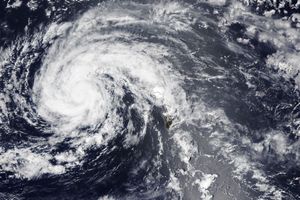




















Ragged from its encounter with the mountains of Haiti, Gustav re-emerged over the Caribbean Sea as a tropical storm on August 27. The storm was just starting to strengthen again when the Moderate Resolution Imaging Spectroradiometer (MODIS) on NASA’s Terra satellite captured this image at 11:30 a.m. local time on August 27, 2008. The National Hurricane Center estimated Gustav’s winds to be about 95 kilometers per hour (60 miles per hour). While the storm’s outer clouds maintained some hint of a spiral shape, the storm center little resembled a hurricane. Towering clouds make the surface of the storm seem to bubble. Gustav was predicted to become a hurricane, possibly even a major hurricane, before crossing Cuba on August 30 and striking the Gulf Coast of the United States a few days later.
The high-resolution image provided above is at MODIS’ full spatial resolution (level of detail) of 250 meters per pixel. The MODIS Rapid Response System provides this image at additional resolutions.
You can download a 250-meter-resolution KMZ file of the storm suitable for use with Google Earth.
References & Resources
NASA image by Jeff Schmaltz, MODIS Rapid Response Team, Goddard Space Flight Center.