









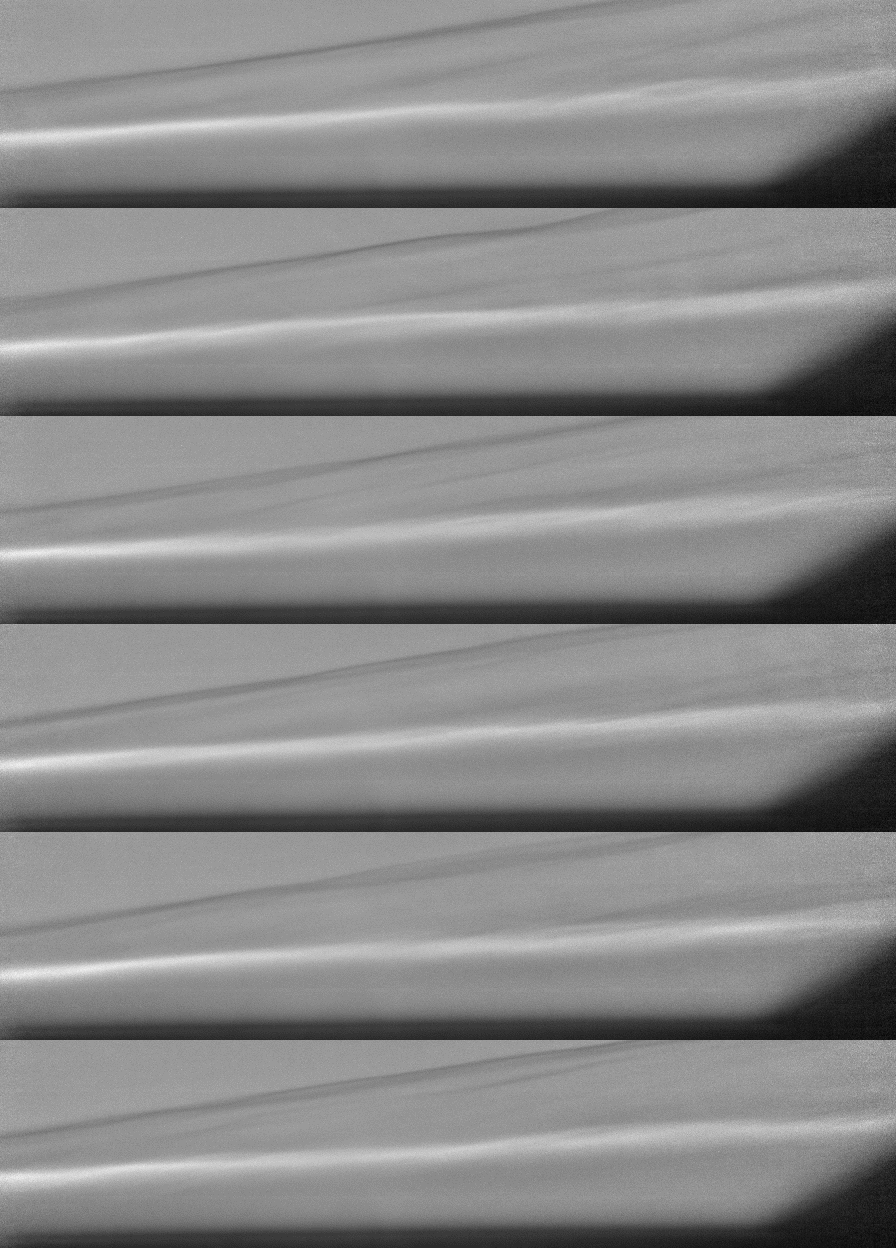





animations:
animation (1.6 MB MPEG)
After originating in the eastern Atlantic west of the Cape Verde Islands,Isabel became the second major hurricane of the 2003 Atlantic season whenit was declared a Category 3 storm by the National Hurricane Center onSeptember 8. Since that time, Isabel has strengthened tremendously intoan extremely powerful Catergory 5 hurricane with winds estimated at 160 mph.During its journey across the central Atlantic, the Tropical RainfallMeasuring Mission (TRMM) satellite has been able to capture some astoundingimages of Isabel.
The first image (top left) was taken on 10 September at 21:41 UTC (5:41 pm AST) whenIsabel was still a Category 4 storm with winds estimated at 140 mph. Theimage provides a top down view of Isabel with rainfall rates from the TRMMPrecipitation Radar (PR) in the inner swath and the TRMM Microwave Imager(TMI) in the outer swath overlaid on Infrared (IR) data from the TRMMVisible Infrared Scanner (VIRS). It shows that Isabel has a very well-defined eye with an nearly concentric ring of intense rainfall rates (seenby the darker reds) that are providing heat energy to fuel the stormdirectly into the core. There is also excellent cirrus outflow in allquadrants especially to the south and west indicating that environmentalconditions continue to be favorable for further strengthening.The next image (top right) was taken at 4:56 UTC (12:56 am AST) on September 12th.Isabel was now a powerful Catergory 5 storm with sustained winds estimatedto be 160 mph with gusts up to 195 mph by the National Hurricane Center.Isabel continues to be a very symmetrical storm with good cirrus outflow.The eye is now slightly larger and is again surrounded by a nearlyconcentric ring of intense rainfall. This TRMM image also shows anamazing view of Isabel's inner eyewall structure. The inside edge ofthe eyewall contains several waves. These waves are actual mesovorticesbeing shed from the eyewall. The next image (bottom left) provides a close-up viewof the mesovortices as seen by TRMM.
The last image (bottom right) is a visible image of Isabel taken by GOES at 12:44 UTC(8:44 am AST) again on September 12th. It also shows the mesovorticesas rings of cloud in the eye. Where the rings border each other can beseen as what appear to be cloud "spokes". The five spokes indicate thatthere are 5 mesovortices inside the eye of this very powerful hurricane.
TRMM is a joint mission between NASA and the Japanese space agency NASDA.
References & Resources
Images produced by Hal Pierce (SSAI/NASA GSFC) and caption by Steve Lang (SSAI/NASA GSFC).





