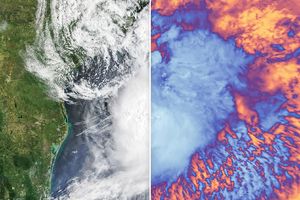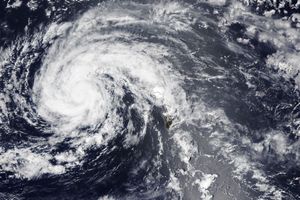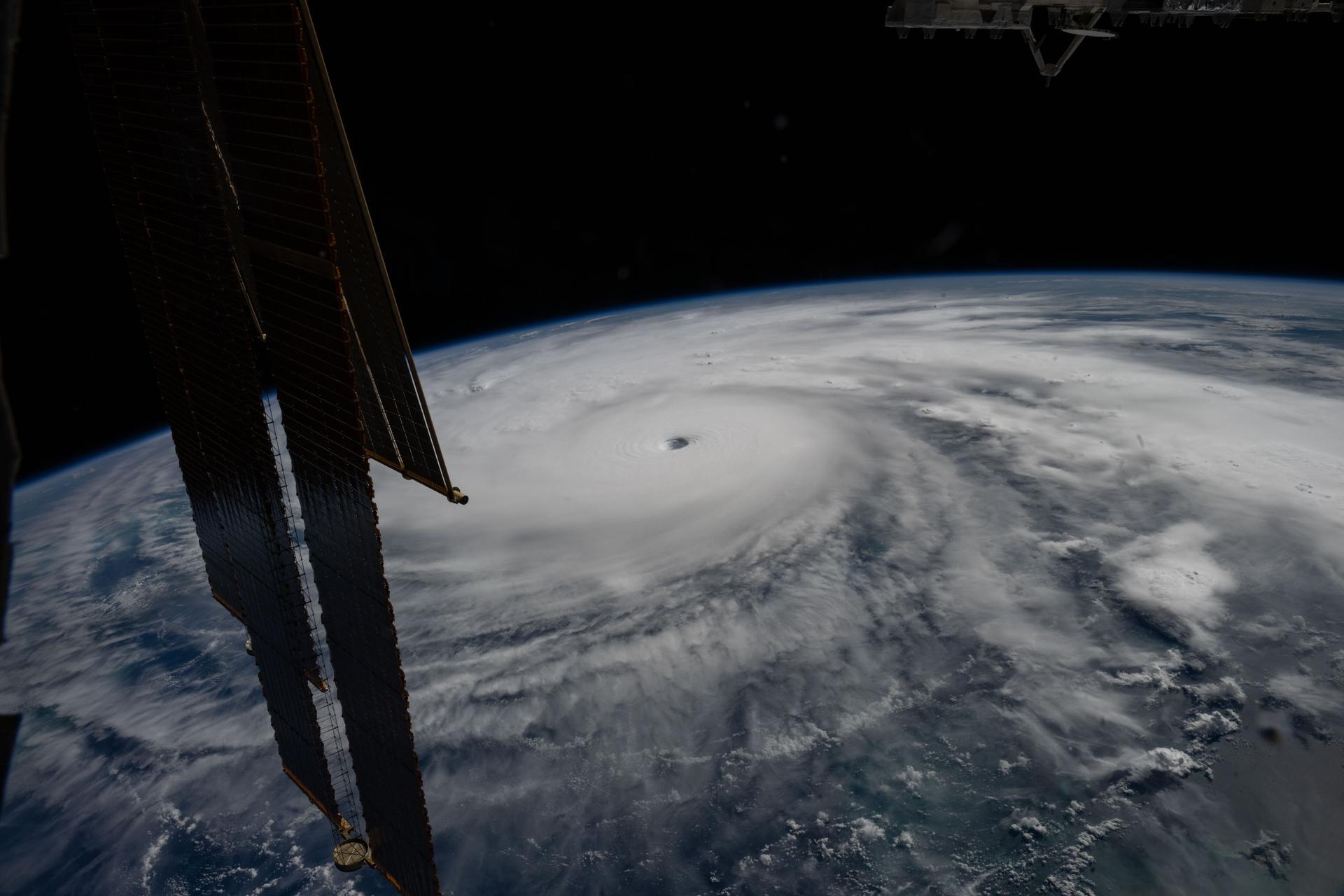
























Katia continued traveling northwest over the Atlantic Ocean on September 7, 2011. The same day, the U.S. National Hurricane Center (NHC) reported that Katia was a Category 1 hurricane. Located about 320 miles (515 kilometers) southwest of Bermuda, the storm had maximum sustained winds of 85 miles (140 kilometers) per hour, with higher gusts.
The Moderate Resolution Imaging Spectroradiometer (MODIS) on NASA’s Terra satellite captured this natural-color image at 11:15 a.m. Atlantic Standard Time (AST) on September 7. Katia sports the spiral shape and eye typical of strong storms.
At 11:00 a.m. AST on September 8, the NHC reported that Katia was still a Category 1 hurricane, but with slightly stronger winds of 90 miles (150 kilometers) per hour. The storm was located west-northwest of Bermuda. Five-day projections forecast that Katia would turn toward the northeast and head back out over the open ocean east of the continental United States. As of September 8, however, ocean swells from the storm continued to affect the U.S. East Coast and Bermuda.
References & Resources
- National Hurricane Center. (2011, September 8). Hurricane Katia Advisory Archive. Accessed September 8, 2011.
NASA image courtesy MODIS Rapid Response Team, Goddard Space Flight Center. Caption by Michon Scott.