















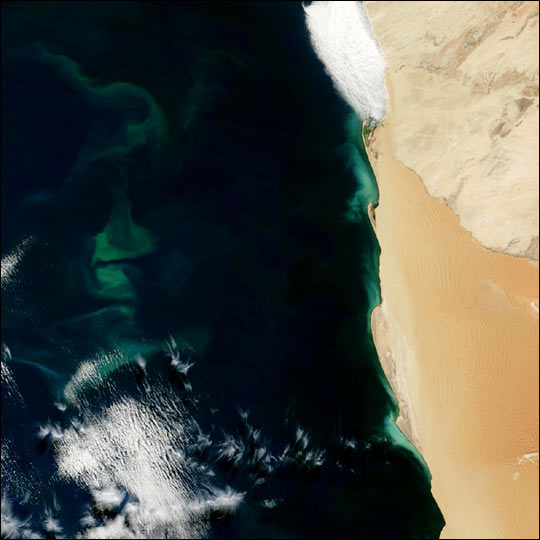
People living along Namibia’s desert coast have long been familiar with the rotten egg smell that periodically emanates from the Atlantic Ocean. With an economy that is largely based on fishing, the locals are also used to seeing millions of fish die whenever the unpleasant scent fills the air. The smell and the fish die-off are caused by hydrogen sulfide erupting from decaying plants on the sea floor.
In the southeast Atlantic Ocean, strong ocean currents carry nutrient-rich deep-ocean water to the surface. The waters nourish free-floating microscopic plants, called phytoplankton, and other sea life. When the plants die, they sink to the ocean floor where bacteria begin to break them down. The oxygen is quickly used in the decay process, and anaerobic bacteria take over. These bacteria emit hydrogen sulfide gas as a by-product. The gas builds on the ocean floor until it erupts suddenly. When it reaches the surface, the hydrogen combines with oxygen to form water, allowing solid white sulfur to precipitate into the ocean. Of itself, hydrogen sulfide gas is toxic to fish, but this reaction with oxygen also creates deadly low-oxygen conditions in the ocean.
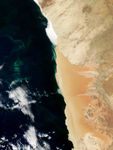
The reaction at the surface also makes hydrogen sulfide eruptions visible in satellite imagery. The white sulfur reflects light, tinting the water bright green along the Namibian coast. On May 12, 2004, the Moderate Resolution Imaging Spectroradiometer (MODIS) on NASA’s Terra satellite captured this image of a hydrogen sulfide eruption in progress. Along the coast, milky green sections of ocean show where hydrogen sulfide gas is coming up. Offshore, a phytoplankton bloom forms a bright green swirl in the ocean water, proof of the productivity that triggers the deadly eruptions.
Both the image above and the full image are at MODIS’ maximum resolution of 250 meters per pixel. The image is available in additional resolutions.
References & Resources
NASA GSFC image courtesy Jacques Descloitres, MODIS Rapid Response Team.