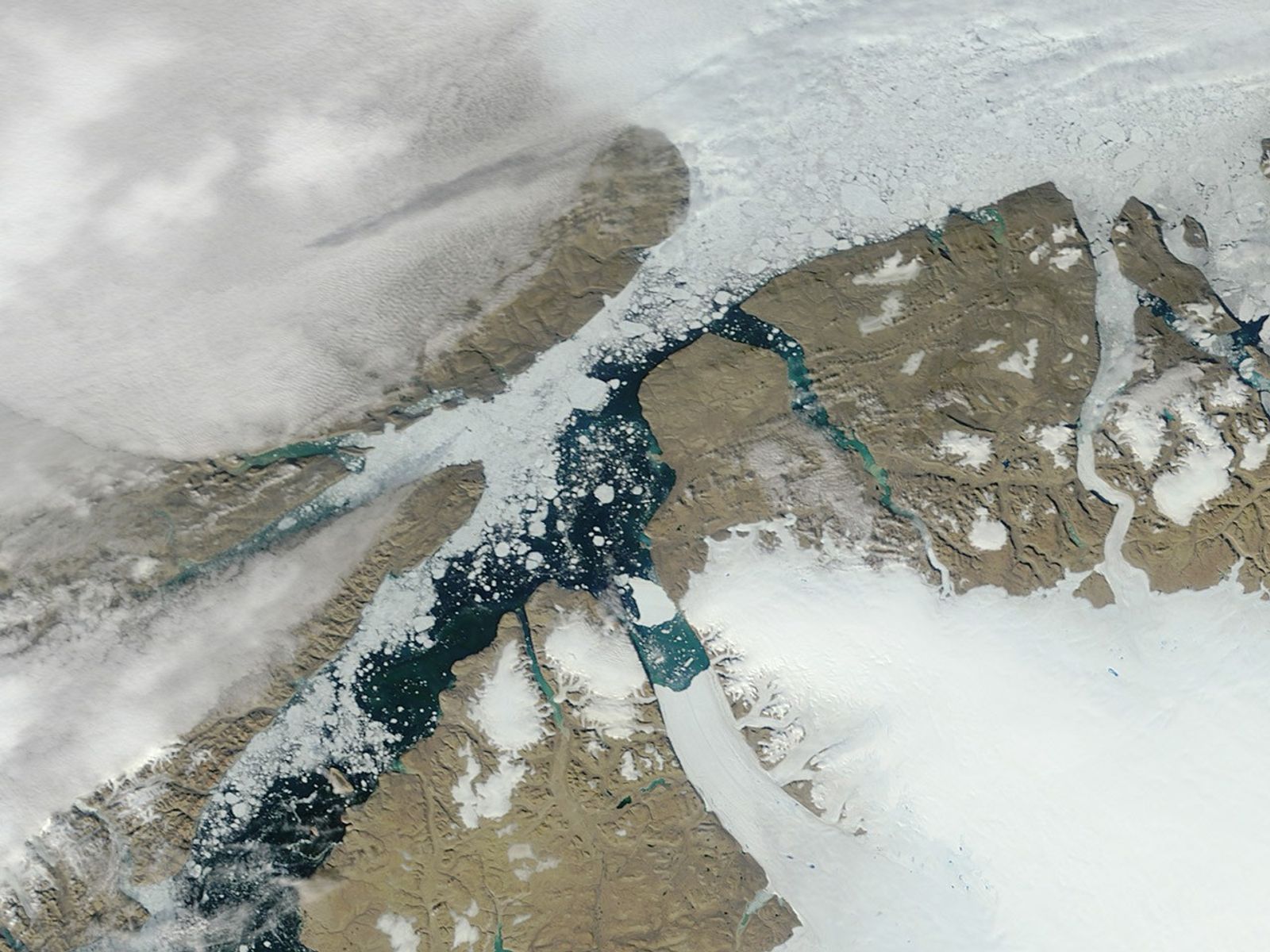





















The giant iceberg that broke off Greenland’s Petermann Glacier in mid-July 2012 continued moving down the fjord at the end of the month. The Moderate Resolution Imaging Spectroradiometer (MODIS) on NASA’s Terra satellite captured this natural-color image on July 30, 2012.
By the time MODIS acquired this image, the iceberg—named PII-2012—had traveled roughly 22 kilometers (14 miles) from the edge of the Petermann Glacier and had rotated counter-clockwise.
Andreas Muenchow, associate professor of physical ocean science and engineering at the University of Delaware, tracked the progress of the iceberg on his Icy Seas blog. On July 31, he reported that the iceberg’s speed had increased from 1 kilometer per day to 2 kilometers per day. He expected the iceberg to exit the fjord and enter Nares Strait around August 4.
In mid-July 2012, Muenchow stated that air temperatures in the region had increased by roughly 0.11 +/- 0.025 degrees Celsius (0.20 +/- 0.045 degrees Fahrenheit) per year since 1987, but that air temperatures have minimal effect on the Petermann Glacier. Ocean temperatures likely exert a greater influence, but the time-series data for ocean temperatures in this region is not old enough to establish a clear trend.
References & Resources
- Bryant, T. (2012, July 16) Greenland glacier loses ice. University of Delaware. Accessed August 2, 2012.
- Muenchow, A. (2012, July 31) Nares Strait 2012: First Challenges and Petermann Ice Island Coming. Icy Seas. Accessed August 2, 2012.
NASA image courtesy Jeff Schmaltz, LANCE MODIS Rapid Response Team at NASA GSFC. Caption by Michon Scott.