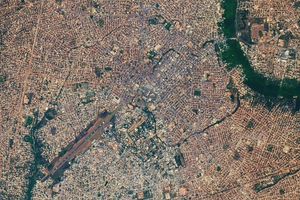
This April 7, 2000 image of Istanbul, Turkey shows a 21 by 24 km Advanced Spaceborne ThermalEmission and Reflection Radiometer (ASTER)sub-scene in the visible and infrared channels.Vegetation appears red, and urban areas blue-green. Bustling Istanbul, with itsmagnificent historical heritage, has spanned the divide between Europe and Asiafor more than 2,500 years. Originally called Byzantium, the city was founded inthe 7th century BC on the Golden Horn, an arm of the narrow Bosporus Strait,which connects the Sea of Marmara to the south, with the Black Sea to the north.Constantine I made it his capital of the Eastern Roman Empire in AD 330. AsConstantinople, the strategically located city arose as the preeminent cultural,religious, and political center of the Western world. It reached the height ofits wealth and glory in the early 5th century. After centuries of decline, thecity entered another period of tremendous growth and prosperity when, asIstanbul, it became the capital of the Turkish Ottoman Empire in 1457. AlthoughTurkey moved its capital to Ankara in 1923, Istanbul remains the nation's largestcity with a population of over 8 million, its commercial center, and a majorport. Two bridges spanning the Bosporus, and ships in the busy channel can beseen.
References & Resources
Image courtesy ASTER science team.