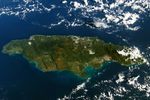



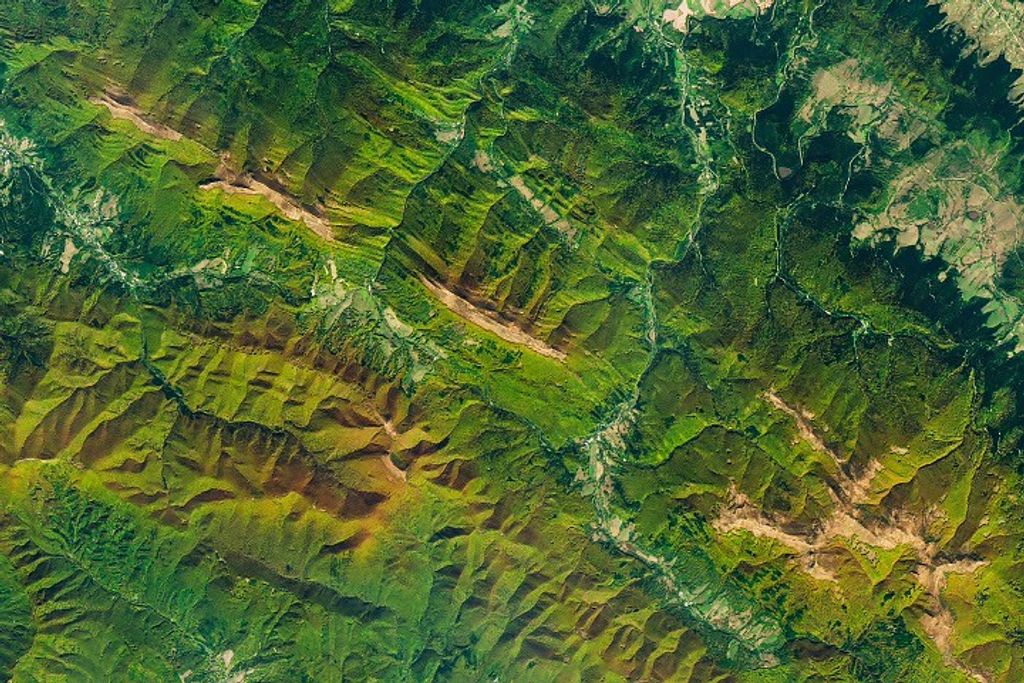













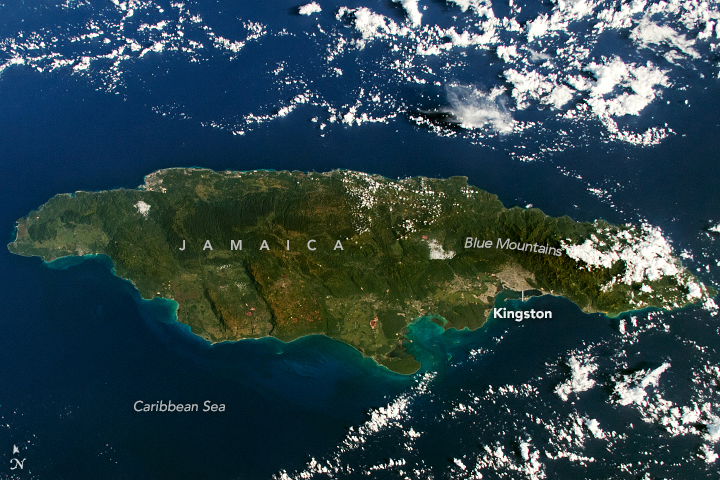
Jamaica is located at the boundary of the Gonâve and Caribbean tectonic plates. The ongoing convergence of these plates causes uplift, giving Jamaica its mountainous topography as well as frequent earthquakes. The highest point on the island, Blue Mountain Peak, rises 2,256 meters (7,402 feet) above sea level.
Much of Jamaica’s landscape is underlain by limestone. Over geologic time, cockpit karst terrain (such as sinkholes) has formed because limestone is dissolvable in water. The simultaneous dissolution of bedrock and the tectonic uplift lead to a range of elevations across the island.
Trade winds from the northeast deliver varying amounts of precipitation across Jamaica, with most of the rain (approximately 130 inches or 3,300 millimeters per year) falling on the mountainous windward end of the island and less falling downwind. This rainfall gradient facilitates a diversity of landscapes ranging from savannas in the west to lush rainforests in the east.
References & Resources
Astronaut photograph ISS061-E-33572 was acquired on November 8, 2019, with a Nikon D5 digital camera using a focal length of 50 millimeters. It is provided by the ISS Crew Earth Observations Facility and the Earth Science and Remote Sensing Unit, Johnson Space Center. The image was taken by a member of the Expedition 61 crew. The image has been cropped and enhanced to improve contrast, and lens artifacts have been removed. The International Space Station Program supports the laboratory as part of the ISS National Lab to help astronauts take pictures of Earth that will be of the greatest value to scientists and the public, and to make those images freely available on the Internet. Additional images taken by astronauts and cosmonauts can be viewed at the NASA/JSC Gateway to Astronaut Photography of Earth. Caption by Amber Turner, Jacobs Technology, JETS Contract at NASA-JSC.