















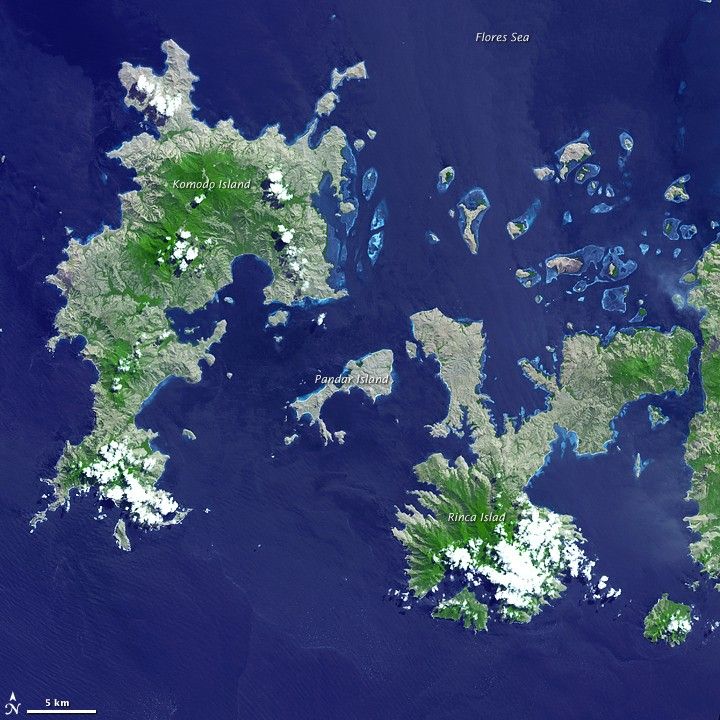
Established in 1980, Indonesia’s Komodo National Park includes three large and many small islands in Indonesia’s Lesser Sunda Islands. Initially planned to protect the Komodo dragon species, the park’s aims expanded to encompass protection of the area’s terrestrial and marine habitats in the context of a rapidly growing human population. In 1986, the park became a World Heritage Site of the United Nations Educational, Scientific and Cultural Organization (UNESCO).
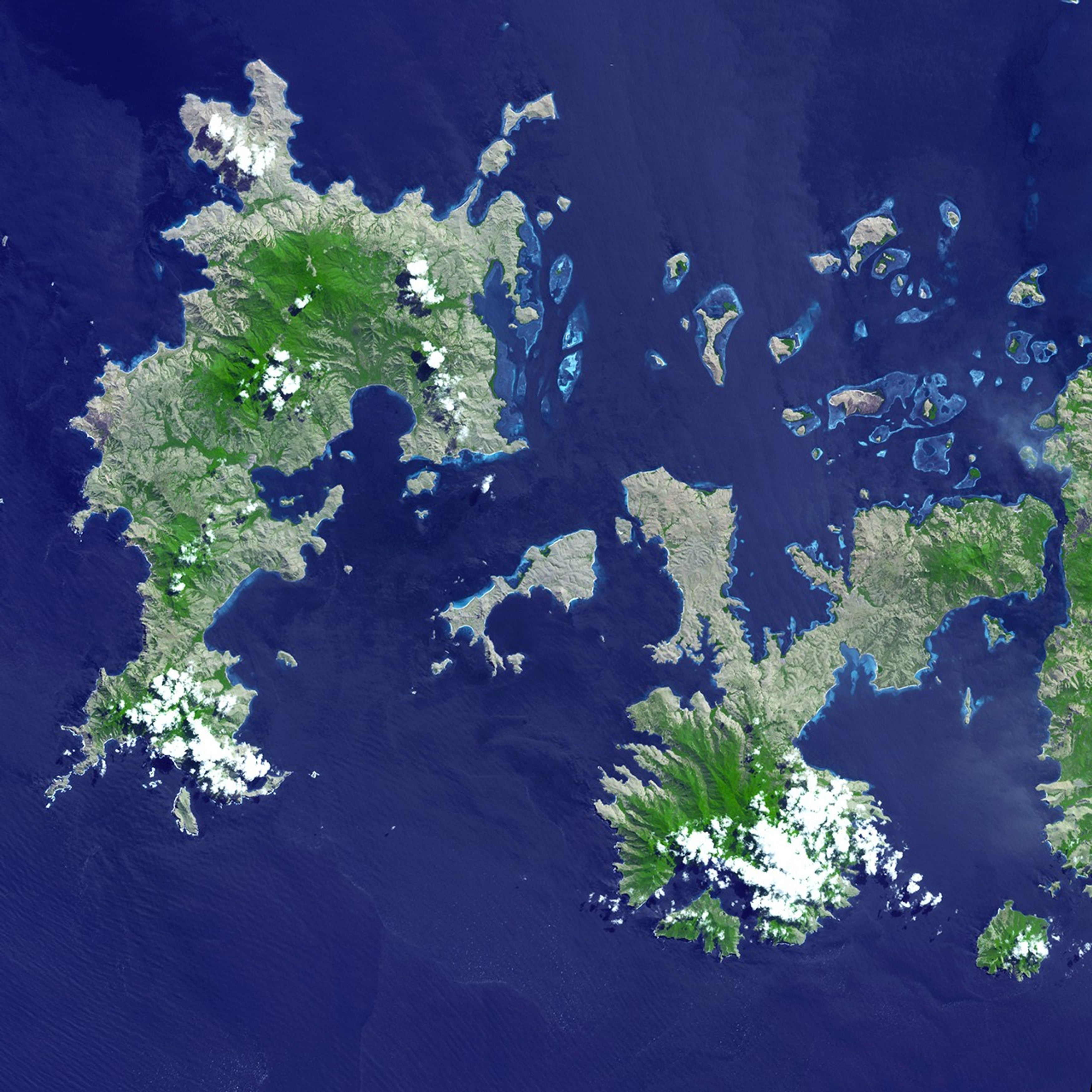
The Advanced Spaceborne Thermal Emission and Reflection Radiometer (ASTER) on NASA’s Terra satellite captured this image of the park on July 20, 2000. This image approximates true color. Blue indicates water, gray-beige indicates bare ground, and bright green indicates vegetation.
The three largest islands in Komodo National Park are (from west to east): Komodo, Padar, and Rinca. Together with smaller islands, the park’s land area totals roughly 600 square kilometers (230 square miles). The islands are volcanic in origin; the underlying juncture of the Sahul and Sunda continental plates has caused volcanic eruptions and uplift of coral reefs. The terrain is rugged and hilly, and what little flat land exists in Komodo occurs primarily along the shorelines. Affected by monsoonal rains, the island group sees little or no rainfall for roughly eight months out of every year.
Komodo dragons (Varanus komodoensis), for which the park was initially established, are the world’s largest living species of lizard. (Besides Komodo National Park, some Komodo dragons also live on the neighboring islands of Flores, where the big lizards once cohabitated with small people.) On average, adult Komodos weigh 70 kilograms (154 pounds). Gifted with keen eyesight, strong jaws, steak-knife teeth, and toxic saliva, they are formidable hunters. Komodos can sprint up to 20 kilometers (13 miles) per hour, but they generally rely on stealth more than speed.
References & Resources
- Komodo National Park. Komodo Collaborative Management Initiative. Accessed May 15, 2009.
- National Zoological Park. Komodo Dragon Fact Sheet. Smithsonian Institution. Accessed May 15, 2009.
- World Heritage. (2009). Komodo National Park. UNESCO. Accessed May 15, 2009.
NASA image created by Jesse Allen, using data provided courtesy of NASA/GSFC/METI/ERSDAC/JAROS, and U.S./Japan ASTER Science Team. Caption by Michon Scott.