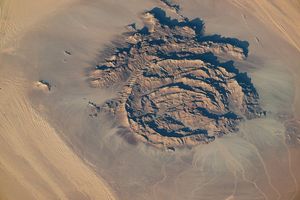

















An astronaut aboard the International Space Station took this image of the Ambohiby volcanic complex in the central highlands of Madagascar. The circular crater of the extinct volcanic system is about 15 kilometers (9 miles) in diameter. Most of the landscape in the image is light brown, indicating a lack of forest cover. In contrast, greener areas farther west (along the left third of the image) retain more of the original forest of Madagascar’s central highlands.
Geologists date the complex to 90 million years old and attribute its existence to volcanism that was active during the breakup of the supercontinent Gondwana. The structure’s semi-concentric rings stand out due to the darker rocks that comprise the curved ridgelines of hills. Two parallel fault lines are visible immediately east of the complex. Faults often occur in the rocks of places where volcanoes have erupted.
Towns exist in and around Ambohiby, but their small size makes them difficult to discern at the resolution of this image. Brighter patches are fields on flat, easy-to-plow upland surfaces. A dark, rectangular patch within the crater appears to be a burned area over a plot of land.
Natural forests once covered a majority of Madagascar’s surface. But in the past several decades, the island nation’s population has increased rapidly—from 5 million in 1960 to 27 million in 2020. One major consequence of the population growth is that the natural forest is now being lost at one of the fastest rates in the world. Trees are cut to clear the land for new pasture and farmland and for fuel and building materials.
References & Resources
Astronaut photograph ISS071-E-673752 was acquired on September 15, 2024, Nikon Z9 digital camera using a focal length of 400 millimeters. It is provided by the ISS Crew Earth Observations Facility and the Earth Science and Remote Sensing Unit, Johnson Space Center. The image was taken by a member of the Expedition 71 crew . The image has been cropped and enhanced to improve contrast, and lens artifacts have been removed. The International Space Station Program supports the laboratory as part of the ISS National Lab to help astronauts take pictures of Earth that will be of the greatest value to scientists and the public, and to make those images freely available on the Internet. Additional images taken by astronauts and cosmonauts can be viewed at the NASA/JSC Gateway to Astronaut Photography of Earth . Caption by Justin Wilkinson, Texas State University, Amentum JETS II Contract at NASA-JSC.
None